This captivatingly provocative book falls firmly into the current genre of critical ethnographic and methodological literature in anthropology. Ethnography and the Historical Imagination is a tour de force of the ethnographic enterprise and attempts to locate ethnography squarely within the boundaries of the broader historical contexts which have shaped the discipline of anthropology in all its manifestations. It…also raises some fundamental questions of epistemology in the construction and presentation of so-called “savage societies” to Western readers.
Applies To: Jean Comaroff
-

Ethnography and the Historical Imagination
Over the years John and Jean Comaroff have broadened the study of culture and society with their reflections on power and meaning. In their work on Africa and colonialism they have explored some of the fundamental questions of social science, delving into the nature of history and human agency, culture and consciousness, ritual and representation. How are human differences constructed and institutionalized, transformed and (sometimes) effaced, empowered and (sometimes) resisted? How do local cultures articulate with global forms? How is the power of some people over others built, sustained, eroded, and negated? How does the social imagination take shape in novel yet collectively meaningful ways?Addressing these questions, the essays in this volume—several never before published—work toward an “imaginative sociology,” demonstrating the techniques by which social science may capture the contexts that human beings construct and inhabit. In the introduction, the authors offer their most complete statement to date on the nature of historical anthropology. Standing apart from the traditional disciplines of social history and modernist social science, their work is dedicated to discovering how human worlds are made and signified, forgotten and remade.
Part One of the volume, “Theory, Ethnography, Historiography,” includes chapters on ethnographic method and imaginative sociology, totemism and ethnicity, and the anthropology of the body as an historical practice. Part Two, “Dialectical Systems, Imaginative Sociologies,” covers the analysis of African societies and polities over time, the relationship between cattle and capital in those societies, and the meaning of labor in apartheid South Africa. Finally, Part Three, “Colonialism and Modernity,” explores the impact of imperialism on African polities, medicine and colonialism, the impact of colonization on African consciousness, and the ways in which colonization reconstructed concepts of home reciprocally in Africa and Europe.
-
Reflections on Youth, From the Past to the Postcolony
PROLEGOMENON
…philosophy does not concern itself with children. It leaves them to pedagogy, where they’re not in very good hands. Philosophy has forgotten about children.
Bernhard Schlink, The Reader, p.141
There has long been a tendency in the public discourse of the West to speak of youth as a transhistorical, transcultural category. As if it has existed everywhere and at all times in much the same way. This is in spite of the fact that anthropologists and historians have insisted, for almost as long, that the cultural meanings and social attributes ascribed to “youth” have varied a great deal across time and space; recall Malinowski and Margaret Mead, not to mention Philippe Ariès. It is also an anthropological truism that the way in which young people are perceived, named, and represented betrays a lot about the social and political constitution of a society. Thus it is that, in nineteenth-century Britain, down-class juveniles were referred to as “nomads’; their terrains, the internal colonies of the industrial metropole, were called “Jungles,” even “Africas” (Hebdige 1988:20). Similarly, in late twentieth-century North America and South Africa (Seekings 1993:xii, citing David Everatt), white pre-adults are typically termed “teenagers” while their black counterparts are “youth”; adolescents with attitude, so to speak. In this manner, language racializes and demonizes difference without explicitly marking it. “Words,” Joseph Conrad (1957:11) once said, are “the great foes of reality.” But they also open a window onto its secrets.
Far from constituting a universal category–a social status generated by the abstract sociological principle of generation– youth, as we speak of them here, are the historical offspring of modernity; modernity, that is, as the ideological formation which arose during the Age of Revolution, 1789-1848 (cf. Hobsbawm 1962), and was honed in the fraught dialectics of empire; modernity as an ideological formation which naturalized its own telos in a model of human development (Lukose 2000) that casts “youth” as both the essential precondition and the indefinite postponement of maturity.1 Industrial capitalist society has been
1
Constructs like “racial adolescence,” deployed by civilizing missions abroad to measure the (lack of) “progress” of more-or-less unique in making childhood into a site of self- conscious cultural reproduction, releasing its young from the workplace so that they might enter the rarified world of education; the latter being the space in which the nation-state seeks to husband its potential, in which it invests in its human capital, in which, says Foucault (1976:81), it “hides its dreams.” Yet juveniles are also the creatures of our nightmares, of our social impossibilities and our existential angst.
It is in this latter sense that, for Hebdige (1988:17), youth enter modernist narratives only when they stand for trouble. But the matter is more ambiguous than this suggests. Trouble, Butler (1990:vii) insists, need not merely be cast in the negative. It can also imply the productive unsettling of dominant epistemic regimes under the heat of desire, frustration, or anger. Youth, in other words, are complex signifiers, the stuff of mythic extremes (Blanch 1980:103); simultaneously idealizations and monstrosities, pathologies and panaceas. This has been true for a very long time. Witness the ambivalent appearance of the young in Dickensian London, on one hand as orphans and artful dodgers, yet also as the bearers of Great colonized peoples toward “modernity,” demonstrate the ideological uses of this form of developmentalism; see W.C. Willoughby (1923:239) for a South African instance.
Expectations. Or the discordant images of juvenile activists in late twentieth-century Africa: contrast, for example, the preternatural child soldiers of Mocambique or Siera Leone, the very epitome of civil disintegration (Honwana 1999), with the heroic “young lions” of South Africa, who were the harbingers of democracy and the end of apartheid. Such contrasts are likely to persist: in Brazil, homeless children have come to symbolize both the collective shame of the nation-state and its future resurrection through proper planning and legal intervention (Veloso n.d.).
In short, “youth” stands for many things at once: for the terrors of the present, the errors of the past, the prospect of a future. For old hopes and new frontiers (cf. De Boeck in this volume). In all of these tropic guises, of course, they are figures of a popular imagination far removed from more nuanced social realities.2 This is crucial to keep in mind as we interrogate the place of young people in the late twentieth- century nation-state–especially those neoliberal nation-states currently in difficulty–in Africa and elsewhere.
Apart from all else, “youth” are always only a fraction of those not yet adult: that fraction whose anomalous agency asserts itself in honor or breach of communal order. Often they are the mutant citizens of the modern nation, purveyors of its violent undersides. This is a point to which we shall return.
Generation Trouble
The meaning of globalization, at least as an analytic concept, might still be in dispute in some circles. But few would deny that one global feature of the contemporary world–from Chicago to Cape Town, Calcutta to Caracas–is a sense of crisis surrounding the predicament of juveniles. Although it is always locally mediated and modulated, that predicament appears to arise out of the workings of neoliberal capitalism and the changing planetary order of which it is part. It takes many forms, patently. But it seems everywhere to be founded on a counterpoint, a doubling, a contradiction perhaps. On one hand is the much remarked exclusion of the young from national economies, especially from their shrinking, metamorphosing productive sectors. As the frenzied expansion of the free market runs up against the demise of the welfare state, a process that manifests itself in an ever widening gulf between rich and poor, the commonweal of all but few sovereign polities has been drastically eroded. In the upshot, most are unable to sustain previous levels of social services and benefits, to afford the cost of infrastructural reproduction, or to underwrite a labor market in which there is regular or secure employment in any abundance.
Even in advanced industrial societies, the modernist dream of infinite progress–a narrative according to which each generation does better than its predecessor–is constantly mocked; mocked by conditions that disenfranchise many people,3disproportionately the young and unskilled of the inner city and the countryside, from full waged citizenship in the nation-state.4 This despite the claims by some that the current generation of mainstream American “kids” is more compliant, less cynical than those who came before them (Howe and Strauss 2000). To be sure, patterns of polarization and exclusion, among youth and across the age spectrum at large, is ever more palpable in these neo liberal times.
This theme was sounded repeatedly by proponents of Ralph Nader’s Green Party in the recent US elections. Michael Moore, radical film-maker and anti-corporate activist, described Nader as the champion of “young people, who feel disenfranchised and dispossessed by mainstream American politics” (special election report, 848, National Public Radio, November 6, 2000).
While it might be argued that, constitutionally, citizenship in liberal democracies has never included a right to work, the provision of unemployment benefits, worker’s compensation, and pensions to the nationals of welfare states has implied entitlement to an income. Such benefits are widely under threat in this neoliberal age, but the obligation to sustain the highest possible levels of employment continues to be one of the taken-for-granted expectations of government everywhere, notwithstanding the ferocious realpolitik of market competition. In this paper, we use the notion of “waged citizenship” to imply social and moral membership in the national commonweal.
On the other hand is the recent rise of assertive, global youth cultures of desire, self-expression, representation; also, in some places, of potent, if unconventional, forms of politicization to go along with them. In the cyberspace age, juveniles have an enhanced capacity to communicate in, and act effectively on, the world at large. Generation has become a concrete, quotidian principle of social mobilization, inflecting other dimensions of difference; notably, race, gender, ethnicity and class.5Transnational youth activism, and the mutually comprehensible signifying practices on which it is based, are facilitated by planetary flows–of currencies, people, value– across old sovereign boundaries (cf. Venkatesh n.d.[a]:6; Appadurai 1990). The young have taken to the internet and to the streets in growing numbers as post-Fordist economics recast relations between capital and labor, profoundly altering global geographies of production. More of this below.
This is not to imply that youth forms a “homogeneous, sociological category of people which thinks, organizes and acts” in coherent ways (Seekings 1993:xiv); but the same may be said of “working class politics” (pace Seekings, loc.cit.). Youth, like the working class, is a politically constructed category; both are rooted in their relationship to production and consumption. Most notably, immigrant workers and non-autochthonous minorities; see Comaroff and Comaroff (2000b).
Increasingly, moreover, they are entailed in each other (cf. Corrigan and Frith 1976; Comaroff and Comaroff 2000a). In the late twentieth century, in sum, youth have gained unprecedented autonomy as a social category an und für sich, both in and for themselves. This is in spite, or perhaps because, of their relative marginalization from the normative world of work and wage. In many Western contexts they, along with other disenfranchised persons,6add up to an incoherent counter-nation with its own illegal economies of ways and means, its own spaces of production and recreation, its own parodic patriotisms.
Elsewhere (1999b), we use the term “alien-nation” to describe the phenomenon; in like vein, Zizek (1997:127f) treats these disenfranchised persons as the “symptoms” of late-capitalist universalism, whose imminent logic ensures that their equivalent deprivations never find unified voice in some “rainbow coalition”, notwithstanding progressivist liberal hopes and expectations. As this suggests, youth embody the sharpening contradictions of the contemporary world in especially acute form. Take South Africa for example. Here, in the apartheid years, the juvenile black counter-nation had a palpable opponent in the racist state. With the demise of the ancien regime, the dispossessed won the right to enter the workplace as “free” individuals. But, in a tragic irony, this occurred just as the global impact of neoliberal capitalism began to kick in. Now large-scale privatization, the loss of blue-collar employment, and the erosion of working-class identities vitiate the prospects of building an inclusive social democracy. Young people of color, would-be citizens of the “new” millennial order, must find their place in a society whose hard- won nationhood is already subverted by forces that compromise the territorial sovereignty of its political economy.
But we are running ahead of ourselves. In order to push our understanding of the contemporary predicament of youth beyond the merely superficial, to explore further the doubling–the ambiguous threat and promiseB-inherent in its formation, it is necessary to dig a little deeper into the modernist archaeology of the category. For it is here that we are likely to find the source of contemporary generation troubles. Or, at least, our apprehension of them.
A BRIEF HISTORY OF YOUTH
Foucault (1976:80) may or may not have been correct in claiming that modern Western society is unique in accentuating the gulf between children and adults. But we do appear to have romanticized and commodified that space, making it a site wherein immature carelessness confronts full-grown desire, wherein an irrepressible sense of invincibility seems to drive precocious power. Of course, the nation-states of Europe were not alone in marking out “youth” as a life-phase whose liminal force could be tapped for the collective good. Age-based societies in Africa mobilized premarital warriorhood to this end as well; indeed, those who languish between corporeal and social maturity, debarred from marrying or establishing families, have become the footsoldiers of adult hegemony in many places. Youth, from this perspective, is everywhere a potential category of exclusion and exploitation, a source of surplus value.
It is arguable that twentieth-century European polities– with their technologies of mass production, communication, and coercion–have been singularly well positioned to idealize and utilize the physical and imaginative resources of the young. Yet one of the hallmarks of the present moment, of the age of globalization and postcoloniality, has been a diminishing of the capacity of governments’-if not of the market forces they foster–to control adolescent bodies, energies, or intentions. From the spread of global youth cultures and environmental politics to the sprouting of urban gangs, soccer armies, and neoNazi cadres, the nation-state plays host to forces that it can no longer adequately reign in. Often, moreover, the more radical of these forces name themselves–Hip Hop Nation, Gay Nation–in ways that both mimic and mock it, all the better to trouble its sovereignty. Thus the phalanxes of football supporters in the new Europe, who savage people and property, assault police, and transgress barriers and borders at home and abroadB-all in the name of national pride (Buford 1993). Likewise the rise of libertarian militias, whose youthful troops declare war on established government in the name of purer forms of patriotism, albeit often at the behest of more cynical, less visible father figures.
How has this come to be? Whatever its resemblance to comparable usages in other periods and places, the Euro-construction of “youth,” we repeat, is the outworking of a specific set of social conditions; its evolution, still ongoing, bespeaks a submerged history of modernity and its imperial underbelly. While those covered by the term have long had their deviant identity thrust upon them (see below)–and, since World War II, sold to them–they have increasingly made it their own. A brute deus ex machina propels this unfolding story: the complex relationship between capital and the nation-state. Industrial capitalist economies were capricious in the ways in which, Janus- faced, they both begat and undermined equalities of citizenship and entitlement; their post-industrial counterparts have cumulatively subverted national sovereignty and the substantive rights of subjects. The sanguine expectations that once framed bourgeois cultures of progress and their civilizing missions abroadB-ideals that vouchsafed the young a future under the sign of “development”–are, as we have already said, sorely compromised by the growing inequalities wrought in the name of neoliberal capitalism. Postmodernity is often characterized as modernism bereft of its hopeful, utopian thrust.
Concomitantly, the new age of globalism might be seen as one in which the world-wide fabrication of desire, of the promise of infinite possibility, meets the impossibilities occasioned by widening disparities of wealth, itself a corollary of the devolution and decommissioning of economies of manufacture. In the face of all this, many youthful entrepreneurs, having been raised in advanced commodity cultures, find their own ways and means. Sometimes these involve the supply of hitherto unimagined “services”; sometimes the recommissioning of the detritus of consumer society; sometimes the resale of purloined property of the state; sometimes the short-circuiting of existing networks of exchange. For a burgeoning number, they entail entry into the lower reaches of the transnational trade in drugs, and/or into a netherworld in which the deployment of violence becomes a routine mode of production and redistribution–often in a manner that replicates the practices of international business. And visibly corrodes the authority of the state. But more of this in due course.
If, to return to the earlier moment, it was the rise of industrial capitalism that first created the conditions for the emergence of a semi-autonomous category of “youth,” it was in the exploding cities of modern Europe that this category first took on a manifest sociological reality. Hebdige (1988;19f; see above) has argued that the young first showed their insolent face, across modern Britain, in the “delinquent” crowds that gathered in manufacturing towns, where the offspring of the rising working-class were often left to survive, and to create their own social worlds, independent of paternal or patrician control (Blanch 1980; Gillis 1974; Jones 1984). Observers were particularly disturbed by children and adolescents in urban slums, by the “wandering tribes” or “young Arabs” who inhabited the internal colonies at the heart of London and Manchester (Mayhew 1851:277f). These were the artful dodgers of the Dickensian inner city, to whom we alluded above, the mutant citizens of its alien-nation. They inspired a civilizing crusade, prompting the founding of Ragged Schools and Reformatories, and, in due course, a compulsory system of state education; also a pedagogic mission to “the dark places” of the earth. One might note, with the hindsight of history (Willis 1977), not least South African history, that state education would not so much eradicate the alien-nation as reproduce it by different means. The South African Broadcasting Corporation, in collaboration with the Department of Education, recently commissioned a team of the country=s most gifted young film-makers to make a docudrama on post-apartheid schooling. 7They painted a chilling portrait of endemic frustration and routine violence, prompting widespread and anguished national debate.
Youth as a sign of contradiction, as the figuration of mythic bipolarity, is enshrined in the foundations of the modern collective imaginary. In the abstract, the term congeals pure, utopic potential. In everyday reality, however, “youth” is a collective noun that has all too often indexed a faceless mass of persons who were alike underclass, unruly, male, challengingly out of place–and, at once physically powerful and morally immature, always liable to seize the initiative from their elders and betters. They personify the failure of moral reproduction, the dangerous obverse of capitalist optimism, the limits of a meliorist, bourgeois social vision. The tensions embodied in this pre-adult population, exacerbated where differences of race or creed color those of generation, have peaked in periods of economic slump. For, as surplus citizens, youth are not born. They are made by historical circumstances. And rarely as they like.
7 Yizo Yizo, a thirteen part series, aired on SATV3 in 1998. It was created and written by Mtutuzeli Matshoba and Angus Gibson, and directed by Angus Gibson and Teboho Mahlatsi.
But if these young people have embodied the threat of civil disorder, they can also be harnessed for state projects of organized violence; in particular, for mobilization as soldiers. Often, those not yet deemed ready to live as full citizens of the nation-state have been called upon to die for it. (Remember, in this respect, the Africans who served the colonial powers in both world wars; see e.g. Bent 1952). This is the flip side of the story of youth and modernity: adolescence as the infantry of adult statecraft, as the ever more reluctant blood and bone of national aspiration. At the core of the making of “modern” youth, then, has been the role of the state in naturalizing, exploiting, and narrating the relationship between juveniles and violence, a relationship all too neatly eclipsed in the disciplinary logic of peacetime discourses about adolescent deviance.
And so it is that the association of juveniles with the threat of precocious, uncontained physicalityB-sexual, reproductive, combativeB-has haunted popular and scholarly perceptions alike in the twentieth century. In the 1920s, a rapidly professionalizing sociology (first in America, then in Europe) depicted “youth” as a disruptive masculine force in the city, as purveyors of violent crime and ready recruits to the barbarities of life in gangs. Functionalist sociology turned historical contradiction into social pathology, and took these youth to be its epitome. They were tribal, feral beings who hunt in packs, anti-citizens, an affront to bourgeois family values and social order. Delinquent, down-class, male, and violent, they were also increasingly black. Nor is this true only in the northern and western hemispheres. Recent South African history is another instance. In the final years of struggle against apartheid, the category of “youth” expanded to include diverse classes of freedom fighters: students, workers, even criminals.
In this story, it is true, not all young blacks are youth. But all youth are black. Also overwhelmingly, if not exclusively, male. And if some people never become “youth,” others seem unable to outgrow the label, even in middle age (cf. Buford 1993; Seekings 1993:11). Shades here again of Mannheim’s foundational insight, recalled by Bundy (1987:304) in the African context, that generation is a social, not a chronological, category. It is also a political one. With deep material roots.
The Rise of Global “Youth Culture”
The rise of neoliberal capitalism on a planetary scale has further complicated the modernist construction of youth. Often associated with the events of 1989, this epochal transformation was heralded by the thoroughgoing shifts in global power, economy, and modes of communication set in motion in the wake of World War II; shifts that would reshape the structure of international capital and intensify its workings. As we shall see, those shifts would not merely reconstruct colonial relations, national economies, and international markets in goods, services, and signs. They would also globalize the division of labor, remake human subjects, alter the relationship between production and consumption, and reform identities and citizenships across the world. While in no sense homogenizing, this process involved novel forms of space-time compression, as well as the reformulation of boundaries and localities everywhere. It also ushered in a new moment in the history of youth; to be sure, as we noted earlier, an electronically mediated “youth culture” was one of its earliest, most expansive cultural expressions, providing a lexicon for the ever more explicit assertion of juveniles across the globe as agents in and of themselves.
It is significant, in this respect, that the USA–“the only victor” of the Great War (Fussell 1975:317)–emerged as the major economic and cultural force on the international scene after 1945. For here, where postwar affluence and pronatalism combined to usher in a fresh phase of expansionist capitalism, the “teenager” became the new model consumer-citizen, the term itself an invention of the marketing industry (Cook 1998). Equipped with disposable wealth to spend on commodities and “leisure” (Cohn 1969; Hebdige 1988:30), this was the first generation set loose to craft itself in large part through consumption. Capitalists for the first time saw youth as a market with its own infinitely cultivable needs. “Fawning like mad” (Cohn 1969:15), they manufactured the means–clothes, music, magazines, dances–for creating age-based collectivities with unprecedented self- awareness, visibility, and translocal potential.
The capacity of the languages of youth culture to mark emergent identities and consciousness was shown when the “rebels without a cause” of the 1950s became rebels with causes aplenty, from the romance of white hippy flower power to militant Black Panther antiracism. And while the naive self-absorption of lifestyle politics and rock resistance might have been evident from its roots in Haight Ashbury, the mass protests against the Vietnam War demonstrated that a self-conscious youth counter- culture could engage mainstream politics. Artful dodgers became draft dodgers, and the right of states to commandeer the means of violence, especially in the bodies and purposes of youth, was seriously challenged. Neither was this a purely parochial struggle; that much was attested by simultaneous upheavals among restive students in many parts of the world. The historical significance of these youth uprisings remains an open question.
But one thing about them is clear: youth activism was a precursor of new sorts of social movements, movements born of the creative refiguring of local means and ends in light of global, media- driven identities, ideologies, and vocabularies. The sounds of the sixties, perhaps the true Age of Youth, traversed a multicentered, electronically unified planet, fueled by transnational commercial interests. Amidst a rapidly proliferating flow of signs and values (Appadurai 1990; Hannerz 1989), youth culture began to construct an “elsewhere”–a universe-wide, alienated age-grade–that gave pre-adults the language for an identity apart from the “soiled and compromised parent culture” (Hebdige 1988:30).
This age-grade, purely a figurative community of course, was inherently tenuous and virtual. Its imagining could seldom fully transcend the limitations imposed by the commodity-dependence of mass cultural forms. As actors-through-consumption, teenagers bought–literally–into mainstream interests at the same time as they contested them. In so doing, they typified the predicament of would-be subversives in advanced capitalist contexts; of those who struggle to seize control of commodified signs and practices, thus to use them in ways that do more than merely reaffirm the status quo. Located far from sites of primary production, theirs is often a politics of style. Its iconoclasm is effected on camera ready bodies; or, more recently, along digital frontiers where hackers and “cyberpunks” protest freedoms lost as computer technology becomes ever more subject to corporate control (Coleman n.d.). To the critically minded, like Hebdige (1988:35), their exertions appear ambiguous, as “neither affirmation nor refusal.” Their iconoclastic play with mainstream commodity forms often signal subversionB-as in the case of Punk and RapB-and may discomfort the guardians of property and propriety. But it must always struggle to remain ahead of encroaching market forces, forces that threaten to neutralize its effects by reducing its creativity to bland consumer goods.
Beyond the Politics of Metaphor
Still, we mistake the possibilities of the moment if we see youth culture simply as a “politics of metaphor” (Hebdige loc. cit.). It is a mistake that flows from focusing more on the products of that culture, on its disembodied images and texts, than on their situated production and use. The potential of its signs and objects to be (re)deployed, to be “cut and mix[ed],” have made them easily available for the fashioning of a wide variety of identities and projects; identities and projects whose sometimes subversive strain, itself often acted out rather than spoken out, underlie the ambivalences endemic to the late twentieth-century representation of the young, sui generis. Also, perhaps to the political spirit of the age writ large. For the productive aspect of “youth culture” has expanded as juveniles have come to participate on a global scale in shaping their own markets, both legal and illegal; as their signifying practices have connived with those species of post-Fordist capital that owe little loyalty to local establishments or economies. Youth have been integral to the opening up of new economic spaces of unprecedented profitabilityB-the fertile Silicon Valleys, where young “nerds,” eschewing academic credentials and professional regulation, have become multimillionaires; the childlike insouciance that typifies this field, in image if not in terms of real control, being legible in the bespectacled boyishness of an aging Bill Gates.
The libertarian possibilities of electronic technologies that simultaneously privatize and globalize the means of communication are intrinsic to the effects of capitalism in its neoliberal guise, and have generated new openings for juvenile adventurers, ostensibly unfettered by a gerontocratic establishment. This is captured in the equivocal figure of the “hacker,” an underage outlaw bent on maintaining the freedom of the information highway, and redeeming his (more rarely her) creative potential from the grasp of evil corporations and imperious governments (Coleman n.d.). A string of American movies (like Hackers, Wargames, and Johnny Mnemonic) rehearse popular nightmares of electronic whizkids breaking into top security enclaves, and threatening to hold the state and its guardians to ransom. Recent reports in the US media, interestingly, tell of teenage e-traders amassing huge fortunes in their bedrooms while putatively doing their school “homework.”
But suburban cyberbrats are hardly unique in their capacity to mine the potential of new economic frontiers. Every bit as inspired and ingenious have been the ventures of less advantaged young people from the inner cities, from postcolonial and postrevolutionary societies, and from other terrors incognita, who seek to make good the promise of world-wide laissez-faire.
Here, too, liberalization has created room for youthful entrepreneurs to manoeuver beyond the confines of modernist modes of production, polity, legitimacy. Take the burgeoning “bush economies” of Cameroon and Chad, where “market boys” cross borders, change passports, trade currencies, and traffic in high-risk cargo like guns and drugs; in so doing, they invent fresh ways of getting rich on the margins of global markets (Roitman n.d.). Or consider the ferociously escalating teenage diamond trade-Banother amalgam of danger, desire, and deregulationB-that provisions armies in West and Central Africa, setting up innovative configurations of libertarian commerce, violence, and profit (De Boeck n.d.). Or observe the young Mouride men from Senegal who have taken to translocal enterprise with such energy that they talk of New York as “a suburb of Dakar;” their remittances finance major reconstruction of urban neighborhoods at home, transform local power relations, and, concomitantly, highlight the dwindling capacity of the nation-state to sustain its infrastructure (Mamadou Diouf, personal communication; Buggenhagen n.d). These fluid economies are usually not altogether free of gerontocratic control, of course. Nor do they supplant all formal political and economic arrangements, with which they have complex and multiple interconnections. But they do circumscribe and relativize them in significant ways, thereby challenging their exclusive sovereignty.
In sum, youth culture, in an epoch of liberalization, has shown itself uniquely able to link locales across transnational space; also to motivate the kinds of material practices that, in turn, have redrawn the maps of high modernism. Contemporaneity is its essence. In this, it echoes present-day pop, whose fast moving “sampling” distends the normative by juxtaposing sounds in startlingly labile ways, not least when it cannibalizes ethnomusics from across the planet. Small wonder that our nightmare adolescent–wearing absurdly expensive sports shoes, headphones blaring gangsta rap, beeper tied to a global underground economy–is a synthesis of street child and corporate mogul.
A qualification here. The marginalization of young people, at least in its present-day form, may be a very general structural consequence of the rise of neoliberal capitalism. And “youth culture” may be increasingly global in its reach. But this does not mean that the predicament of juveniles, or the manner of its experience, is everywhere the same, everywhere homogenized.
Neither in its social nor in its cultural dimensions is this the case. It takes highly specific forms, and has very different material implications, in Los Angeles and Dakar, London and Delhi. Hip hop, Air Jordans, and Manchester United colors might animate youthful imaginations almost everywhere, often serving as a poignant measure of the distance between dream and fulfillment, between desire and impossibility, between centers of great wealth and peripheries of crushing poverty. But these signs are always domesticated to some degree. Otherwise they would have very little density of meaning. Appropriated and re-contextualized, they are translated into hybrid languages capable of addressing local concerns. Thus it is that rap music is inflected in one way on the Cape Flats, another on the streets of Bombay or Havana.
Writes Richard Ssewakiryanga (1999:26):
Today in Uganda, rap music is not only received in its American form, but repackaged by borrowing from some of the traditional folklore to fill in the incomprehension…suffered by the audience listening to the poetics of American rappers.
Imported images, he notes, quickly penetrate local repertoires of humor, irony, anger. At the same time, these media remain points of intersection, points of connection between here and elsewhere, between sameness and difference, between received identities and a global imaginary.
Partly as a result of all this, youth tend everywhere to occupy the innovative, uncharted borderlands in which the global meets the local; this often being audible in the elaboration of creolized argots–like Street Setswana and Kwaita in South Africa–that give voice to imaginative worlds very different from those of the parental generation. 8These frontiers are also sites of tension, particularly for young people who confront the contradictions of modernity as they try to make good on the millennial promise of democracy and the free market in the newly liberalized states of Africa and Eastern Europe. In the late twentieth century, we have suggested, the image of youth-as- trouble has gained an advanced capitalist twist as impatient adolescents try to “take the waiting out of wanting,” thus to lessen the gulf between hope and fulfillment. In the process they have felt their power, power born of a growing willingness and ability to turn to the use of force, to garner illicit wealth, to hold polite society to ransom. Bill Buford (1993:264f) has said that it is only in moments of concerted violence that riotous British soccer fans experience a real sense of community, a point others have extended to gangland wars in US cities, to witchburning in the northerly provinces of South Africa, and to cognate social practices elsewhere. Is it surprising, then, that so many juveniles see themselves as ironic, mutant citizens of alien-nations, finding scant reflection of themselves in the rites and rhetoric, the provisions and entitlements, of a liberal democratic civic order?
8 For an excellent study of Street Setswana in the North West Province of South Africa, see Cook (1999).
ENDNOTE
It was the ANC manifesto that proclaimed “jobs for all at a living wage”…Where are the promised youth brigades? Where are the jobs? Where is the living wage? Now is the time.
Shaheed Mohamed, Cape Times, 7.xxix.99
Elsewhere (2000a) we explore the (onto) logic of neoliberal capitalism; or “millennial capitalism,” as we refer to it, thus to index not merely its epochal rise at the end of the century, but also the fact that it has become invested with an almost magical, salvific capacity to yield wealth without work, money without manufacture. There we seek to show that structural transformations in the material, moral, and signal relationship of production to consumption have altered the very essence of labor and social reproduction; also the essence of–and mutual bleeding into each other–of class, race, gender, and generation. 9 In the final analysis, it is this epochal history, this analytic ur-narrative, that holds the key to any understanding of the present and future predicament of youth; even of its unfolding construction as a category an und fur sich. Here we have sought to lay out, somewhat cavalierly, bits and pieces of the genealogy of that ur-narrative.
9 Age and generation, as the marxist anthropology of precapitalist societies has long pointed out, may coalesce in self-reproducing structures of exploitation. In many of these societies, youthful cadres provided the labor power, and hence surplus value, for their elders. The parallel with neoliberal capitalism is obvious. Increasingly, “youth” and “underclass,” both ever more racinated and ethnicized, run together; note, here, Abdullah’s (1998) suggestive use of the term “lumpen youth culture.”
In so doing, we have sought to complicate current talk, at least in populist discourses, of “the crisis of youth”; talk that portrays the predicament of the younger generation in monochromatically bleak terms. And 10 if all were entropy, all catastrophe, all impossibility in this Age of Futilitarianism, this age in which rampant self-interest meets rampant pessimism (Comaroff and Comaroff 1999a). It is not that these terms are inaccurate. Nor that deep concern is unwarranted. To the contrary. The metamorphosis of the global economy is marginalizing many people before they grow to full maturity, excluding them from the prospect of regular employment, treating them increasingly as adults before the law when they transgress the bounds of the normative, demonizing them as they turn to crime in the absence of any other means of livelihood. The young of today, it seems, are more than ever enfranchised as consumers-welcomed into the marketplace in the immediate interests of corporate capital–often then to be excluded from the benefits of mainstream economic participation, political acknowledgement, and civic responsibility (cf. Venkatesh n.d.[b]).
But this is only a part of the story.
10 No less problematic are statements of unqualified optimism about a new and undifferentiated “millennial generation” in the US, bereft of the cynicism and rebelliousness of their parents (Howe and Strauss 2000).
For one thing, as we have said, the attribution to unruly youth of the standardized nightmares of polite society–not unlike the witch in precolonial and colonial Africa (Wilson 1951)–goes back to the genesis of industrial capitalism and its bourgeois sensibilities. It is on the back of those situated in the liminal space between childhood innocence and adult responsibility that modernist sociomoral anxieties have tended to be borne. For another thing, it is crucial, if we are to make any real sense of the contemporary predicament of youth, of its neomodern construction as a category in and for itself, that we stress its intrinsic bipolarity, its doubling. Youth is not only a signifier of exclusion, of impossibility, of emasculation, denigration, and futility. Nor, by all accounts, is it experienced as such. While they may not, for the most part, have captured the mainstream–and may, indeed, constitute an infinitely exploitable market, an inexhaustible reservoir of consumers, an eternal font of surplus value to be extracted–the young remain a constant source of creativity, ingenuity, possibility, empowerment. A source of alternative, yet-to-be- imagined futures.
-
Privatizing the Millennium
The first is from post-apartheid South Africa.
The New Life Church in Mafikeng-Mmabatho, capital of the North West Province, was established just before the fall of apartheid. It typifies a brand of upbeat, technically-hyped Pentecostalism that aspires to fill the moral void left by a withering of revolutionary ideals and civic norms in the postcolony. While New Life is the creation of a talented pair of pastors, a husband and wife who have shaped it independently of denominational oversight, their community belongs to the International Federation of Christian Churches; this is a global network of congregations, all of which combine a lively charismatic realism with a frank materiality, the latter embodied in a subject not embarrassed by this-worldly desire. Congregants pay a tithe, and are encouraged to expect that their investment, both spiritual and monetary, will yield tangible empowerment. They are offered a range of services, from marriage guidance to financial counseling, that recast the pastoral in a distinctly service-oriented, therapeutic key. As in many such movements, the stress on divine manifestation is accompanied by a preoccupation with cutting-edge media: “It might sound heretical,” noted the founding pastor, “but we strive above all to make our services exciting, affecting. Our competition, after all, is the video arcade, the movie house, and the casino.” Remember the casino. We shall return to it. In New Life’s sparkling suburban sanctuary, a sophisticated sound stage replaces the altar. Services are punctuated by lilting hymns and love songs to Jesus, crooned by a modishly dressed, youthful band–or “worship team”–equipped with electronic instruments. Overhead, a large karaoke screen flashes the lyrics; in a booth to the rear, a technician monitors the acoustics. Meetings draw large crowds that span a wide spectrum of race, age, and class. They center on stylized personal testimonies that narrate, in psychological terms, a self-reborn into an individualized world of transparency, purpose, and prosperity.
The second comes from post-Soviet Russia.
The messiah has arrived. He is to be found in East Siberia, wherein lies “the Promised Land of the Future.” More prosaically, he lives in a compound near Minusinsk Depression, east of Abakan. Sergei Torop by name, he prefers to be called Vissarion. He had his own webpage in the 1990s,1 on which he explained that Vissarion–also the name of Stalin’s father–means “giving the life” in “the language of the Universe.” In the event that that language is not understood by ordinary mortals, seven more conventional vernaculars conveyed his cyber-message, which promised that his Word would soon spread across the World. The 40-ish year-old, ethereal looking savior established the Last Testament Church in 1991, after the repressed memory of two millennia flooded back to him, after he came to realize that he was not the child of Siberian construction workers but the Son of God, after he learned that “all religions are inserted in him”; the origin myth of the movement, significantly, dates these revelations roughly to the fall of the USSR. Vissarion acquired a substantial following during the 1990s, the Vissariontsi, composed largely of “disenchanted [former] Soviet intellectuals and idea lists.” While their exact number is uncertain–it is said to run into tens of thousands today–they soon attracted the attention of the Orthodox Church, which took to monitoring them carefully; also of the state, which appears to have left them alone, largely because the arrival of the church breathed life into a dying local economy. The movement has a strong green orientation, seeing itself as “A Siberian Global Experiment targeting Human Survival under Circumstances of Social and Natural Cataclysm.”Vissarion himself was a traffic warden until he turned messiah, persuaded his disciples to hand over their earthly wealth to him, and established the City of Sun, which is what he calls his rural dominion. This dominion is reminiscent of a Soviet collective— although, some time back, it formed a joint stock company, Tabrat Ltd., to bankroll its material existence. In short, the Second Coming here envisages a future in the past, a hereafter (or there-before?) that revivifies the glories of a socialist commune by lodging it securely in the global capitalist economy. Vissarion has not escaped skepticism. He has been portrayed as an enchanted entrepreneur who earns a lucrativeincome from service delivery in the God business, a business flourishing anew in these turbulent times,2 a business, suggested Tom Whitehouse in 1999, that often yields high profits to its High Priests. Torop, he went on to note, lived in lavish circumstances. No wonder that Orthodox clergy saw him as an “evil pyramid schemer,” an image which we shall have cause to revisit. Whether or not he is a charlatan, a con man with a Christ- like appearance and a creative line in income redistribution, is beside our present point. The various features of his religious movement–its entry into the world of the joint stock ventures, its presence on the web, its global outreach, its appeal to eco-technical solutions for planetary problems, its promise of instant redemption at a price in hard currency, its well-requited head of operations–are all of a piece. They tell a story at once very old and very new.
The third is from the American heartland.
In Columbus, Indiana, a small town some four hours drive from Chicago on Highway 64, there is an extraordinary array of churches. Columbus is known for its public architecture because the local captains of industry came to a decision, at some point in the past, to make their town into a shrine to the built form. As a result, many internationally famous “names” erected buildings across the flatlands of this otherwise unprepossessing corner of the Midwest. One of them is a profoundly beautiful, profoundly spiritual, edifice. Designed by Eero Saarinen, the North Christian Church houses a congregation of Disciples of Christ, whose journal, Cutting Edge, is unusually revealing. Volume 29 no.2 of 2000 is dedicated to the topic of “Buildings for the Post- Christendom Church” (Blankenship 2000: 1-2). “Christendom,” it declares, “is dying” (p.1). What began in the fourth century of the common era is over, a new reformation is under way. But what, precisely, are its signs? Among other things, “the adoption of market driven planning to replace tradition”; this in order to appeal to a generation that wants “choices, convenience, quality, and specialized services” in religion as in everything else (p.2; after Schaller 1999). By extension, church facilities, like prayer itself, require “above all [to be] useful, adaptable, and marketable.” And so, in the most conservative crannies of Christian America, the church enters the new millennium by making common cause not with a capitalist ethos grounded in virtuous work, in the production of the self through the production of value, but with a world of convenience and consumption, of free choice and flexibility; a world in which the provision of services, religious services like other customer services, is paramount.
Each of these vignettes evokes the ghost of Max Weber. Each speaks of a new moment in the history of capitalism, of its Second Coming, this time in neoliberal guise, this time on an even more global scale than before. They also speak of a new religious spirit to go with that moment, a spirit which, as we shall see, is rampant in Africa. But not only in Africa. Note that our three instances come from what used to be called, respectively, the third, second, and first worlds.
All of which raises a number of conundrums for our understanding of economy and society, culture and history, faith and identity in the early years of the new millennium. Some of the corollaries of the Second Coming –“plagues of the ‘new world order’,” Derrida (1994:91) calls them–have occasioned heated debate. Thus, for example, populist polemics have dwelt on the planetary conjuncture, for good or ill, of “homogenization and difference” (e.g. Barber 1992); on the simultaneous, synergistic spiraling of wealth and poverty; on the rise, like a disfigured phoenix, of a “new medievalism” (Brownlee et al 1991; cf. Connelly and Kennedy 1994). For its part, scholarly debate focused, at the turn of the century, on the confounding effects of rampant liberalization: on whether it engenders truly transnational flows of capital or drains them off to a few major sites (Hirst and Thompson 1996); on whether it weakens, sustains, or reinvents the nation-state (Sassen 1996); on whether it frees up, curbs, or compartmentalizes the movement of labor; on whether the current fixation with democracy, its resurrection in so many places, betokens a measure of mass empowerment or an “emptying out of [its] meaning” (Negri 1999:9; Comaroff and Comaroff 1997). Equally in question is why the present infatuation with civil society has been accompanied by alarming increases in civil strife; why, in like vein, the politics of consumerism, human rights, and entitlement has coincided with puzzling new patterns of exclusion, patterns that refract long-established lines of gender, sexuality, race, and class (Gal 1997; Yudice 1995); why, also, there has been a palpable rise in many countries of domestic violence, rape, child abuse, prison populations and, most dramatically of all, criminal “phantom-states” (Derrida 1994:83; Blaney and Pashsa 1993); forms of organized crime, in short, that mimic the state, arrogating its powers and providing some of its services for a fee.
Other features of our present predicament were less remarked at the millennium, although they have become more so in recent times. Among them are the odd coupling of the legalistic with the libertarian, constitutionality with deregulation, and–at the core of our concerns here–hyper-rationalization with the exuberant spread of innovative occult practices and money magic, of pyramid schemes and prosperity gospels; the enchantments, that is, of a decidedly neoliberal economy, whose ever more inscrutable speculations seem to call up fresh specters in their wake. Note that, unlike others who have discussed the “new spectrality” of that economy (Negri 1999:9; Sprinker 1999), we do not talk here in metaphorical terms. We seek, instead, to draw attention to the distinctly pragmatic qualities of the messianic and the millennial; not merely in the tenor of organized religion, of which we shall have a lot to say, but of capitalism itself as a gospel of salvation. As this suggests, in speaking of Millennial Capitalism we intend not merely capitalism at the millennium–capitalism, that is, in its chronological contemporaneity–but also capitalism in its messianic, salvific, even magical manifestations; capitalism as a cultural and moral economy with the capacity, if harnessed properly, to enrich the poor and further enrich the wealthy, to solve social problems, to heal the sick, to elicit divine favor, to add material value to the commonweal.
The question, patently, is why? Why has capitalism taken on these features? What is new about them? And how, exactly, have they reconfigured the religious world in their wake? It is on this last issue that we focus here.
Let us, then, cut to the heart of the matter. If we are to understand the spirits of our age, the place to begin, as Marx noted for another historical juncture, is with epochal shifts in the constitutive relationship of production to consumption. This is not to say that the essence of neoliberal capitalism is reducible purely to that relationship. Quite the opposite: there is now a large literature on the various dimensions of the new global economy–from the workings of finance capital, the electronic commons, and transnational corporations through the changing, labile character of work and labor, its mobility and its transience, its gendered and generational inflections, to the impact of space-time compression, of flexible accumulation, and of the planetary flow of signs, styles, and commodities upon old sovereignties, old loyalties, old identities. All of these things are crucially important in understanding the shape of the world we live in (see Comaroff and Comaroff 2000). For now, however, we have perforce to take them for granted. In any case, we would suggest, it is specifically by interrogating the shifting articulation of production to consumption, of the pro to the con in capitalist economics, that we might make sense of the emergence of new forms of enchantment–and of the kinds of Neoprotestantism to which they appear to be giving rise in postcolonial Africa. And elsewhere.
Capitalism at the millennium, millennial capitalism
Consumption, recall, was the hallmark disease of the eighteenth and nineteenth centuries: of the First Coming of Industrial Capitalism, an age in which the ecological conditions of production, its consuming passions, ate up the bodies of producers. Now, at the beginning of the twenty-first, semiotically transposed, it is often said to be the “hallmark of modernity,” the measure of its wealth, health, and vitality. An over- generalization? Maybe. Yet the claim does capture popular imaginings. It also resonates with the growing Eurocultural truism that the (post)modern person is a subject made with objects. Nor is this surprising. Consumption, in its ideological guise–as “consumerism”–refers to a material sensibility actively cultivated, for the common good, by Western states and commercial interests, particularly since World War II. Also by some noncapitalist regimes: in the early 1990s, even Deng Xiaoping advocated “consumption as a motor force of production” (Oirlik 1996:194).
As consumption became the moving spirit of the late twentieth century, so there has been a concomitant eclipse of production; an eclipse, at least, of its perceived salience for the wealth of nations. This has heralded a shift, across the world, in ordinary understandings of the nature of capitalism. The workplace and labor, especially work- and-place securely rooted in a stable local context, are no longer prime sites for the creation of value or identity (Sennett 1998). The factory and the shop, far from secure centers of fabrication and family income, are increasingly experienced by virtue of their replacement at the hands of nonhuman or “nonstandard” means of manufacture. Or by their removal to an elsewhere–where labor is cheaper, less assertive, less taxed, more feminized, less protected by states and unions; in South Africa, for example, 80% of employers prefer to hire non standard workers. Hence the paradox, in many economies, of high official employment rates amidst stark deindustrialization, joblessness, and growing carceral populations. In the upshot, production appears to have been superseded, as the ur-source of wealth, by less tangible ways of generating value: by control over intellectual property, copyrights, franchises, and licensees; by owning the means of communication and the conveyancing of people and things; by the provision of services; and, above all, by the capacity to direct the flow of finance capital.
Symptomatic in this respect, we argue in another essay (2000b), are the changing historical fortunes of gambling. Risk has always been crucial to the growth of modern economies. But, removed from the dignifying nexus of the market, it was treated until recently, alike by Protestant ethics and populist morality, as a “pariah” practice. Casinos were set apart from the workaday world, being situated in liminal places of leisure rather than sites of honest toil. Living off the proceeds of this form of speculation was, normatively-speaking, the epitome of immoral accumulation: the wager stood to the wage as sin to virtue. Over a generation, betting, in its marked form, has changed moral valence and invaded everyday existence almost everywhere, being routinized in high risk dealings in stocks, bonds, and funds whose fortunes are governed largely by chance. It also expresses itself in a fascination with “futures” and their populist counterpart, the lottery. Here the mundane meets the millennial: “Not a lotto tomaro,” proclaimed an ironic, inner-city mural in Chicago in 2000, large hands grasping a pile of casino chips, beside which nestled a motherless baby;3 this at a time when, increasingly “operated and promoted” by government, “gambling [had become not just] the fastest growing industry in the US,” but one “tightly woven into the national fabric.”4 Indeed, life itself is now a common object of bookmaking; it is no longer the sole preserve of the “respectable” insurance industry. Take, by way of an example that has always fascinated us, a report in Newsweek from early 1999:5
In America’s casino culture, no wager is outre. So how about betting on how long a stranger is likely to live? You can buy part or all of his or her insurance policy, becoming a beneficiary. Your gamble: that death will come soon enough to yield a high return on the money you put up. The Viatical Association6 of America says that $1 billion worth of coverage went into play last year.
In the era of millennial capitalism, securing instant returns is often a matter of life and death. Also in 1999, the India Tribune7 reported that one of the Indian states, Madya Pradesh, was “caught in a vortex of lottery mania” which had led to several suicides. It described “extreme enthusiasm among the jobless youth towards trying their luck to make a fast buck.” More mundanely, efforts to enlist divine help in tipping the odds, from the Taiwanese countryside to the Kalahari fringe, have become a regular feature of what Robert Weller (2000:482) terms “fee for service” religions. These are locally- nuanced fantasies of beating capitalism at its own game by drawing a winning number at the behest of unseen forces.
The change in the moral valence of gambling also has a public dimension. In many countries, lotteries have become a favored means of filling national coffers and generating cultural capital. The defunct machinery of a growing number of welfare states, to be sure, is being turned by the wheel of fortune. With more and more governments depending on this source for quick revenue fixes, notes George Will, a well-known conservative commentator in the U.S., betting has “been transformed from a social disease”–subjected, not so long ago, to scrutiny at the hands of Harvard Medical School8–“into social policy.”9” Once a dangerous sign of moral turpitude, “it is now marketed almost as a ‘patriotic duty.”10
And yet crisis after crisis in the global economy, and growing income disparities on a planetary scale, make it painfully plain that there is no such thing as capitalism without production. Apart from all else, Fordist manufacture has not disappeared. It has been transformed, dispersed, and reorganized–with the effect that sites of fabrication have been removed from sites of consumption in such a way as to give the appearance that proletariats, sensu stricto, are a thing of the past. This displacement, this rendering absent of visible production, has convinced the likes of Derrida (n.d.; after Rifkin 1995) that we have reached the end of “the world of work” as we know it: the end of the epoch of homo faber, of class consciousness, of the modernist idea of self-construction through virtuous labor. All identities seem to be contrived through self-fashioning, all wealth by means of the entrepreneurial. All of which, tautologically, affirms the putative primacy of consumption. And makes the operations of capital appear arcane, quixotic, magical. If Western scholars have been somewhat slow to reflect on why this is so, their “others” have not; especially those others who live in places where there has been a sudden infusion of commodities, an explosion of new forms of wealth, and a simultaneous shrinking of the labor market. Like South Africa. Many, to be sure, have been quick to give voice to their perplexity at the secret of this wealth: of its sources and the capriciousness of its distribution, of the mysterious forms it takes, of its slipperiness, of the opaque relations between means and ends embodied in it. Our concern here grows directly out of these perplexities: out of world-wide speculation, in both senses of the term, provoked by the shifting conditions of material existence at the end of the twentieth century. The revalorization of speculation, we have also argued before, is itself a corollary of the experiential paradox, the doubling, at the core of neoliberal capitalism, of capitalism in its millennial manifestation: the fact that it appears to produce desire on a global scale yet to decrease the certainty of work or the security of persons; that it appears to magnify class differences but to undercut class consciousness; above all, that it appears to offer up vast, almost instantaneous riches to those who master its spectral technologies–and, simultaneously, to threaten the very being of those who do not.
This doubling is most visible in postcolonies; especially in those like South Africa- -set free by the events of 1989 and their aftermath–that entered the global arena with distinct structural disadvantages. A good deal is to be learned about the historical implications of the current moment by eavesdropping on the popular anxieties to be heard in such places: on the mounting disenchantment with liberty under libertarian conditions; on the nostalgia for past regimes, some of them immeasurably repressive; on moral panics occasioned by rapidly rising suicide rates; on the upsurge of assertions of identity and autochthony; on the widespread fears, in many parts of Africa, Asia, and Central Europe alike, concerning the apparently preternatural production of wealth. The close of the Cold War–and, in its wake, the death of apartheid in South Africa and democratization movements elsewhere on the continent–fired utopian imaginations. But liberation under neoliberal conditions has been marred by a disconcerting upsurge of violence, crime, and disorder. The quest for democracy, the rule of law, prosperity, and civility threatens to dissolve into strife and recrimination, even political chaos. Everywhere there is evidence of an uneasy fusion of enfranchisement and exclusion; of xenophobic reaction to the bleeding of national borders; of the effort to realize modern utopias by decidedly postmodern means; of the waxing, in many places, of conspiracy theories; of the fetishization of human rights, the rule of law, and civil society, a construct whose populist appeal seems everywhere to rise in rough proportion to its inchoateness as a principle of praxis.
Gone is any official-speak of egalitarian futures, work-for-all, or the paternal government envisioned by the freedom movements of yore. Transformed, too, is the modernist nation-state as we once knew it, its hyphenation more or less ruptured under the impact of global economic and electronic integration, amidst unprecedented flows of people, commodities, and currencies, amidst changes in the very nature of citizenship and the construction of identity. These transformations have expressed themselves increasingly in a spirit of deregulation, with its taunting mix of emancipation and limitation. As those citizens not fortunate enough to win the lottery of life try to find salvation in enterprise, they find themselves battling the eccentric currents of the “new” world order, which shortcircuit received sovereignties, received means and ends, received connections between personhood and place. And as the great containers of modern social order have been fractured, so have the cultural, ethical, and spiritual coordinates on which they were founded; coordinates that charted a conceptual and institutional terrain long taken for granted in classic Western (for which read JudaeoProtestant) ideology and its civil extension–among them, the dichotomy between the sacred and the secular, the transcendent and the temporal, the material and the moral, the pious and the pecuniary, and, most of all, modernity and enchantment. Which, by turn, focuses our gaze on occult economies and new religious movements?
Occult economies and new religious movements
A striking corollary of the Age of Millennial Capitalism has been the global proliferation of “occult economies.” These economies have two dimensions: a material aspect founded on the sustained effort to conjure wealth–or to account for its accumulation–by appeal to techniques that defy practical reason; and an ethical aspect, grounded in the moral discourses sparked by the manufacture of value, either real or imagined, by arcane, “magical” means. It is difficult, of course, to quantify the presence of the occult–and, therefore, to make any claim that it is on the increase. As we have already noted, finance capital has always had its spectral enchantments, its modes of speculation based on less than honest toil, on less than rational connections between means and ends. Both its underside (the pariah forms of gambling of which we spoke a moment ago) and its upper side (a fiscal industry embracing everything from insurance to stock markets) have been rooted, from the first, in two inscrutables: a faith in probability, itself a notoriously unreliable way of predicting the future from the past, and a monetary system which depends for its existence on confidence, a chimera knowable, tautologically, only by its effects. Wherein, then, lies the claim that occult economies are presently on the rise? In the specific context of South Africa, we have demonstrated (1999a) that there has been an explosion of occult-related activity–arising out of accusations of ritual killing, witchcraft, and zombie conjuring–since the late apartheid years; also of fantastic Ponzi schemes, of the sale of body parts for “magical” purposes, of allegations of satanic practice, even of tourism based on the sighting of fabulous monsters. Middle class magazines run “dial-a-diviner” advertisements, national papers carry front page articles on medicine murders, prime-time television broadcasts dramas of sorcery, and more than one “witchcraft summit” has been held. Whether or not the brute quantum of occult activity exceeds that of times past, it is clear is that their reported incidence, written about by the mainstream press in more prosaic terms than ever before (Ford red 1999), has forced itself upon the public sphere, rupturing the flow of mediated news. It is this rupture–this focus of popular attention on the place of the arcane in everyday production–to which we refer when we speak of a global proliferation of occult economies.
It is not difficult to catalogue the presence of these economies in different places across the planet. In West Africa, for example, Geschiere (1997) has shown how zombie making is an endemic feature of everyday life, how sorcery has entered into postcolonial political economy, how magic has become as much an acknowledged aspect of mundane survival strategies as it is indispensable to the ambitions and machinations of the powerful. Nor is all of this based in rural situations or among poor people. In Nigeria’s lively national press, Bastian (1993: 133f) shows, witchcraft is a frequent topic, both in quality broadsheets and in tabloids. Far from falling into the domain of the “customary” or the “exotic,” it is a vital idiom for understanding contemporary life–urban and rural, political and personal. One might add, parenthetically, that accounts of Nigerian supernaturalism are frequently recycled in the popular American press, where they have an avid readership, both black and white.
Occult economies thrive in various parts of Asia, too, as Rosalind Morris (2000) indicates. In Thailand–where fortune telling has been transformed by global technology and email divination has taken off–one “traditional” seer, auspiciously named Madam Luk, reports that her clients nowadays ask three questions to the exclusion of all others: “‘Is my company going broke?’ ‘Am I going to lose my job?’ and ‘Will I find other employment?,,,11Here, as well, the fallout of neoliberal capitalism is having a profound impact on magical practice, a process splendidly captured in Morris’s account of the career of one of Thailand’s most renowned spirit mediums, who recently staged a dramatic, mass-mediated confession: he declared himself a fake. This, no less, so that he might take up a career as a distributor for Amway, a global pyramid scheme run by two Christian patriarchs in a small rural town in Michigan. Such schemes, says Morris, are the economic counterpart of mediumship: they “occult” the production of value with a disarmingly personalized, hyper-real directness. The verb is hers, after Zizek (1997:10); of the point itself, more in a moment.
Sometimes dealings in the occult have a more visceral, darker side. Throughout Latin America in the 1990s, as in Africa and Asia, there have been mass panics about the clandestine theft and sale of the organs of young people, usually by unscrupulous expatriates (Scheper-Hughes 1996); violence against children has become metonymic of threats to social reproduction in many ethnic and national contexts, the dead (or missing) child having emerged as the standardized nightmare of a world out of control (J. Comaroff 1997). There, and in other parts of the globe, this commerce–like international adoptions, mail-order marriage, and indentured domestic labor–is seen as a new form of imperialism, the affluent north siphoning off the essence of poorer “others” by mysterious means for nefarious, often ritual ends. All of which gives evidence, to those at the nether end of the global distribution of wealth, of the workings of potent magical technologies and insidious modes of accumulation.
That evidence reaches into the heart of Europe itself: hence the scares some years back, in several countries, about the sexual and satanic abuse of children (La Fontaine 1997);12 also about the theft and abuse of human tissue and genetic material by an unholy alliance of Godless scientists and corporate Frankensteins. An extreme instance is the urban myth that traversed the internet in 1997 about the secret excision of kidneys, by arcane means, from business travelers waylaid at international airports. Several police departments, moral commentators, and mass media in the USA took these stories seriously enough to investigate them.13
Note a persistent theme in all this: the anxiety that has come to surround transformations in the everyday economic world occasioned by two things. The first is the opening up of new kinds of translocal markets, of an inscrutable traffic in people, labor, services, and things; the second, the explosion of new forms of financial speculation and investment that are at once seductive and dangerous. If the former is epitomised by the sale of persons and their bodies, part or whole, the latter reaches its apex in the extraordinary intensification, lately, of pyramid schemes, many of them tied to the electronic media. These schemes and a host of scams allied with them–a few legal, many illegal, some alegal–are hardly new. But their recent mushrooming across the world has drawn a great deal of attention; this partly because of their sheer scale and partly because, by crossing national borders and registering at addresses far from the site of their local operation, they insinuate themselves into the slipstream of global capital, thereby escaping control. Recall those whose crash sparked the Albanian revolution early in 1997, several of which took on almost miraculous dimensions for poor investors; one pyramid manager in Albania was “a gypsy fortune teller, complete with crystal ball, who claimed to know the future.”1414 Even in the tightly regulated stock markets of the USA, there has been a huge rise in illicit dealings that owe their logic, if not their precise workings, to Ponzi operations; this because investors have become ever more “disposed to throw dollars at get-rich-quick schemes.” $6 billion, infact, was lost to scams on the New York Stock Exchange in 1996.15 Voodoo economics is alive and well at the financial center of the Western World.
These scams also bring to mind others, different yet similar, that arise from a promiscuous mix of scarcity and deregulation; also of enchantment, mystery, even salvation. This was the case with the Foundation for New Era Philanthropy, a US pyramid created “to change the world for the glory of God.” On the basis of a promise to double their money in six months, its founder, John Bennett, persuaded 500 nonprofit organizations, Christian colleges, and Ivy League universities to invest $354 million.16 Miracle 2000, a South African “empowerment” scheme that promised a 220% return on investments in 42 days, also had a strongly millennial side to it. So popular did it become that it drew crowds from across the land to the East Rand home of its 39-year- old founder, Sibusiso Radebe, crowds that would wait days to make their deposits. When an elite crime-busting unit of the South African Police Services cracked down on the scheme, arresting Radebe, hundreds of outraged investors marched on the Directorate of Public Prosecutions in Pretoria, carrying placards that proclaimed him as their “Messiah.” He was, they said, “doing more to alleviate poverty than the government.”17 In something akin to a memorial service, these protestors sung hymns and prayed for the return of both their savior and their savings.18 When Radebe was eventually released on bail, “ululating investors carried [him] shoulder-high and described him as a biblical Moses, who had delivered the downtrodden Israelites to God’s promised land.”19
All of these things have a single common denominator: the allure of conjuring wealth from nothing. In this respect, while they recall older magicalities, they are the offspring of the same animating spirit as casino capitalism; indeed, perhaps they are casino capitalism for those who lack the fiscal or cultural capital–or who, for one or another reason, are reluctant to gamble on more conventional markets. Like the wizardry that made straw into gold (Schneider 1989), these alchemic techniques defy reason in promising to return unnaturally large profits on small investments, to yield wealth without work, to produce value without effort. Here, again, is the specter, the distinctive spirit, of neoliberalism in its triumphal phase. In its shadowy penumbra, the line between Ponzi schemes and prosperity gospels is very thin indeed.
This, in turn, brings us to the spread of new religious movements across the planet. These, we suggest, may be seen as the apotheosis of the occult economies of which we have been speaking; as their holy-owned subsidiaries, if we may be forgiven the pun. Such movements take on a wide variety of guises. Some, like the Vissariontsi with which we began, sound perennial themes of apocalypse and utopian communitarianism, albeit tuned to a distinctively local key. But the followers of Vissarion also share a good deal with other Neoprotestant denominations elsewhere, among them the New Life Church in South Africa: a propensity for seeing congregations as joint stock companies, offering the faithful a tangible return on their investments; a fascination with new technologies and media that seem to condense the numinous magic of global enterprise; an eclipse of the ideal of patient toil and paradise postponed by the promise of prompt reward; the fusing of a millennial spirit with the speculative force of finance capital, so that the instant accumulation of wealth becomes synonymous with the unmediated power of God; a tendency, because of all this, to be viewed by orthodox believers as being mercenary, Satanic, magic-ridden.
These features are even more palpable in the socalled “fee-for-service” faiths, those consumer cults alluded to above, which are challenging established Christian denominations in Africa and elsewhere. Typical of them is the Brazilian movement, the Universal Church of the Kingdom of God (Igreja Universal do Reina de Deus), which, since 1994, has grown rapidly all over southern Africa. Controversial in its country of origin, this church is reforming the Protestant Ethic with enterprise and urbanity. It owns a major television network in Brazil, has an elaborate website, and sponsors high- profile religious rock groups and soap operas (Kramer 1999). Above all, it promises swift payback to those who embrace Christ, denounce Satan, and “make their faith practical” by “sacrificing” all they can to the movement.20 Here Pentecostalism meets neoliberal enterprise head on; here the theological waxes psychotherapeutic. In its African churches, most of them–literally–storefronts in town centers, prayer meetings respond to candidly mercenary motives, offering everything from cures for depression through financial advice to remedies for unemployment; itinerant passers-by, clients and customers really, select the services they require. Even the smallest churches have elaborate electronic sound systems; pounding music, indistinguishable from any other rock music to all but the best trained ear, beats out a distinctly this-worldly ethos. A collage of advertisements for BMWs and lottery winnings adorned the altar in one such church that we visited. Above it was the banner heading: “Delight Yourself in the Lord and He Will Give You the Desires of Your Heart (Psalms 37: 4).” Tabloids stuck to walls and windows carried stories, told in the first person, about those whose rebirth in the fold was rewarded by a rush of wealth or an astonishing recovery of health.
The ability to deliver in the here-and-now, itself a potent form of space-time compression, is offered as the measure of a genuinely global God, just as it is taken to explain the lively power of Satanism. Both have the instant efficacy of the magical and the millenniary. As Kramer (1999:35) says of Brazilian Neopentecostals, “innerworldly asceticism has been replaced with a concern for the pragmatics of material gain and the immediacy of desire … [T]he return on capital has suddenly become more spiritually compelling and imminent … than the return of Christ.” This shift is endemic to many new religious movements nowadays. For them, and for their many millions of members, the Second Coming evokes not a Jesus who saves, but one who pays dividends. Or, more accurately, one who promises a miraculous return on spiritual venture capital.
It might be argued that, as neoliberal forces have eroded the provenance of liberal democratic states in respect of education, health, and welfare, religious movements– above all, those flexible “prosperity” movements that mimic the workings of business– have expanded their institutional reach into formerly “secular” public domains. In South Africa, as a rising sense of entitlement runs up against the reality of privatization and limited state resources, churches have invested ever more heavily in building schools, clinics, and sports centers. They have extended their ministry in time and content, offering a host of individualized, special services–from exorcism to book-keeping–to members and nonmembers alike. Ever more aware of their role in civil society, these denominations involve themselves actively in current politics, both local and national. As a consequence, notions of the sacred and profane, of membership and congregation, of the calendar and the institutional scope of organized religion are all being reshaped. So, too, are the means of mediating and manifesting divine power.
Why? How, to put the matter more generally, are we to account for the current spread and impact of occult economies and prosperity cults? In framing the problem, of course, we have already pointed in the direction of some answers.
Toward a privatized millennium
To the degree that millennial capitalism fuses the modern and the postmodern, hope and hopelessness, utility and futility, the world created in its image presents itself as a mass of contradictions: as a world, simultaneously, of possibility and impossibility. This is precisely the juxtaposition associated with cargo cults and chiliastic movements in other times and places (Worsley 1957; Cohn 1957). But, as the growth of prosperity gospels and fee-for-service movements illustrates, the chiliastic urge in neoliberal times expresses itself in a privatized millennium, a personalized rather than a communal sense of rebirth. In this, the messianic meets the magical. In the here-and-now, the cargo, glimpsed in large part through TV and the Internet, takes the form of huge concentrations of wealth accruing, legitimately or otherwise, to the rich of the new planetary economy. It is enigmatic wealth, derived mysteriously, as we said earlier, from financial investment and management, from intellectual property and other rights, from electronic expertise and the command of cyberspace, from transport and its cognate operations, and from the supply of various sorts of post-Fordist services. All of this points to the fact that the covert mechanisms of changing markets, not to mention abstruse technological and informational knowledge , hold the key to hitherto unimaginable fortunes: to capital amassed by the ever more rapid flow of value, across time and space, into the fluid coordinates of the local and the global.
Herein, of course, lies the other side of the coin: the sense of impossibility, even despair, that comes from being left out of the promise of prosperity, from having to look in on a global economy of desire from its immiserated exteriors. Whether it be in post-Soviet Central Europe or postcolonial Africa, in post-Thatcherite Britain or the neoliberal USA, in a China edging towards its own form of capitalism or in Neopentecostal Latin America, the world-historical process which came to be symbolized by the events of 1989 held out the prospect that everyone would be set free to accumulate and speculate, to consume, and to indulge repressed cravings in a universe of less government, greater privatization, more opulence, and infinite enterprise. For the vast majority, however, the millennial moment passed without visible enrichment.
The implication? That, in these times–the late modernist age when, according to Weber and Marx, enchantment would wither away–more and more ordinary people see arcane forces intervening in the production of value, diverting its flow toward a new elect. They also attribute to these arcane forces their feelings of erasure and loss: an erasure, in many places, of community and family; a loss of human integrity, experienced in the spreading commodification of persons and their bodies, in the unyoking of the market value from the social value of objects and relations, in the substitution of quantities for quality, abstraction for substance. None of these perceptions is new, as we have said. Balzac (1965 [1847]) described them for France in the 1840s, as did Conrad (1957 [1911]) for prerevolutionary Russia, and neither were alone. Gluckman (1959) spoke long ago of the “magic of despair” which arose in similarly dislocated colonial situations in Africa.
Nonetheless, to reiterate, many people across the world are experiencing these disruptions right now in ways that make them appear ever more acute, ever more devastating, ever harder to grasp or to rationalize to themselves. Which is why the ethical dimensions of occult economies are so prominent, why the mass panics of our times tend to be moral in tone, why they so often express themselves in religious movements that pursue instant material returns and yet condemn those who enrich themselves in unGodly ways. And why, more generally, occult economies consist, at one level, in the constant quest for new, magical means for otherwise unattainable ends, and yet, at another, voice a desire to sanction, even eradicate, people held to have accumulated assets by those very means. Satan and salvation, it seems, remain the conditions of each other’s imaginings.
In sum, occult economies in general, and Neoprotestant religious movements in particular–in Africa and elsewhere–are a response to the perception of an epochal shift in the constitution of the lived world: a world in which the most promising way to create real wealth seems to lie in forms of power/knowledge that transgress the conventional, the rational, the moral, thus to multiply available techniques of producing value, fair or foul. In their cultural aspect, these economies bespeak a resolute effort to come to terms with that power/knowledge, to account for the inexplicable phenomena to which it gives rise, to plumb its secrets–a byproduct of which is the invention of new occult specters. Thus, for example, the unprecedented manifestation of zombies in some parts of the South African countryside has grown in direct proportion to the shrinking labor market for young men (Comaroff and Comaroff 1999b). The former provide a partial explanation for the latter: the living dead are commonly said to be killed and raised up by older people, by witches of wealth, to toil for them, thereby rendering rural youth jobless. There are, in this era of flexitime employment, even part-time zombies, a virtual working c1ass–of pure, abstract labor power–that slaves away at night for its masters. In this context, moreover, the angry dramas through which ritual murderers are identified often become sites of public divination. As they unfold, the accusers discuss, attribute cause, and speak out their understanding of the forces that make the postcolony such an inhospitable place for them. This is an extreme situation, obviously. But in less stark circumstances, too, changing moral and material economies tend to spawn simultaneous strivings to garner wealth and to make transparent the means by which that wealth may be produced.
As all this suggests, appeals to the occult in pursuit of the secrets of capital generally rely on local cultural technologies: on vernacular modes of divination or oracular consultation, on spirit possession or ancestral invocation, on sorcery busting or forensic legal procedures, on witch beliefs or prayer. Whatever. We stress, though, that the use of these technologies does not imply an iteration of, a retreat into, “tradition.” Per contra, their deployment in such circumstances is frequently a means of fashioning new techniques to preserve persisting values, of retooling culturally familiar signs and practices. As in cargo cults of old, this typically involves the mimicking of powerful new ways of producing wealth (Comaroff and Comaroff 1993:xvf).
The rise of occult economies–amidst and alongside more conventional modes of economic practice, shading into the murky domains of crime and corruption–seems overdetermined in the early twenty-first century. This, after all, is an age in which the extravagant optimism of millennial capitalism runs up against an increasingly nihilistic, thoroughly postmodern pessimism. As the connections between means and ends grow increasingly opaque, the occult becomes an ever more semantically saturated metaphor for our times. Note how commonplace it is nowadays to pepper media-parlance, science-speak, new age psychobabble, and technologese–even the law21–with the language of enchantment. But, we insist, occult economies are not reducible to the symbolic, the figurative, or the allegorical alone. Magic is, everywhere, the science of the concrete, aimed at making sense of and acting upon the world–especially, but not only, among those who feel themselves disempowered, emasculated, disadvantaged. The fact that the turn to enchantment is not unprecedented, that it has precursors in earlier times, makes it no less significant to those for whom it has become an integral part of everyday reality. Maybe, too, all this describes a fleeting phase in the long, unfinished history of capitalism. But that makes it no less momentous. Especially in the white heat of the millennial moment.
Towards a beginning
However we wish to characterize this Uncommon Age–as an epoch of death (of ideology, politics, the subject) or rebirth (of the spirit of Marx, Weber, and the Adams, Ferguson and Smith)–ours are perplexing times; times caught uneasily between Derrida’s “end of work” (n.d.; see above) and Zizek’s (1997) “plague of fantasies”; times in which the conjuncture of the strange and the familiar, of stasis and metamorphosis, plays tricks on our perceptions, our positions, our praxis. This conjuncture appears at once to endorse and to erode our understanding of the lineaments of modernity. And its post-ponements. Here, plainly, we have tried to do no more than offer some preliminary observations about the passage from the apocalyptic perplexities of the present to the mundane realities of the future, interrogating, with due respect to Max Weber, the elective affinity between the spirit of a rising millennial capitalism, the occult economies which are growing up in its penumbra, and those Neoprotestant religious movements that give voice to its ethos.
As we have already intimated, and as we all know well, the inscription of materiality in moral economy, of the pursuit of this-worldly wealth in other-worldly religious faith is hardly new. In the Protestant Ethic, Weber (1958: 175) himself italicizes a passage from John Wesley that says: “we must exhort all Christians gain all they can, and to save all they can; that is, in effect, to grow rich.” What, then, is new? We have suggested that the answer lies in a historically concrete conjuncture. One side of that conjuncture is a post-Fordist, salvific form of capitalism, a capitalism that no longer waits for the messiah–with due respect to Vissarion–but acts like one. It is a form of capitalism that is experienced, to invoke Marx’s camera obscura, upside down; that appears to have done away with production, and productive labor, as its fundamental source of property, personhood, family, identity, community, moral order, even “society”; that has altered the sovereignty of the nation-state and displaced its established public institutions; that has reconstituted space and time, expanding their virtual and global coordinates; that has elevated consumption into a prime mover, into the foundation of being in the world, into an epistemic act that makes the legal, psychotherapeutic, self-contracting individual of the “new” world order into a stakeholder, itself a trope that fuses gambling with corporate citizenship.
On the other side of the conjuncture is the religion of the Vissariontsi in Siberia, of the New Life Church in South Africa, of those Disciples of Christ in Indiana, and many others besides. It is a religion of free choice and a flexible architecture, of instant materialities and dealmaking with the divine, of radically voluntarist subjects and repressed memories, of mass-mediations, global imaginings, and enchanted investments. Old time religion, it seems, is, at least in its Neoprotestant manifestation, being compressed into space-time religion. Thus it is that, as the past becomes the future, new spiritual movements, especially in African postcolonies, seek to harness the numinous magic of global enterprise, to fuse a messianic spirit with the speculative force of finance capital, thereby “taking the waiting out of wanting.” And thereby separating salvation from saving and/or this-worldly ascetism. This is not to say that the [old] Protestantism is dead and gone. Quite the contrary: there are many contexts in which it is putting up animated resistance, in which the first incarnation of Max Weber is alive and well. However, a Second Coming seems imminent in more and more places across the planet. It is a Second Coming that heralds a new Protestant Ethic, a new Spirit of Capitalism, and a new historical anthropology to make sense of both.
Postscript
In 2002, as we were walking on a street in Cambridge, Massachusetts, we were given what looked like a check by an eager, clean-cut young man. It was a check. Issued by the “Jesus Christ Bank of Unlimited Resources” (Matthew 6:33), dated “Now,” and made out to “Whosoever Will” (John 1:12) for the sum of “Eternal and Abundant Life” (Romans 6:23), it bore the signature of “The Blood of Jesus Christ” (Matthew 26:28). The account number, in the name of Love, Grace and Face – which sounds like a combination of a 1960s rock group and a law firm – is Romans 5:8/Ephesians 2:8,9. On the back are instructions for cashing the check “Secure your heavenly passport and visa today,” they advise. “Cash this check daily for your every need as you strive to stay away from sin…And if you need prayer and counseling, contact Pastor S@prodigy.com.” We share this promissory note in the spirit of its final message: “Please pass this tract on.”
-

Christianity and Colonialism in South Africa
Christian evangelists were intimately involved in the colonial process in southern Africa.
This essay distinguishes two dimensions of their historical role, each associated with a
different form of power. In the domain of formal political processes, of the concrete
exercise of power, the effect of the nonconformist mission to the Tswana, as elsewhere
in Africa, was inherently ambiguous. However, in the domain of implicit signs and
practices, of the diffuse control over everyday meaning, it instilled the authoritative
imprint of Western capitalist culture. But there was a contradiction between these
dimensions: while the mission introduced a new world view, it could not deliver the
world to go with it. And this contradiction, in turn, gave rise to various discourses of
protest and resistance. [South Africa, Tswana, colonialism, Christianity, missionaries,
power, domination and resistance, historical agency and cultural discourse] -
Sasha Newell Array
Back cover of volume
Just over a decade after the publication of Ethnicity, Inc., the heady cocktail of commoditization, culture, and corporation originally modelled there has only further entangled itself in global social processes. This stunning new collection traces myriad extensions and analogs of ethnocommodities within contemporary late capitalism, while courageously exploring the limits of the model in places where the economic logic of ethnic distinction is muddled by pan-regional identities, nation-branding, and economies of violence. As these authors deftly demonstrate, even as the Durkheimian enchantment of the collective can conjure quantifiable brand value, the capacity of the brand itself to enchant is increasingly the dominant mode with which to produce―and consume―collectivity.
-

Ethnicity, Commodity, In/corporation
In the economics of everyday life, ethnicity has become a potential resource to be tapped, generating new sources of profit and power, new ways of being social, new expressions of solidarity and affect, and new visions of the future. Throughout much of Africa, ethnic corporations have been repurposed to do business in mining, tourism, and the culture industry; in the USA, Native American groupings have expanded their involvement in gaming, design, and other domains of the market; and all over the world, the commodification of culture has sown itself deeply into everything from medicine through music to fashion – and much else besides. Ethnic groups increasingly seek empowerment by formally incorporating themselves, by deploying their sovereign status for material ends, and by copyrighting their cultural practices as intellectual property. Building on ethnographic case studies from Kenya, Nepal, Peru, Russia, and several other countries, this collection poses the question: Does the turn to the incorporation and commodification of ethnicity really herald a new historical moment in the global politics of identity, or is it merely an extension of long existing practices and potentials? The answer offer in this volume is…both, albeit in complicated ways.
-

Ethnicity, Inc.
PROLOGUE: toward the ethnologist-future
In October 2000, Business Day, a leading South African newspaper, published an extraordinary story. Its title read: Traditional Leaders Form Private Firm for Investment.1 Contralesa, the Congress of Traditional Leaders, is the voice of ethnicity in this postcolony. It speaks for culture, customary law, and the collective rights of indigenous peoples. Also for the authority of chiefs who, as a power bloc, seek to change the national constitution. Their objective is a nation-state that accords them sovereign autonomy over their realms, a nation-state that puts the dictates of indigeneity before the universal rights of citizens.
According to Business Day, Contralesa had decided to move ethnicity into the global market place: it was creating a corporation to investin mining, forestry, industry and tourism, that archetypical site for the commodification of culture. Said Patekile Holomisa, powerful Xhosa head of the organization: “We have concentrated for too long on the political fight for constitutional recognition.” The time had come to empower their peoples by venturing out from their traditional capitals into the realm of venture capital. Since then, Contralesa has become a truly cosmopolitan concern, a multi-million dollar business with interests carefully diversified across the planetary economy.
Could it be, pace all social science orthodoxy, that the future of ethnicity – or, at least, a future – lies, metaphorically and materially, in ethno-futures? In taking identity into the market place? In hitching it to the world of franchising and finance capital? Leruo Molotlegi, King of the Bafokeng,2 a wealthy South African chiefdom, intimated as much in an address on “corporate ethnicity” at a leading American university. The Wealth of ETHNO-Nations is a topic about which he knows a lot. His people is famed throughout Africa for its lucrative platinum holdings. In 2000, soon after he succeeded to his throne, Leruo was picturedon the cover of Mining Weekly under the caption, “Meet the New CEO of Bafokeng Inc.”3
Cut away to another time, another optic, another part of South Africa.
In 1994, in the North West Province, there appeared an op-ed piece in The Mail, the local weekly,4 by one Tswagare Namane. “Our futures,” he predicted, are going to rely increasingly on tourism. To attract it, however, demands not just hotels or game parks. It requires “uncovering,” and marketing, “what is authentically Tswana.” Recourse to the cargo of cultural tourism, as we all know, has become a global panacea, an autonomic reflex almost, for those with no work and little to sell; this despite the fact that it seldom yields what it promises. But Namane had in mind something more than simply the tourist dollar. The commercialization of identity, he argued – pace Frankfurt School orthodoxy – does not necessarily reduce it to a brute commodity. Per contra: marketing what is “authentically Tswana” is also a mode of self-construction, of producing Tswana-ness. And an assertion, thereby, of universal being-in-the-world.
-
The Madman and the Migrant
At its broadest, this essay explores the nature of historical consciousness among a South African Tswana people. On the basis of the imagery of two Tswana men – a “madman” institutionalized by the apartheid regime and a former migrant laborer – it examines the content of Tswana historical consciousness as expressed in vernacular cultural practices, specifically in relation to productiv work and wage labor. These differ from the narrative modes of representation associated with “history” in Euromodernist contexts, and build on various poetic devices – most strikingly, on the rhetoric of contrast – to give voice to contemporary experience and its historical roots. Thus the opposed concepts of productive work and wage labor, one associated with Setswana (Tswana ways) and the other with Sekgoa (European ways), are major tropes through which Tswana construct their past and present. It is argues that this excursion into the poetics of history in South Africa illuminates very general questions concerning the connection between consciousness, culture, history, and the poetics of representation.
-
Alien-Nation
What might zombies have to do with the implosion of neoliberal capitalism at the end of the twentieth century? What might they have to do with post–colonial, post-revolutionary nationalism? With labour history? With the “crisis” of the modernist nation-state? Why are these spectral, floating signifiers making ;in appearance in epic, epidemic proportions in several parts of Africa just now? And why have immigrants those wanderers in pursuit of work, whose proper place is always elsew-
- here-become pariah citizens of a global order in which, paradoxically, old borders are said everywhere to be dissolving? What, indeed, do any of these things, which bear the distinct taint of exoticism, tell us about the hard-edged material, cultural, epistemic realities of our times? Indeed, why pose such apparently perverse questions at all when our social world abounds with practical problems of immediate, unremitting gravitas?
So much for the questions. We shall cycle slowly back toward their ans wers. Let us move, first, from the interrogative to the indicative, from the conundrums with which we shall be concerned to the circumstances whence they arise.
Spectral capital, capitalist speculation: From production to Consumption
Consumption
In the eighteenth and nineteenth centuries it was the hallmark illness of the First Coming of Industrial Capitalism. Of the age in which the ecological conditions of production, its consuming passions (Sontag1978; cf Comaroff 1997), ate up the bodies of producers. Now, at the end of the twentieth, semantically transposed into another key, it has become, in the words of van Binsbergen and Geschiere (n.d.:3), the “hallmark of modernity”. Of its wealth, health, and vitality. Too vast a generalization? Maybe. But the claim captures popular imaginings, and their mass-media representation, from across the planet. It also reso nates with the growing Eurocultural truism that the (post) modern per son is a subject made by means of objects. Nor is this surprising.
Consumption, in its ideologicai guise-as “consumerism”-refers to a material sensibility actively cultiva ted, ostensibly for the common good, by Western states and com mercial interests, particularly since World War II.’ In social theory, as well, it has become a Prime Mover (loc. cit.), the force that determines definitions of value, the construction of identities, even the shape of the global ecumene.’ As such, tellingly, it is the invisible hand that animates the political and material impera tives, and the social forms, of the Second Coming of Capitalism; of capitalism in its neoliberal, global manifestation. Note the image: the invisible hand. It recalls a moving spirit of older vintage. a numinous force that dates back to the Time of Adam. Adam Smith, that is. Cone is the deus ex machina, a figure too mechanistic, too industrial for the post-Fordist era.
– consumption has become the moving spirit of the late twentieth century, so there has been a concomitant eclipse of production; an eclipse, at least, of its perceived salience for the wealth of nations. With this has come a hidespread shift, across the world, in ordinary understandings of the nature of capitalism. The work place and honest labour, especially work-and-place securely rooted in local community, are no longer prime sites for the creation of value. Per contra, the factory and the workshop, far from secure centres of fabrication and family income, are incrtasingly experienced byvirtueof their closure: either by their removal to somewhere else-where labour is cheaper, less assertive, less taxed, more feminized, less protected by states and unions- or by their replacement by non human means of manufacture, which, in turn, has left behind, for ever more people, a legacy of part time piece work, menial make work, relatively insecure, gainless occupa tion. For many populations, in the upshot, production appears to have been replaced, as the Jons et ongo of capital, by the provision of services and the capacity to control space, time, and the now of money. In short, by the market and by speculation.
Symptomatic, in this respect, are the changing historical fortunes of gam bling. Until very recently, living off its proceeds was, normatively spea king, the epitome of immoral accu mulation; the wager stood to the wage, the bet to personal better ment, as did sin to virtue. Now it is routinized in a widespread infatua tion with, and popular participation in financial “investments” that take the form of vast, high risk dealings in stocks and bonds and funds whose rise and fall appear to be governed purely by chance. It also expresses itself in a fascination with futures and with their downmarket counter part, the lottery; banal, if symbolical ly saturated fantasies these of abundance without effort, of beating capitalism on its own terms by drawing a winning number at the behest of unseen forces.’ Once again thal, invi sible hand. At a time when taxes are anathema lo the majoritarian political centre, gambling has become a favoured means of raising revenues, of generating cultural and social assets, in what were once welfare states. Some even talk or the ascen dance of “casino capitalism”. Argues Susan Strange (1986:1-3; cf. Harvey 1989:332; Tomasic 1991), who likens the entire Western fiscal order to an immense game of luck, undignified even by probability “theory”:
Something rather radical has happened to the international financial system to make it so much like a gambling hall. V. iat that change has been, and how it has come about, are not clear. What is certain is thatit has affected everyone … [It] has made inveterate, and largely involuntar)’. gam blers of us all.
The gaming room, in other words, has become iconic of the central impetus of capital: its capacity to make its own vitality and increase seem independent of all human labour (Hardt 1995: 39), to seem like the natural yield of exchange and consumption.
Something rather radical has hap pened to the international financial system to make it so much like agam blinghall. What that change has been, and how it has come about, are not clear.
And yet crisis after crisis in the global economy, and growing income disparities on a planetary scale, make it painfully plain that there is no such thing as capitalism sans production; that the neoliberal stress on consumption as the ur-source of value is palpably problematic. At once in perception, in theory, in practice. Indeed, if scholars have been slow to reflect on the fact, people all over the world-not least those in places where there have been sudden infusions of commodities, of wealth without work-have not. Many have been quick to give voice, albeit in different registers, to their perplexity at the enigma of this wealth. Of its origin and the capriciousness of its distribution, of the opaque, even occult, relation between means and ends embodied in it
(Comaroff and Comaroff 1999; van Binsbergen and Geschiere n.d. :3). Our concern in this paper grows, directly out or these perplexities, these imaginings: out of world-wide speculation, in both senses of the term, at the spectres conjured up by real or imagined changes in the conditions of material existence at the end of the twentieth century.
We seek here, in a nutshell, to inter rogate the experiential contradiction at the core or neoliberal capitalism in its global manifestation: the fact that it appears to offer up vast, almost instantaneous riches to those who control its technologies-and, simultaneously, to threaten the very livelihood of those who do not. More specifically. our objective is to exp lore the ways in which this conundrum is resolved, the ways in which the enchantments of capital are addressed, through efforts to plumb the mysterious relation of consumption to production; efforts that take a wide variety of local, culturally modulated forms; efforts that reveal much about the nature of economy and society, culture and politics in the postcolonial, post-revolutionary present. As anthropologisLS are wont to do, we ground our excursion in a set of preoccupations and practices both concrete and historically particular: the obsession, in rural post apartheid South Africa, with a rush of new commodities, currencies, and cash; with things whose acquisition is tantalizingly close, yet always just out of reach to all but those who understand their perverse secrets; with the disquieting figure of the zombie, an embodied, dis-spirited phantasm widely associated, with the production, the possibility and impossibility, of these new forms of wealth. Although they are creatures of the momenL, zombies have ghostJy fore bears who have arisen in periods of social disruption, periods characte rized by sharp shifts in control over the fabrication and circulation of value, periods that also serve to illuminate the here-and-now.
We shall argue that the half-life of zombies in South Africa, past and present, is linked to that of compromised workers of another kind: immigrants from elsewhere on the continent, whose demonization is an equally prominent feature of the postcolonial scene. Together, these proletarian pariahs make visible a phantom history, a local chapter in a global story of changing relations of labour to capital, of production .to consumption-indeed, of the very’ pro and con of capitalism–on the cusp of the millennium. Their manifestation here also allows us to pon der a paradox in the scholarly literature: given that the factory model of capitalist manufacture is said now to infuse all forms of social production (e.g. Deleuze 1986), why does labour appear less and less to undergird the social order of the present epoch (Hardt 1995: 39)?
Thus we bring you the case of the Zornbie and the (Im) Migrant; this being the sequel to an earlier inquiry into work, labour, and the nature of historical consciousness in South Africa (Comaroff and Comaroff 1987). But first a brief excursion into the problematic status of production in the age of global capital.
Labour’s lost
The emergence of consumption as a privileged site for the fashioning of society and identity, it may be argued, is integrally connected to the changing status of work under contemporary conditions. For some, the economic order of our times represents a completion of the intrinsic “project” of capital: namely, the evolution of a social formation that, as Tronti (1980:32) puts it, “does not look to labour as its dynamic foundation” (cf Hardt 1995:39). Others see the present moment in radically different terms. Lash and Urry (1987:232[). for instance, declare that we are witnessing not the denouement but the demise of organized capitalism; of a system in which corporate institutions could secure compromises between employers and employees by making appeal to the national interest. The internationalization of market forces, they claim, has not merely dislocated national economies and state sovereignties. lt has led to a decline in the imponance of domestic production in many once inrlustrialized countries. All of which, along with the worldwide rise of the semce sec tor and the feminization of the work force in many places, has dramatically eroded the bases of proletarian identity and its politics-dispersing class relations, alliances and antinomies, across the four comers of the earth. The globalization of the division of labour reduces workers everywhere to the lowest common denominator, to a disposable cost, compelling them to compete with sweatshop and family manufacture.’ It has also put such a distance bet ween sites of production and consumption that their relationship becomes all but unfathomable, save in fantasy.
Not that Fordist fabrication has disappeared. Neither is the mutation of the labour market altogether unprecedented. For one thing, as Marx (1967: 635) observed, the development of capitalism has always conduced to the cumulative replacement of “skilled labourers by less skilled, mature labourers by immature, male by female… “. For another, David Harvey (1989:192!) reminds us, the devaluation of labour power has been a traditional response to falling profits and periodic crises of commodity production. What is more, the growth of a global free market in commodities and semces has not been accompanied by a correspondingly free flow of workers; most nation-states still regulate their movement to a greater or lesser extent. Yet the likes of Harvey insist, nonetheless, that the current moment is different, that it evinces significant features which set it apart, rupturing the continuing history of capital-a history that “remain (s] the same and yet-[is] constantly changing”.’ Above all else, the explo sion cf new monetary instruments and markets, aided by ever more sophisticated means of planetary co ordination and space-time compres sion, have allowed the financial order to achieve a degree of autono my from “real production” unmatched in the annals of modern political economy. Indeed, the ever more virtual qualities of fiscal circulation enable the speculative side of capitalism to seem increasingly independent of manufacture, less constrained either by the exigencies or the moral values of virtuous labour.
The internationalization of market forces… has not merely dislocated national economles and state sove reignties. It has led to a decline in the importance of domestic produc• tion in many once industrialized countries.
How might any of this be connected to conditions in contemporary South Africa, to the widespread preoccupation there with reserve armies of spectral workers? What might we learn about the historical implications of the global age by eavesdrop ping on popular anxieties at this coordinate on the postcolonial map? How do we interpret mounting local fears about the preternatural production of wealth, about its fitful flow and occult accumulation, about the destruction of the labour market by technicians of the arcane?
The end of apartheid might have fired utopian imaginations around the world with a uniquely telegenic vision of rights restored and history redeemed. But South Africa has also been remarkable for the speed with which it has run up against problems common to societies, especially to post-revolutionary societies, abruptly confronted with the prospect of liberation under neoliberal conditions. Not only has the miraculously peaceful passage to democracy been marred by a disconcerting upsurge of violence and crime, both organized and everyday. The exemplary quest for Truth and Reconciliation threatens to dissolve into recrimination and strife, even political chaos. There is widespread evidence of an uneasy fusion of enfranchisement and exclusion, hope and hopelessness; of a radically widening chasm between rich and poor: of the effort to realize modern utopias by decidedly post modern means. Gone is any official speak of an egalitarian socialist future, of work-for- all, of the welfare state envisioned in the Freedom Charter that, famously, mandated the struggle against the ancien regime.’ Gone, too, are the critiques of the free market and of bourgeois ideology once voiced by the antiapartheid movements, their idealism re-framed by the perceived reality of global economic forces (cf. Sharp 1998:245!).” Elsewhere (1999), we have suggested that these conditions, and similar ones in other places, have conduced to a form of ‘millennial capitalism’. By this we mean not just capitalism at the millennium, but capitalism invested with salvific force: with intense faith in its capacity, if rightly harnessed, wholly to transform the universe of the marginalized and disempowered. At its most extreme, this faith is epitomized by forms of money magic, ranging from pyramid schemes to prosperity gospels, that pledge to deliver immense, immediate wealth by largely inscrutable means: in its more mundane manifestation, it accords the market itself an almost mystical capacity to produce and deliver cash and commodities.
Of course, as we intimated in spea king of consumption and specula tion, market redemption is now a world-wide creed. Yet its millennial character is decidedly more prominent in contexts-like South Africa and Central Europe-where there has been an abrupt conversion to laissez-faire capitalism from tightly regulated material and moral econo mies: where evocative calls for entrepreneurialism confront the realities of marginalization in the planetary distribution of resources: where totalizing ideologies have suddenly given way to a spirit of deregulation, with its taunting mix of desire and disappointment, liberation and limitation. Individual citizens, many of them marooned by a rudderless ship of state, attempt to clamber aboard the good ship Enterprise by whatever they have at their disposal. But, in so doing, they find themselves battling the eccentric currents of the “new” world order, which forge expansive connections between the local and the trans local, short-circuit established ways and means, disarticulate conventional relations of wealth and power, and render porous received borders, both within and between nation-states. In the vacuum left by retreating national ideologies-or, more accurately, by ideologies increasingly contested in the name of identity politics-people in these societies are washed over by a flood of mass media from across the earth; media depicting a cargo of animated objects and life-styles that affirm the neoliberal message of freedom and self-realization through consumption.
In the vacuum left by retreating natio nal ideologies–or, more accurately, by ideologies increasingly contested in thename of identity politics people in these societies are washed over by a flood of mass media from across the earth; media depicting a cargo of animated objects and life styles that affirm the neoliberal message of freedom and self-realization through consumption.
Under such conditions, where images of desire are as pervasive as they are inaccessible, it is only to be expected that there would be an intensification of efforts to make sense of the hidden logic of supply and demand, to restore some trans parency to the relation between pro duction and value, work and wealth. Also to multiply modes of accumulation, both fair and foul. The occult economies of many postcolonial societies (Comaroff and Comaroff 1999), and the spectacular rise within them of organized crime, are alike features of millennial capitalism, disturbing caricatures of market enterprise in motion, of the impetus to acquire vast fortunes without ordinary labour costs. Yet, distinctive as they are, the conditions of which we speak here are not unprecedented. In Africa at least, they recall an earlier moment of global expansion, of dramatic articulations of the local and the translocal, of the circulation of new goods and images, of the displacement of indi genous orders of production and power. We refer to the onset of colonialism. It, too, occasioned world-transforming, millennial aspirations (cf Fields 1985).
With this parallel in mind, we turn to contemporary South Africa.
The nightshift: Workers m the alternative economy
…. no job; no sense
Tell him, Joe,
go kill
Attention,
quick march…
Open your lap,
stand at ease
Fall in,
fall out,
fall down…
Order: dismiss! ‘
Zombie’, Fela Anikulapo Kuti & Africa 70′
There can be no denying the latter day preoccupation with zombies in rural South Africa. Their existence, far from being the subject of elusive tales from the backwoods, of fantastic fables from the veld, is widely taken for granted: As a simple matter of fact. In recent times, respectable local newspapers have carried banner headlines like ‘”Zombie’ Back From The Dead”, illustrating their stories with conventional, high-realist photographs;” similarly, defence lawyers in provincial courts have sought, by forensic means, to have clients acquitted of murder on grounds of having been driven to their deadly deeds by the zombification of their kin;” and illicit zombie workers have become an issue in large scale labour disputes.” Public culture is replete with invocations of the living dead, from popular songs and prime-time documentaries to national theatrical productions.” Not even the state has remained aloof. The Commission of Inquiry into Witchcraft Violence and Ritual Murders (Ralushai et al. 1996), appointed in 1995 by the Northern Province administration to, investigate an “epidemic” of occult violence, reported widespread fear of the figure of the zombie. The latter, it notes in a tone of ethnographic neutrality (p.5),
is a person who is believed to have died, but because of the power of a witch, he is resurreted … [and] works for the person who has turned him into a zombie. To make it impossible for him to communicate with other people, the front part of his tongue is cut off so that he cannot speak. It is believed that he works at night only…[and] that he can leave his rural area and work in an urban area, often far from his home. Whenever he meets people he knows, he vanishes.Speechless and unspeakable, this apparition fades away as soon as it becomes visible and knowable. It is a mutation of humanity made mute.
The observations of the Commission are amply confirmed by our own experience in the Northwest Province since the early 1990s; although our informants added that zombies (dithotst!la; also diphoko)” were not merely the dead-brought back-to-life, that they could be killed first for the purpose. Here, too, refe rence to them permeates everyday talk on the street, in private backyards, on the pages of the local press, in courts of law. Long-standing notions of witchcraft, boloi,have come to embrace zombie-making, the brutal reduction of others-in South Africa, largely unrelated neighbours-to instruments of pro duct.ion; to insensible beings stored, like tools, in sheds, cupboards, or oil drums at the homes of their creators (cf Ralushai et al. 1996: 50). In a world of flexitime employment, it is even said that some people are made into “part-time zombies” (cf Ralushai et al. 1996:224-5), whose exhaustion in the morning speaks of an unwitting nocturnal mission, of involuntary toil on the night shift.
Thus do some build fortunes with the lifeblood of others. And, as they do, they are held to destroy the job market-even more, the very essen ce of self-possessed labour-in the process. Those typically said to conjure up the living dead tend, unsurprisingly, to be persons of conspicuous wealth; especially new wealth, whose source is neither visible nor readily explicable. Such things, of course, are highly relative: in very poor rural communities, where (almost) all things are relatives, it does not take a great deal to be seen to be affluent. In point of fact, those actually accused of the mystical manufacture of night workers, and assaulted or killed as a result, are not always the same as those suspected: much like peoples assailed elsewhere as witches and sorcerers, they are often elderly, relict individuals, mostly female. Note: not all, although there is a penchant in much of northerly South Africa to refer to anyone alleged to engage in this kind of magical evil as “old women”.” Conversely, their primary accusers and attackers, more often than not, are young, unemployed men (Comaroff and Comaroff 1999).
Zombie-makers are sexual perverts whose deformed genitalia and poiso nous secretions make them wtable toreproduce; they fuse, in a single gro tesque, the very essence of negative value: the simultaneous, reciprocaldestruction of both production and reproduction.
Zombie-makers, moreover, are semiotically saturated, visually char ged figures. In contrast to their victims, who are neutered by being reduced to pure labour power, they are stereotypically described as sexual perverts whose deformed genitalia and poisonous seo·etions make them unable to reproduce; worse yet, to make them likely to spoil the fertility of others. Also, by extension, of the collectivity at large, be it a clan, a village, a town. Which is why they have become iconic of a perceived crisis of household and community in rural South Africa.1• In this respect, they fuse, in a single grotesque, the very essence of negative value (cf Munn 1986): the simultaneous, reciprocal destruction of both production and reproduction. On one hand, by manufacturing spectral workers, they, annihilate the very possibility of productive employ· ment, imaginatively if not manifestly; on the other, by taking jobs away from young people, they prevent them from securing the wherewithal to establish families and to reproduce-and so make it impossible for any community to ensure its future. No wonder that, in one of the most poignant witch-killings of the 1990s, the old woman set alight by morally outraged youths-determined to save their community by removing all evil-doers-was to hear, in her final agony. the words:
‘Die, die you witch. We can’t get work because of you!’ (Ralushai 1996:193f; Comaroff and Comaroff 1999).
Discourse in a range of overlapping public spheres, from ‘customary’ tri bunals and provincial courts through local religious and political assemblies to the print and broadcast media, makes it clear that, for many, the threat of a spectral workforce is all too concrete. And urgent. On more than one occasion, large crowds have gathered in towns in the region to watch the epic effort of healers to “liberate” zombies from their captors; in vernacular parlance, to “return them home”. Here the spectral becomes spectacle. The fantasy of forcing underground evil into public visibility, of reversing the arcane alienation that creates phantom workers, is a palpable feature of the domestic cultural scene. The media, widely Africanized since the fall of apartheid, have been crucial in all this. They have taken the conventions of investigative reporting far beyond their orthodox rationalist frame in order to plumb the enigma of new social realities ( Fordred 1998); harsh realities whose magicality, in the prevailing historical circumstances, does not permit the literary conceit of magical realism. demanding instead a deadly serious engagement with the actuality of enchantment.
Thus a long-running saga in 1993 on the pages of Mail-formerly the Mafikeng Mail, a small town newspaper, now a Northwest provincial weekly with large circulation in the region-in which a pair of journalists sought to verify the claims of a healer, one Mokalaka Kwinda. Kwinda had claimed that he had revived a man who had been living for four years as the ‘slave’ of witches in the nearby Swartruggens district; this before the “eyes of his”, the zombie’s “weeping mother”.” Likewise a quest that same year to cover the efforts of four diviners to “retrieve” a “zombie woman” from the clutches of a male volent in the nearby Luhurutshe district.20 These stories marry the surreal to the banal, the mystical to the mundane: in the former case. the healer told the reporters that his elusive patient was undergoing ‘preliminary’ treatment, so that he might be “able to speak and return to normal life”.” Nor are such events confined to the cutback. In Mabopane, in the eastern part of the Northwest Province, “hundreds of students and workers” reportedly filled the streets one weekday in May 1994, eager to witness a “zombie hunt”.”
The fear of being reduced to ghost labour, of being abducted to feed the fortunes of a depraved stranger, occurs alongside another kind of spectre: a growing mass, a shadowy alien-nation, of immigrant black workers from elsewhere on the continent. So overt is the xenophobic sentiment that these workers are disrupting local relations of production and reproduction-that they usurp scarce jobs and resources, foster prostitution, and spread AIDS-that they have been openly harassed on South African streets. Like zombies, they are nightmare citizens, their rootlessness threatening to siphon off the remaining, rapidly diminishing prosperity of the indigenous population. Interestingly, like zombies too, they are characterized by their impaired speech: the common term for immigrant, makwerekwere, is a Sesotho word implying limited competence in the vernacular. Suggesting a compromised capacity to engage in intercourse with autochthonous society, this usage explains why migrants live in terror that their accents might be detected in public.”
‘Die, die you witch. We can’t get work because of you!’
Their apprehension is well-founded. In September 1998, for example, a crowd returning by train from a march in Pretoria-held, significantly, to protest mass unemployment threw three makwerekwere to their deaths, purportedly for stealing scarce jobs; two were Senegalese, one from Mozambique.” Three months later, in December, there came alarming reports of a band of hoodlums in Johannesburg who seemed bent on the “systematic elimination” of foreign nationals… Immigrants from neighbouring countries, and from further abroad, have worked in industry, on farms, and across the service sector in South Africa for over a century. But, in the 1990s, the tight regulation of these labour flows has given way to less controlled, often subcontracted, sources of supply.” Employers are ever more attracted by the potential of this cheap labour; it is said that as many as 80% of them use casual, “non-standard” workers (Horwitz, cited in Adam et al. 1998:209). A recent investigation shows that, while the preponderance of immigrants in the past decade have actually been male entrepreneurs plying their trade in large cities, a great number do find their way into other areas of the economy, often in provincial towns;” some, especially those lacking legal documentation (frequently, women and children) land up in the highly exploitable reaches of rural agriculture-in places like the Northwest Province. v\lherever they land up in South Africa, immigrants take their place on a fraught histori cal terrain. Anxieties about unemployment have reached unprecedented levels: by common agreement, the rate is much higher than the unofficial 38% to which the state admits. According to one estimate, 500,000 jobs, virtually all of them held by blacks, have evaporated over the last five years. And this is probably a conservative reckoning, based primarily on shrinkage in the formal sector. “No jobs means our youth are destroyed,” a resident of Soweto told a reporter from The Chicago Tribune in February 1999. Even the eternal optimist Nelson Mandela, his retirement imminent, recently quipped: “In a few months, I’ll be standing by the road with a sign: Please help. Unemployed with a new wife and a big family.”
In the northerly provinces, which are among the poorest in the country, there has been scant evidence of the prosperity and redistribution that was expected to follow the fall of apartheid. True, the newly deregulated economy has granted some blacks a larger share of the spoils: postcolonial South Africa has seen a raised standard of liiving for sections of the African middle class, most notably for the ‘liberation aristocracy’, a few of whom have become instant millionaires and living personifications of the triumph of nonracial, neoliberal capitalism (Adam et al. 1998:203) . In spite of all this, or perhaps because of it, the so-called “transition” has, as we noted earlier, kindled a millennial faith in the opportunities of “free” market enterprise, now ostensibly open to all . “I want every black person to feel that he or she has the opportunity to become rich and only has himself to blame if he fails, ” declared Dan Mkhwanazi, launching the National Economic Trust (Adam ct al. 1998:217).”
But, for the vast majority, millennial hope jostles material impossibility. The much vaunted Reconstruction and Development Plan (RDP), designed to root out endemic poverty, has thus far had minimal impact. Indeed, its broad reformist objectives, which harked back to the age of the welfare state, soon hardened into GEAR, the government’s Growth, Employment And Reconstruction strategy, which privileges development understood in terms of privitization, wage flexibility and massive public service cutbacks (Adam et al. 1998:206) Little of the positive effect of these policies, or of recent post Fordist expansion in domains like tourism, finds its way into rural landscapes of the North or the Northwest Provinces. Here a living has to be eked out from pitiful small-scale subsistence farming and (very) petty commerce; from such things as brewing, sex work and the refashioning of used commodities, classically the pursuit of women. Such assets as pensions, paltry though they may be, have become the subject of fierce competition; their beneficiaries, mainly widows and surviving old men, are prime targets of bitter jealousy and allegations of avarice. Meanwhile, the regular migrant labour wages that had long subsidized agrarian endeavours, and had given young men a degree of independence, are noticeably diminishing; this, in turn, has exacerbated their sense of threatened masculinity, and has under-scored the gendered, generational conflicts of the countryside. which is why the overwhelming proportion of those accused of witchcraft and zombie making are older and female. And why their accusers are overwhelmingly out-of-work young adult males.
At the same time, provincial towns in these northerly provinces are home to small but bustling black elites, many of them spawned originally by the late “homelands,” into which the apartheid regime pumped endless resources over several decades. Well positioned to soak up novel business opportunities and to engage in behind-the-scenes dealings, they have quickly taken charge of a sizeable proportion of retail marketing and the provision of services in the countryside. For them, increasingly, the conspicuous consumption of prized commodities-houses, cars, TVs, cell phones–does more than just signal accomplishment. It also serves to assuage the inequities of the colonial past. But, as it does, it also marks the growing inequities of the postcolonial present. These distinctions, to those who gaze upon them from below, also seem to be a product of enchantment; given that they have appeared with indecent speed and with little visible exertion, their material provenance remains mysterious. So, even more, does the cause of joblessness amidst such obvious prosperity. In the upshot, the two sides of millennial capitalism, post apartheid style, come together: on one is the ever more distressing awareness of the absence of work, itself measured by the looming figure of the immigrant; on the other is the constantly reiterated suspicion, embodied in the zombie, that is only by magical means, by consuming others, that people may enrich themselves in these perplexing times.
The symbolic apotheosis of this syllogism is to be found in a commercial advertisement run by a “traditional healer” in Mmabatho, capital of the Northwest. It appears, in of all places, the Mafeking Business Advertiser, a local trade weekly. Top among the occult skills on offer is a treatment which promises clients to “get a job early if unemployed.” The healer in question, Dr. S. M. Banda, should know. He is an immigrant.
Precursors: The ghosts of workers past
On the face of it, much of this is new. When we did research in the Northwest in the late 1960s and mid 1970s-it was then the Tswana ethnic “homeland”-most males were, or had been away as migrants in the industrial centres. There was barely a black middle class to speak of and no manifest anxieties about immigrants. Labourers had long come from elsewhere to seek employment in local towns and on the farms of the neighbouring Western Transvaal; and there were “foreigners” (Zimbabweans, and Xhosa descendants of those who had built the railroad at the turn of the century, for instance) who lived quite amicably with Tswana-speaking populations. There was also no mention of zombies at the time. True, many people spoke of their concern about witchcraft, understood as an unnatural means of garnering wealth by “eating” others and absorbing their capacity to create value. On occasion, moreover, malevolents would cause young migrants to loose their moorings, to forsake their kin at home and to eschew the demands of domestic reproduction.” But there was nothing like the current preoccupation with the danger of humans being made into toiling automatons; nor with the sense that a spectral economy. founded on the labour of these and other aliens, might be draining the productive or reproductive potential of the community at large.
Yet these late twentieth-century preoccupations are not entirely unprecedented either. In disinterring vernacular conceptions of work, labour and consciousness during the high years of apartheid (Comaroff and Comaroff 1992:169), we noted that Tswana regarded certain modes of migrant toil (mmi:reko) as alienating; that they spoke of the way in which its disciplined routines reduced humans to draft animals, even to “tinned fish”.” These tropes implied a contrasting notion of self possessed work (tiro), typically work at-home, which created social value. By contrast to selfish activity, this form of exertion constructed person hood in a positive key through the simultaneous building up of others. And, concomitantly, of a centred collective world. But the historical record indicates that Tswana ideas of estranged labour are not limited to the experience of proletarianization alone. Accounts from earlier this century tell of a condition linked to the eclipse, typically by witches, of self-possession and, with it, the capacity to accumulate wealth and social power. An individual affiicted in this manner was “alienated from fellowship with his kith and kin,” noted.Tom Brown (1926:137-8), a missionary-ethnographer with a well developed grasp, of SetSwana. He goes on, in the real-time ethnographic present:
… they apply to him a name (sebibi or sehihi). which signifies that though the body lives and moves it is only a grave. a place where something has, died or been killed. The essential manhood is dead. It is no uncommon thing to hear a person spoken of as being dead when he stands before you visibly alive. When this takes place it always means that there has been an oveshadowing of the true relationships of life …
Here, patently, we have a precursor of the zombie. But, whereas the latter is conjured from a corpse, either killed for the purpose or already deceased, sehihi is a state of eclipse effected by the appropriation of the essential selfhood of a living person, leaving behind a sentient shell as mute witness to the erasure of the social being it once housed. Moreover, where sehihi entailed the loss of all human creativity-often said to have been eaten whole by witches to enhance their own physical, political, and material potency the zombie is transformed purely into alienated labour power, abducted from home or workplace, and made to serve as someone else’s privatized means of production.”
Evidence from elsewhere in sou thern Africa fills out this phantasma goric history of labour, enabling us to track its fitful figurings, its continuities and breaks. Thus Harries’s (1994:221) study of the world of Mozambican migrants to South Africa between 1860 and 1910 shows that witches (baloyi), held to be prevalent on the mines, were said to seize the “life essence” of others, forcing them to toil for days as zombies (dlukula) in closed-off subterranean galleries, where they lived on a diet of mud. The poetic particularity of phantom workers-here, as else where-is sensitive register of shifting experiences of labour and its value. The introduction of compensation pay for miner’s phthisis, for example, quickly led to a notion that zombies returned from below ground with numbers-potential payouts, blood money-chalked on their backs. Junod (1927:298-9;5 l 3; cf Harries 1994:221). classic ethno grapher of early south-eastern Africa, remarked on similar fears in the southern Mozambique country side around 1910. “Modernized” witches there, anticipating their lat ter-day South African counterparts, were thought capable of reducing their fellows to a nocturnal agrarian workforce, masquerading by day as innocent children.” Some could even induce young men to wander off to the Witwatersrand mines, never to return. Once more we see the zombie as a “walking spectre,” an object of collective terror and desire, to use Clery’s (1995:174) description of the “terrorist genre” of haunted Gothic fiction in late eighteenth century England, where industrialization was similarly restructuring the nature of work-and-place. Like these “Horrid Mysteries,” zombie tales dramatize the strangeness of what had become real; in this instance, the problematic relation of work to the production of social being secured in time and place.
Other instances of ghost workers in Africa underline the point. Take Ardener’s (1970) piquant narrative of zombie beliefs among the Bakweri of West Cameroon. These beliefs an intensification, it appears, of older ideas about witchcraft-arose at the time of the Great War, with the relatively sudden penetration of German colonisers into this fertile agricultural region. Their land expropiiated for the establishment of plantations manned largely by foreigners, the Bakweri found them selves crowded into inhospitable reserves; as a result, they entered a period of impoverishment and reduced fertility. It was then that the zombie labour force (vekongi) first made itself felt, sheltering in tin houses built by those locals who had somehow managed to profit from the unpromising circumstances. The living dead, many of them children, were said to be victims of the murderous greed of their own close kin; they were sent away to work in distant plantations, where witchmasters had built a town overflowing with modem consumer goods.
Here, as in newly colonized Mozambique, we see the sudden conjuncture of local world-in which production is closely tied to kin groups-with forces that arrogate the capacity to create value and redirect its flow. Above all, these forces fracture the meaning of work and its received relation to place. Under such conditions, zombies become the stuff of “estranged recognition” (Clery 1995:ll 4): recognition not merely of the commodification of labour, or its subjection to deadly competition, but of the invisible predations that seem to congeal beneath the banal surfaces of new forms of wealth.
In their iconography of forced migration and wandering exile, of children abused and relatives violated, the living dead comment on the disruption of an economy in which productive energies were once visibly invested in the reproduction of a situated order of domestic and communal relations; an order through which the present was, literally. kept in place. And the future was secured.
Ardener (1970:l 48) notes the complex continuities and innovations at play in these constructions, which have, as their imaginative precondition, ideas of the occult widely distributed across Africa and, the New World; in particular, the idea that witches, by their very nature, consume the generative force of others. Zombies themselves seem to be born, at least in the first instance, of colonial encounters: of ilie precipitous engagement of local worlds with imperial economies that seek to exert control over the essential means of producing value, means like land and labour, space and time. It is in this abstract, metaphorical sense that Rene Depestre (1971:20) declares colonialism to be “a process of man’s general zombification”.” In purely historical terms, the affinity between colonization and zombification is less direct: colonialism does not always call forth zombies, and zombies are not always associated with colonialism. What they do tend to be associated with, however, are rapidly changing conditions of work under capitalism in its various guises; conditions which rupture not just established relations of production and reproduction, but also received connections of persons to place, the material to the moral, private to public, the individual to the communal, past to future. In this respect, the living dead join a host of other spectral figures vampires, monsters, creatures of Gothic “supernaturalism”- who alike have been vectors of an affective engagement with the visceral implications of the factory, the plantation, the market, the mine (cf Ardener 1970: 156; Clery 1995: 9).
As this suggests, however abstract a set of ideas may be embodied in the living dead sui generis, any particular zombie congeals the predicament of human labour at its most concrete, its most historically specific. How, then, might those we have encountered in rural South Africa be linked, in more precise terms, to the late twentieth-century transformations with which we began? Or to the impact of millennial capitalism in this postcolony?
Conclusion
These questions have been anticipated, their answers foreshadowed, elsewhere. Thus Harries (1994:221) has argued that, among early twentieth-century Mozambican miners in the Transvaal, zombie making magic was a practical response to the unfamiliar: specifically, to the physical depredations of under ground work and to the explosion of new forms of wealth amidst abject poverty. Witchcraft, in a virulently mutated strain, he says, became a proxy for capitalist exploitation; witch-hunting, a displacement of class struggle. Niehaus (1995, 1993, n.d.:16), writing of the rural Northern Province at the other end of the century, arrives at a similar conclusion: mystical evil is a “cultural fantasy” manipulated by the dominant to defend their positions of privilege. Explanations of this sort belong to a species of interpretation that brings a critical understanding of ideology to Evans–Pritchard’s (1937) classic conception of witchcraft as a “socially relevant” theory of cause (Geschiere n.d. ; Ferguson 1993; Comaroff and Comaroff 1993). Many would agree with their underlying premise: that witches and zombies are to be read as etiological principles which translate structural contradictions, experiential anomalies, and aporiahs – force-fields of greater complexity than is normally implied by “class struggle”-into the argot of human agency, of interpersonal kinship, of morality and passion.
But here lies the rub. How does this very general truism, as valid for early colonial witchcraft as it is for latter day zombies, relate to the implosive, shifting histories of which we have spoken? If the living dead are merely walking spectres of class struggle, why have they not been a permanent fixture of the modern South African scene? What accounts for their comings and goings and, to return to our opening conundrums, for the dramatic intensification of their appeal in the postcolony? How, furthermore, do we make sense of the particular poetics of these fantasies, whose symbolic excess and expressive exuberance gesture toward an imaginative play infinitely more elaborale than is allowed by a purely pragmatic, functionalist explication.
We have tried, in the course of this narrative, to show that the mounting preoccupation with zombies and immigrants here is owed to a precise, if large-scale set of historical conditions; that these conditions underlie a postcolonial moment experienced, by all but the rnostt affluent, as an unprecedented mix of hope and hopelessness, promise and impossibility, the new and the continuing. They have their source in social and material transformations sparked by the rapid rise of neoliberal capitalism on a global scale, a process that has intensified market competition; translocalized the division of labour; rendered national polities and economies increasingly porous, less sovereign; set many people in motion and disrupted their sense of place; dispersed class relations across international borders; and widened the gulf between flows of fiscal circulation and sites of concrete productiion, thus permilting speculative capital to appear to determine the fate of post-revolutionary societies. What is more, because industrial capital chases cheap, tractable labour all over the earth, searching out optimally (de) regulated environments, it often erodes the social infrastructure of working communities, adding yet further to the stream of immigrants in pursuit of employment-and to the likelihood that they will be despised, demonized, even done to death.
The backwash of this process, as we have seen, is readily evident in contemporary South Africa. where rapid deregulation, increasingly labile employment arrangements, and the gross shrinkage of the job market have altered the generic meaning of labour, the specific relationship of production to reproduction, and the connection of work-to-place. Where, also, labour migralion-which had become a rite of passage to social manhood-has all but vanished. In the void left behind, especially in the countryside, there have risen new, unaccountable manifestations of weallh; wealth not derived from any discernible or conventional source. In this void, too, jobs seem available only for “nonstandard” workers: those, like immigrants, who will take anything they can get. Zombies, the ultimate “nonstandard” workers, take shape in the collective imaginary as figurations of these conditions. In their silence they give voice to a sense of dread about the human costs of intensified capitalist production; about the loss of control over the terms in which people alienate their labour power; about the demise of a moral economy in which wage employment, however distant and exploitative, had “always”·been there to support both the founding of families and the well-being of communities. This bears its own measure of historical irony. In the colonial epoch, the migrant contract system was regarded as a social, moral, and political travesty, breaking up black households and forcing men to toil under exacting conditions for pitiable earnings; then a frequent object of protest, it is seen, in retrospect, as having been one of the secure foundations of the social landscape. Shades, here, of earlier revolutions, earlier metamorphoses in the articulation of capital and labour.
Here, then, is what is unique about the moment in the Soulh African postcolony; what it is that has called forth an alien-nation of pariah proletarians, dead and alive. It is a historical moment that, in bringing toge their force-fields at once global and local, has conduced to a seismic mutation in the onlological experience, of work, selfhood, gender, community, and place. Because the terms of reference for this experience are those of, modernist capitalism-indeed, these are the only terms in which the present may be reduced to semiotic sense-and-sensibility-it is framed in the language of labour lost, factories foreclosed, communities crumbling. Which is why the concern with zombies in the northerly reaches of the country, while in many ways a novel confection, replays enduring images of alienated production. In Adorno’s (1981:96) phrase, “it sounded so old, and yet was so new”. Much like the story of labour itself which, in an abstract sense, is still subject to the familiar “laws” of capitalism; yet, as concrete reality, has been substantially allered by the reorganization of the world economy as we know it. To reiterate: it all remains the same and yet [is] constantly changing”.
One final point. Although we have tried to subdue the fantasy of spectral labour by recourse to histoiical reason, its key animus still eludes us. What, finally, are we to make of its symbolic excess? What does the intricate discourse about alien workers tell us of the sublerranean workings of terror, of the life of standardized nightmares in a world of “daylight reason” (Duncan 1992:113)?,. There is little question that this discourse gives motive and moral valence to disturbing events; that, in the classic manner of ideologies everywhere, it links etiology to existing orders of power and value. But zombie-speak seems to do much more: its productive figurations feed a process of fervent speculation, poetic elaboration, forensic quest. The menacing dangers of zombification-the disoriented wanderings, the loss of speech, sense, and will, the perverted practices that erase all ties to kith and kin-serve to conjure with inchoate fears, allowing free play to anger and anguish and desire. Also to the effort to make some sense of them. Like Gothic horror, the elaboration of these images ‘encourage[s] an experience of estranged recognition’ (Clery 1995:114) . And not only at the immiserated edges of polite society. The hardboiled social analyst might insist that the obsession with the living dead misrecognizes the systemic roots of deprivation and distress. But its eruption onto the fertile planes of post-apartheid public culture-via sober press reports, TV documentaries and agitprop theatre–has had a tangible impact. It has forced a recognition of , the crisis in the countryside, of the plight of displaced youth, of an alien nation within the postcolony itself.
As the very conditions that call forth zombies erode the basis of conventional politics of labour and place and public interest, we would do well to keep an open mind about the pragmatic possibilities of these creatures of the collective dread; about the provocative manner in which they, perhaps more than anything or anybody else, are compelling the state to take note. Even to act.
-

Occult Economies and the Violence of Abstraction
Consider the following four fragments, four notes from postcolonial South Africa. Each is drawn from the archaeology of the fantastic in this new global age:
The first. In 1996, in a far north-eastern village, a baboon, taken to be a witch in disguise, was killed by “necklacing,” the infamous way in which collaborators were dealt with during the late apartheid years. Baboons have long been thought of as potential witch familiars; indeed, a state commission recently referred to them as “professor(s) of witch-craft.” The animal in question “was huge…and was carrying a plastic [shopping] bag”–this last object suspect since it signalled an all-too-human capacity to transact and transport ill- gotten goods. Said the woman who set off the alarm, “There was definitely witchcraft here. Just look at how long [the beast] took to catch alight and at how small its body is now that we have…killed it.”
The second. “Is it a duck? No, it’s the Howick monster,” wrote Ellis Mnyandu, also in 1996. Curious crowds are visiting the Howick Falls, in KwaZulu-Natal, to glimpse a myste- rious 25 foot creature. Says Absolom Dlamini, there is “a fearsome spirit here which makes you feel like you are being dragged [in]… [It] proves there is a monster down there.” Bob Teeney, a businessman, claims to have photographs of mom, pop, and baby monsters. But a local anthropologist, disappointingly matter-of-fact, assures us that there is nothing there at all; that the story recuperates an old Zulu myth about a water serpent. Still, people flock to the place. One sculptor, a crippled craftsman from Zaire, has become a convert. “First I believe in God and then the monsters,” he says. “I am making more money than [ever before]. I call it monster-money.”
The third. Since 1994, notes Lumkile Mondi, there has been an explosion of pyramid schemes in the countryside. These undertake to pay three times the initial stake, de- pending for their viability on ever more people signing on. But many investors were not taking their money at maturity, waiting rather to cash in huge sums later. Mondi says that the management of one scheme found itself with R46m [$9], more than it could handle. So it asked a team of authorities–including Mondi himself–to intervene under the Bank Act. Mondi goes on to say that he had been manning a toll free line to answer investors’ questions. The callers had disconcerted him: accused of abetting government efforts to subvert local economic initiatives, he was even threatened with “necklacing.” Apartheid, they told him, had made them desperately poor. And the postcolonial state had not helped much. So “God brought the scheme and changed their lives.” Similar schemes are also rampant among whites. One, entitled “Rainbow,” demands a R10,000 stake and is run in great secrecy by an anonymous cabal with a Liverpool address. It is said to “conduct [meetings] with an almost religious fervour.”
The fourth. Johannesburg, April 1996. A man is arrested in a shopping mall after “trying to sell a pair of blue eyes.” This incident, wrote the city’s largest newspaper, was “linked to the murder of street children for…traditional medicines.” Body parts, it added, were regularly used in potions for fertility, for success in business, and for luck in love. Those of white children fetched the best prices. The local press has been full of such cases, and courts have been kept busy trying those accused of disembowelling their victims, and either retailing organs or using them for their own magical ends. Not only body parts; who- le persons too. Witches are said to bring the dead back to life to work for them. Thus, in KwaZulu-Natal, two years ago, kin of 11 children killed in a bus crash refused to allow them to be buried because “witches [had] abducted them after bringing them back to life.” The bodies in the mortuary were no longer those of the people they knew. Soon after, an old woman, suspected of the evil, was dragged from her home and killed by schoolmates of the deceased, who, in turn, were jailed.
These fragments may appear lurid from the cool distance of Academia Europa. In their own context they are not that at all. Each of them, moreover, has parallels elsewhere: those parts of Europe and the USA beyond the ivory tower, where ordinary people live, produce their own fair share of the fantastic. The Howick Monster recalls not only Loch Ness, which it is said to resemble. It also resonates with celluloid cosmologies of the Jurassic kind, making a mammoth montage of the Spielberg mindscape, the Scottish landscape, and Zulu mythology–all the while tapping into an increasing obsession with the return of extinct sub- yet superhuman creatures. The Leviathan of Natal belongs to a planetary species whose existence conflates the virtual with the veritable, the cinematic with the scientific, gods with godzillas, the prophetic with the profitable.
Likewise the pyramid schemes. These recall the ten or so whose crash sparked the Alba- nian revolution in 1997. They also bring to mind other scams and stratagems, different yet similar, that flow from a promiscuous mix of scarcity and deregulation. Such schemes are springing up all over the place, especially in post-revolutionary societies. Often registered at addresses halfway across the earth from the site of their local operation, they escape control by insinuating them- selves into the slipstream of the global economy. These schemes cover a wide gamut, from chain letters, through national lotteries and offshore gambling, to aggressively speculative investment in the stock markets of the world, now heavily into global funds, which has led to an upsurge of “pump and dump” swindles. These things have a single common denominator, “the magical allure of making money from nothing.” Like efforts to weave gold from straw, an alchemy associated with an earlier transition in the economic history of Europe, they promise to deliver preternatural pro- fits, to yield wealth sans perceptible production, value sans visible effort. In its millennial moment, capitalism has an effervescent new spirit–a magical, neo-Protestant zeitgeist–waxing close to its core. Vide the Foundation for New Era Philanthropy, an American pyramid scheme created “to change the world for the glory of God,” which persuaded 500 non-profit organizations, Christian colleges, and Ivy League universities to invest $354 million–on the promise of doubling their money in six months. So much for rational economics. And for the disenchantment of modernity.
Neither are the narratives of witchcraft, body parts, and the brutalization of children uniquely South African. Everywhere the confident contours, and the boundaries, of the human are being called into question; hence the fascination with cyborgs, the fear of invasion by aliens cloth- ed in humdrum bodily form, the dangerous promise of cloning and genetic mutation. And from everywhere come stories of not-quite-human transactions in the corporeal. Postcolonial Africa is replete with accounts of the way in which the rich and powerful use freakish familiars and monstrous means to appropriate the life-force of their lesser compatriots in order to strengthen themselves and to satisfy consuming passions. Similarly, Latin America has, throughout the 1990s, witnessed mass panics about the theft and sale, by greedy gringos, of the organs of infants and youths. There, and in other parts of the world, this traffic–like the international commerce in adoption and mail-order matrimony–is seen as a new form of imperialism, the west siphoning off the essence, even appropriating the offspring, of impoverished “others” for ends both occult and ordinary. All of which gives ample evidence, to those at the nether end of the planetary distribution of wealth, of the workings of insidious forces, of potent magical technologies and mys- terious means of accumulation. That evidence reaches into the heart of Europe itself: note the recent scares about the satanic abuse of children; also reports, some now well-documented, of a transnational trade in people, again particularly women and young people, for sexual slavery.
Precisely because they are at once parochial and translocal, these fragments raise the same conundrums. Why now? Why now does there appear to be a dramatic intensification–none of these things is new, of course–of appeals to enchantment, to the use of the bodies of some for the empowerment of others? Why now the acute moral panics? What, if anything, has any of this to do with processes of globalization and the forms of capitalism associated with it? With postcoloniality? Or with the sociology of post-revolutionary social worlds? We pose the problem both as a general matter of anthropological concern and, more specifically, of contemporary South Africa. Is it not extraordinary, for example, that the African National Congress saw it necessary, among its first gestures in government, to appoint a commission of enquiry into witchcraft and ri- tual murder in one of the new provinces? That it found itself presiding over an epidemic of mys- tical evil? That this epidemic, far from abating with the end of apartheid, is on the increase? That, according to the head of the Occult-Related Crimes Unit of the South African Police Services– itself a curious creature–the devil actually seems to be making a “revolutionary re-appearance” here?
Finally, what might these things have to do with the memory of Max Gluckman? Or with the present and future of anthropology, about which he had such strong ideas? As we shall see, they challenge us with the problem of doing ethnography on an awkward scale, neither unambiguously local nor, obviously, “global”–but on a plane that, somehow, captures the dialectics of their mutual determination. And their indeterminacies.
Let us take the last question first. Our memories of Max Gluckman go back to the early 1970s, toward the start of our professional careers, toward the end of his. We came to Manchester having read and heard a great deal of debate about his work, and not a few critiques–most of them emanating from certain institutions south of the Watford Gap. None of this, however, prepared us for our encounter with charisma, Mancunian-style. Or with conflict structural-functionalism as propounded, in the flesh, by Gluckman himself, a formidable interlocutor if there ever was one. Maxism, it is true, was not quite Marxism; very much a creature of its day, many of its founding principles are now dated. But they were essayed with vigor, certitude, and a bold sense of possibility. Anthropology, for Gluckman, was both a mission and an invitation to an argument; – though, in point of fact, he was always easier to argue with when not actually present, or, more permanently, when dead. His combative, creative spirit lives on, in our consciousness, for two things above all else. It is these that provide the mandate for our lecture today.
One was his–emphatically pre-postmodern–insistence on discerning design in, on abstracting order from, an “illogical assortment” of disparate details, minutiae, even trivia (1963:1); recall his introduction to Order and Rebellion, which notes, with approval, how a co- herent anthropology grew out of “the study of oddments by eccentrics.” Max, of course, was not lacking in oddness or eccentricity himself. And coherence is no longer valued all that much. But so be it. The serious, if simple, corollary is that our skills and sensibilities ought to be put to the effort of detecting–from diverse, discordant acts and facts–emergent social processes and patterns; that the sacred charter of the discipline is to explain the existence of such partly-obscured, barely audible, often nascent phenomena in the world. Sometimes these phenomena, like the unruly events so memorably described in his Analysis of a Social Situation in Modern Zululand (1940), bring into sharp focus, and serve to bridge, cultural and material forces of dramatically different magnitude or scale; as they do, they compel us to address the evanescent, ever present connec- tions between local concerns and world-historical movements. Herein, in this challenge, lies the essential distillate of the Gluckman heritage.
The second thing is more specific. Max Gluckman is justifiably famed for his work in legal anthropology, for his studies of political and social processes, and the like. Amidst his lesser quo- ted essays, however, is one which warrants special attention today. Entitled “The Magic of Des- pair” (see n.1), it tries to make sense of the ritual practices of Mau Mau. Not only that. Those practices are run up against Central African witchcraft movements (Richards 1935), millennial cults of the middle ages (Cohn 1957), Melanesian cargo cults (Worsley 1957), zionist prophets in South Africa (Sundkler 1948), and various forms of social banditry (Hobsbawm 1959). The point? To explain why Africans should seek recourse to the occult in situations of rapid social transformation; under historical conditions, that is, which yield an ambiguous mix of possibility and – powerlessness, of desire and despair, of mass joblessness and hunger amidst the accumulation, by some, of great amounts new wealth (1963:3f). These circumstances, added Gluckman (p.145) presciently, do not elicit a “reversion to pagan ritual.” Just the opposite. “New situations,” he wrote, citing Evans-Pritchard (1937:513), “demand new magic.”
Put these various pieces together–Gluckman’s concern to decipher patterns-in-the-making from oddments and fragments, his insistence on seeing connections among phenomena of widely different scale, his interest in mystical responses to contradictory historical situations–and the argument of this lecture begins to take shape. So, too, do our answers to the Big Questions.
The essence of our narrative goes like this. The Howick monster and the pyramid schemes, the epidemic of witchcraft and the killing of those suspected of magical evil, the moral panic about markets in body parts; all are, alike, symptoms of an occult economy fourishing up behind the civil surfaces of the “new” South Africa. This economy, itself an integral feature of millenial capitalism, is an odd fusion of the modern and the postmodern, of hope and hopelessness, of utility and futility, of promise and its perversions. Its roots do not lie simply in poverty, however cruel it may be; nor are they merely a reflex of “social change.” They are to be found, rather, in a doubling, the very doubling spoken of by Gluckman in “The Magic of Despair.” On one hand is a perception, authenticated by glimpses of the vast wealth that passes through most postcolonial societies and into the hands of a few of their citizens: that the mysterious mechanisms of the market hold the key to hitherto unknown riches; to capital amassed by the ever more rapid, often immaterial flow of value across time and space. On the other hand is the dawning sense of chill desperation at- tendant on being left out of the promise of progress, of the telos of liberation. In South Africa, after all, the end of apartheid held out the prospect that everyone would be set free to speculate and accumulate, to consume and to indulge repressed desires. But, for many, the millennial moment has passed without palpable payback.
The implication? That something has gone seriously awry; that arcane forces are intervening in the production of wealth, diverting the flow of value for evil purposes. This, in turn, underlies the essential paradox of occult economies, the fact that they operate on two inimical fronts at once. The first is the constant pursuit of new, magical means for otherwise unattainable ends. The second is the effort to eradicate people held to enrich themselves by those very means; through the illegitimate appropriation, that is, not just of the bodies and things of others, but also of the forces of production and reproduction themselves.
Partly because of the nature of the struggle to end apartheid, partly because of the legacy of apartheid itself, partly because of the dawning of a new epoch in the history of production, most of those who experience postcoloniality here as privation, and who engage the commerce in enchantment, are young. It is they–the worldly progeny of an electronic age–who held out the greatest expectations for “the revolution.” They are the repressed for whom the promise of post- colonial return is most obviously blocked by the hardening materialities of life at this coordinate on the map of global capital. As a result, rather than the more familiar axes of social division– class, race, gender, ethnicity–the dominant line of cleavage here has become generation. But entry into the occult economy, on both its fronts, is not confined to youth alone; ultimately it transects color, culture, age, and sex.
Like Gluckman, we have argued before that the practice of mystical arts in postcolonial Af- rica does not imply an iteration of “tradition.” Per contra, it is often a mode of producing new forms of consciousness; of expressing discontent with modernity and dealing with its deformities; in short, of retooling culturally familiar technologies as new means for new ends. New magic for new situations. Nor is this true only in Africa. It is characteristic of a surging, implosive economy of means and ends popping up all over the planet nowadays, albeit in a wide variety of local guises.
As it does, it posits fresh ways of producing immense wealth and power–against all odds, at super- natural speed, and with striking ingenuity. We have hinted that the things of which we speak have to do with global processes; or, more precisely, with specific intersections of the global and the local. And we have implied that there is a lesson in them for the practice of anthropology. Before we can give either claim any cre- dence, however, it is necessary to focus on a particular ethnographic setting, one in which realities appear more than usually fragile, fluid, and fractured. We turn to the northerly provinces of the “new” South Africa, just before and after the end of apartheid.
III.
The Commission of Inquiry into Witchcraft Violence and Ritual Murders in the Northern Province was established by the new provincial government in March 1995 in response to a mounting sense of emergency in the countryside. Official commissions were the stock-in-trade of colonial rule. But these are postcolonial times, in which politics often masquerades as culture. This commission was an unprecedented hybrid of government and ethnography. Chaired by a re- tired Professor of Social Anthropology it comprised nine members, all but one black. Their Report is a rich amalgam of informant accounts, case records, first-hand observation, and recommenda- tions. These recommendations reveal a tension between (i) civic rationalism, expressed in a call for rigorous control of witch-related violence, including a possible reinstatement of the death penalty; and (ii) frank, even assertive relativism. In respect of the latter, says the Report, most Af- ricans regard magical attacks as “normal events of everyday life,” a reality incompatible with Euro- pean law, which criminalizes witchfinding. What is more, it adds, the vast majority of black police believe in witchcraft and are reluctant to intervene when suspects are attacked. The conclusion? That there is “no clear-cut” solution to the legal problem. The commissioners went on to advocate various means of stemming the brute force with which accused witches are hunted down. But they did not question the actuality of witchcraft itself.
On the contrary. The urgent tone of the Commission is underscored by a rising demography of violence: from 1985 to 1995 300 cases of witch-related killings were recorded in the North; in the first half of 1996 there were 676. No wonder people fear that witchcraft is “runn- ing wild.” The mood of alarm is well captured in the opening remarks of the Report: “as the Pro- vince continued to burn,” as “witchcraft violence and ritual murder” was becoming endemic, “something had to be done, and very fast.”
The countryside was burning alright. But there were lots of ironies in the fire. For one thing, this was a moment, much heralded, of exodus from colonial bondage. And yet rural populations were convinced that their neighborhoods harbored trenchant human evil; that their familiar landscapes were alive with phantasmic forces of unprecedented danger; that the state had failed to shield them from malignity, leaving them to protect themselves. For another thing, it was young men, not people in authority, who felt most moved to execute “instant justice” and to cleanse the country. They marked Nelson Mandela’s release from prison, viewed by the world as a sign that reason had prevailed at last, with a furious spate of witch burnings–often to the chanting of freedom songs. All this was accompanied by a burgeoning fear that some people, usually old people, were turning others into zombies; into a virtual army of ghost workers, whose lifeblood fuelled a vibrant, immoral economy pulsing beneath the sluggish rhythm of country life. The – margin between the human and the inhuman had become ever more permeable, transgressed by the living dead and their monstrous owners. Along with a grisly national market in human body parts, these zombies bore testimony to a mounting confusion of people with things.
As we have said, none of this is new. It is now clear that, in much of Africa, the colonial encounter played on pre-existing enchantments. At times, it multiplied the sorts of frictions that ignite witch hunts. Witchcraft has proven to be every bit as protean as modernity itself–thriving on its contradictions and its silences, usurping its media, puncturing its pretensions. Shifts in the cultural conception of witches often register the impact of large-scale transformations on local worlds. Indeed, their very durability stems from a genius for making the language of intimate, interpersonal affect speak of more abstract forces. It is this that underlies the sudden intensification of witch-finding in postcolonial South Africa–and elsewhere. The parochialism of witches, it seems, is an increasingly global phenomenon.
Because they distil complex material and social forces into palpable human motives, then, witches tend to figure in narratives which write translocal scenes onto local landscapes, translocal discourses into local vocabularies of cause-and-effect. In rural South Africa, the recent rise in witchfinding has coincided with an efflorescence of other magical technologies that link the occult and the ordinary by thoroughly modern, even postmodern, means; means that parody the mechanisms of the “free” market.
Thus ritual murder is said to have become “big business” across northern South Africa. In 1995, for example, stories spread widely about the discovery of dismembered corpses in the freezer of a casino in Mmabatho, in the Northwest Province. The casino was built for tourists during the apartheid years, when betting and inter-racial sex were illegal in South Africa but not in the ethnic “homelands”; here, over the border, in the grey interstices of the transnational, white South Africans came to purchase sexual services and to gamble. In the “new” South Africa, black bodies were again for sale, but in different form; the macabre trade now nested comfortably within the orbit of everyday commerce, circulating human organs to whomever had the cash to buy them in order to abet their undertakings. Much the same thing was apparent, too, in all the talk about the “fact” that some local entrepreneurs were turning their fellows into working zombies, a practice which simulates a foundational law of capitalism; namely, that rates of profit are inversely related to labor costs. But the most fabulous narratives were about Satanism, held in the Northwest to be the most robust, most global of all occult enterprises. Less a matter of awesome ritual than of mundane greed, dabbling in the diabolical was said to be especially captivating to the young. In 1996, when Mmabatho TV broadcast two programs on the subject, the ex-Satanists featured were all juveniles. As they took calls from the public they told, in prosaic terms, of the translocal power of the black arts–among them, an ability to travel great distances at miraculous speed to garner enormous wealth at will.
We shall return to the substance of these things–to ritual murder and zombies and satanism–in due course. Here we note merely that what is at issue is an expanded array of enchanted, often unnervingly visceral, means of producing value. Visceral, yet also strangely banal. In colonial times, divination involved a private, clandestine consultation with an expert. Now anxieties about witchcraft, money magic, and unnatural death are ventilated in churches and comic strips, on the radio, TV, and the internet; almost every day, newspapers and magazines advertise “dial-in-diviners.” The public, multi-mediated quality of this communication is reflected in innovative ritual technologies. One is divining by “mirror” or “television.” An electronic update of water bowl oracles, the procedure requires that clients imbibe a fermented drink and watch a white cloth mounted in a darkened “screenroom.” Figures of miscreants take shape on the screen; their transmission and appearance mimic the manner in which satellite dishes, broadcast networks, and the long-distance magic of witches condense images, objects, and sounds from afar. While an adept might help to unscramble the ethereal pictures, these are received directly by his “customers”–mark the term–who sit in the archetypal posture of family viewing-and-listening.
Who are the protagonists in these theaters of the banal, these mundane magical dramas? Who are the witches? And who takes responsibility for killing them? According to the Witchcraft Commission,
…the youth who are called “comrades” are in the forefront. Note: ages of the accused range between 14-38 years. Not only were young men the most identifiable perpetrators of witch-related violence, but they seem often to have forced neighbors and ritual experts to do their bidding. The purported male- volents, on the other hand, were the usual suspects of African witchcraft–men and women of conspicuous, unshared wealth–although those who were physically attacked were overwhelmingly old and, often, weak and defenseless.
Let us take a closer look at the most extended case recorded by the Witchcraft Commission, the Ha-Madura Witch-Hunt. The defendants, who ranged from fourteen to thirty- five, were charged with having murdered an elderly woman by “necklacing.” They were also accused of attacking two others, both of advanced age. Witnesses recounted that, in the afternoon of 21 March 1990, “the youths” of Madura–most of them unemployed, most of them with little to do– gathered near the Primary School. After speakers urged them to exterminate the witches in their midst, they went off in search of suspects. Neither of their first two intended victims was home, so they torched their property and assaulted a man suspected of raising the alarm. They then moved on to the yard of the deceased, doused her with petrol, and set her alight. She fled across her maize field and crawled through a fence, where the crowd caught her. At this point she wailed: “Why are you killing me, my grandchildren?” Her assailants responded: “Die, die you witch. We can’t get work because of you!” Garlanding her with a rubber tyre, they applied more petrol and ignited her one final time.
There could hardly be a more bald statement of intergenerational antagonism. For these rural youth, “mass action” might have delivered the vote. But it brought them no nearer to the wealth and empowerment that the overthrow of apartheid was supposed to yield. Quite the re- verse. Trade sanctions had dramatically increased unemployment, especially in the countryside.
The cruel irony of South Africa is that, as one of the world’s last colonies, it won its right to secular modern nationhood just as global processes were compromising the sovereignty and material in- tegrity of the nation-state, sui generis. Multinational capital is capricious: once apartheid had end- ed, it found cheaper, more tractable labor, and less violence, elsewhere. As a result, many corporations did not return and money flowed in other directions. What is more, alterations in the world economy during the 1990s–the dramatic rise of tourism and post-Fordist production, of the entertainment industry, the electronic market place, and new-age commerce–have made few inroads into the “backveld.” They engage uneasily, or not at all, with rural enterprise, and are experienced primarily as stories-from-the-city or as traces on television screens. The new era, it is true, has raised the living standards for sections of the African middle class. Very visibly. But, overall, work is harder to come by and poverty is still dire.
It is no coincidence that the most spirited witchfinding occurs where conditions are most straitened. Also, where raw inequality has become most blatant. The north is, aggregatively, the poorest province in the country, and the remote regions of the northwest come not far behind. Agriculture, much of it on a pitiably modest scale, continues to be practiced, largely by women and, to a lesser extent, by older men. Petty business–beer-brewing, sex work, wood-cutting, thatching, carpentry, refashioning the detritus of used-up commodities for resale–supplements many household budgets. On the other hand, the migrant wages that had long subsidized faltering agrarian endeavors, and had granted young males a modicum of autonomy, are now diminishing. Concomitantly, cash resources vested in the elderly, like pensions, have risen in relative value; as disposable income, they are the object of fierce jealousy and mystical activity (cf Ritchken 1994:361). In addition, the establishment of the ethnic “homelands” under apartheid facilitated and funded the emergence of small new elites marked by their palpable prosperity and con- spicuous consumption. And so, in towns like Madura, new material distinctions, of widely variable magnitude, have become discernible among neighbors. Such differences are made incarnate, per- sonified even, in prized commodities: in houses, automobiles, televisions, cell-phones. The alleged witch of Madura was the occasional employer of several of her attackers, and sometimes let them watch her TV. The petrol that consumed her was seized from the few local men who now could afford cars.
There is, in short, a good deal of evidence of widespread anxiety about the production and reproduction of wealth, an anxiety that translates into bitter generational opposition. Witch- hunting youth in the Northern Province acted much like an age-regiment in Sotho-Tswana society of old. Ridding the countryside of baloi, witches, was all of a piece with the other forms of “mass action” that had sought to subvert an oppressive social order; not long ago, it should be noted, urban “comrades” demonized the parental generation as passive “sellouts” to colonial oppression. Indeed, the war against mystical evil fused, in a synthetic of set of practices, political and ritual means of both recent and older vintage. In addition to singing songs of freedom as they carried out their exorcisms, “comrades” also intoned one of the best known local circumcision chants.
Age, of course, is a relational principle. The youthful comrades forged their identity against the foil of a sinister, secretive, gendered gerontocracy; significantly, those attacked were referred to as “old ladies,” even when they were men (p.211). The antisocial greed of these predators was epitomized in the idea of unnatural production and reproduction, in images of debauched, un- generative sexuality. The Commission, for example, makes repeated reference to the inability of witches to bear children, to their red vaginas, and to their “rotten” sperm. Killing “perverts” by fire–itself a vehicle of simultaneous destruction and rebirth–bespoke the effort to engender a more propitious, constructive, mode of reproduction.
Threats to local viability, as we said before, were also associated with the creation of the zombie workforce. Thus the following fragment from a case record:
On a certain day, [when] the accused arrived, [people] shouted from the street that she is a witch with a shrinked [sic] vagina. They said she had killed people by lightning and has a drum full of zombies. They also said that her son “Zero” has no male seed and could not impregnate a woman.
It is hard to imagine a more pointedly transparent portrait of perversion: of the zero-sum economy of witchcraft and its negation of life-giving material, sexual, and social exchange. In place of fertile procreation, the witch makes ghost workers out of the able-bodied, cannibalizing others, and robbing the rising generation of a legitimate livelihood and the wherewithal to marry or establish their own families; indeed, to become fully adult and to reproduce.
Precisely this sense of illegitimate production and reproduction pervades youthful discourses of witchcraft in much of South Africa. Many young blacks blame their incapacity to ensure a future for themselves on an aged elite that controls the means of generating wealth without working. Their concern is underscored, with particular clarity, by the preoccupation with zombies, long a feature of Caribbean vodoun but new here. Testimony to a diasporic flow of electronic images–but evocative of a state of “living-death” (sefifi) described by early missionaries to the Tswana–zombies have been spliced into local mystical economies and have taken on the color of their surroundings. As one of our opening fragments suggests, they are missing persons who are thought to have been killed and revived by witchcraft. These living dead exist to toil for their creators. Bereft of tongues to give voice to their affliciton, they are believed to work after dark, mainly in agriculture, but can also be magically transported to urban centers to accrue riches for their owners. In this era of increasingly impermanent employment, there are even “part-time zombies”: people who wake up exhausted in the morning, having served unwittingly in the noc- turnal economy to feed the greed of a malign master.
Although they have no tongues, zombies speak of a particular time and place. The end of apartheid, as we said, was in part the product of a global moment, one in which the machinations of multinational capital and the fall of the Soviet Union drastically restructured older polarities. When black South Africans at last threw off their colonial constraints, much of the rest of the con- tinent had already learned the harsh truth about the postcolonial predicament, having experienced unprecedented marginalization and economic hardship. Or, at the very least, striking new distinctions of wealth and privation. Such conditions disrupt grand narratives of progress. But they do not necessarily dispel their animating desires; to the contrary, they may feed them. Hence the situation that Roitman (n.d.), writing of the Cameroun, describes as “negotiat[ing] modernity in a time of austerity.” In these circumstances there tends to be an expansion both in techniques of producing value and in the meaning of wealth itself. It is an expansion which often breaks the bounds of legality, making crime, as well as magic, a mode of production open to those who lack other means. Which is why violence, as an instrument of income redistribution, is such a ubiquitous feature of postcolonial economies, in Africa and elsewhere.
The zombie is the nightmare citizen of this parallel, refracted modernity. Reduced from humanity to raw labor power, he is stored up in petrol drums or sheds like tools. His absent pre- sence suggests a link to otherwise inexplicable accumulation. Being solely for the benefit of its owner, the toil of the living dead is pure surplus value: it has, as Marx (1976:325) might put have it, “all the charms of something created out of nothing.” Zombie production is thus an apt image of the inflating occult economies of postcolonial Africa. As spectral capital, it will be evident why these forms of extraction are typically associated with older people of apparent means; why they are thought to have multiplied as wage work has become scarce. Not only does the rise of a phan- tom proletariat consume the life force of others. By yielding profit without cost, it destroys the labor market, conventional patterns of reproduction, and the legitimate prospects of “the commu- nity” at large.
But zombie production is merely one means among several. Recall that there has also been an increase in the incidence of so-called “ritual murder,” of killing for the purpose of harvesting body parts. Hence our opening fragment about eyes for sale in Johannesburg. As the Witchcraft Commission explains:
These body parts are used…to secure certain advantages from the ancestors. A skull may be built into the foundation of a new building to ensure a good business, or a brew con- taining human parts may be buried where it will ensure a good harvest.
These practices seem to have been relatively rare in the past. But now a great deal of evidence confirms that, in this domain too, market forces have stimulated production; indeed, newspapers publish the going rate for various parts: R5,000 for testicles, R1,000 for a kidney, R2,000 for a heart ($1=R4.85). This commerce seems to be eroding conventional social, cultural, and moral margins; in December 1994, a white policeman was charged with having removed the insides of a cadaver at a state mortuary in Johannesburg for retailing as medicine. Meanwhile, in different parts of the country, two young couples, both jobless and expecting babies, confessed in court to slaying young girls for their organs. These young people acted on the understanding that the oc- cult economy feeds the malevolent ambitions of their elders, to whom the purloined parts were to be retailed: already in 1988 it was noted that any disappearance of persons, especially children, was “immediately linked to businessmen and politicians” by young activists.
We reiterate, yet again, that the traffic in human organs is neither new nor restricted to South Africa; that there is now a global economy in body parts, which flow from poor to rich coun- tries, from south to north, east to west, young to old; that some national governments are widely rumored to raise revenue by farming corneas and kidneys for export; that, from the Andes through Africa to East Asia, mysterious malevolents are believed to extract blood, fat, members, and living offspring from the unsuspecting. At issue in these panics about corporeal free enterprise is a fear of the creeping commodification of life itself. Among Sotho and Tswana, as elsewhere, people speak, ever more apprehensively, of a relentless process that erodes the inalienable humanity of persons, rendering them susceptible as never before to the reach of the market.
Notice the emphasis on distance. The translocal dimension of dealings in the occult economy is crucial to the way in which its workings are understood in rural South Africa. Throu- ghout the north, people ponder the interplay of mobility and compression in the production of new forms of wealth. These appear to be a consequence of the capacity to siphon goods, people, and images across space in no time at all. Movement, especially instant movement, adds value. But how? How are its mechanics to be mastered? As South Africa casts off its pariah status and seeks ever greater integration with world markets, the growing velocity of long-range transaction is dis- cernible all around. In the rural Northwest, as we observed earlier, its impact is made manifest in, among other things, the rapildy growing interest in Satanism.
Once more, however, a planetary phenomenon takes on a strikingly particular local form. Among rural Tswana, discourses of the diabolical center widely upon the most recent in a long line of missions from “overseas,” the Universal Church of the Kingdom of God of Brazil. This new Protestant denomination promises instant goods and gratification to those who embrace Christ and denounce Satan; it is also rumored to issue charmed credit cards which register no debt whatsoever. Here Pentecostalism meets neoliberal enterprise: the chapel is, literally, a store-front in a shopping precinct. It holds services during business hours, appealing frankly to mercenary motives, mostly among the young. Tabloids in its windows feature radiant witnesses speaking of the employment, health, and wealth that followed entry into the Church; eloquent testimonies, these, to rapid material returns on a limited spiritual investment. The ability to deliver in the here and now, again a potent form of space-time compression, is given as the measure of a truly global God. Bold advertisements for BMWs and lottery winnings adorn the altar, under the legend: “De-light in the Lord and he will give you the desires of your heart” (Psalms 37:4). The immediacy of this, of religion at its most robustly concrete, resonates with a pragmatic strain long evident in black Christianity in South Africa.
For those middle-class Tswana schooled in a more ascetic Protestantism, however, the hordes that pack the store front are being lured by the devil; this notwithstanding his ostentatious denunciation. With the radical reorientation of local contours of desire and despair, of wealth and inequality, the diabolical has been invested with provocative and ambiguous powers. Its interven- tion into everyday life is hotly debated. We were ourselves witness to an intriguing argument among history graduate students at the University of the Northwest: Is the Universal Church the work of the Antichrist or a vindication of Max Weber? To be sure, if Satan did not exist, crusading Christianity would have had to invent him: in order to assume its global mandate, neo-Pentecos- talism summons up a world-endangering antagonist to conquer. Like the Universal Church–with its page on the world wide web–Satanism is a globalizing discourse: “The devil and his demons,” it says on that web page, “have been deceiving people all over the world.”
Remember, in this respect, the television programs we mentioned earlier; the ones in whi- ch “reformed” devil worshippers spoke to callers. When asked to explain the relationship of the diabolical to boloi (witchcraft), one laconic young man said, in a mix of Setswana and English: “Satanism is high-octane witchcraft. It is more international.” By such means are old ideas extended and novel tropes domesticated to meet altered conditions. These devil worshippers were rumored to travel far and wide, fuelling their accumulation of riches with human blood. The “high octane” petrochemical image suggests that the basis of their potency was a capacity, as David Har- vey (1990:31) puts it, to “ride the tiger of time-space compression”: to move instantly, that is, between the parochial and the translocal–here and there, then and now–thus to weave the connections of cause-and-effect that hold the key to the mysteries of this new, postcolonial epoch.
IV.
Perhaps the overriding irony of the contemporary age–this Age of Futilitarianism, in which the promises of late capitalism run up against postmodern pessimism–is how unanticipated it was by modern social thought. None of the grand narratives of the orthodox social sciences came anywhere near predicting the sudden transformation of the twentieth-century international order, the fall of the Soviet Union, the crisis of the nation-state, the rapid deterritorialization of culture and society, the ascendance of an unevenly regulated global economy. The surprising recent past of South Africa is one refraction of this world-historical process. Here, too, the end came unexpectedly.
Apartheid might not have ended in a bloodbath or a race war. But the birth of the “new” nation has nonetheless been tempestuous. Most perplexing, to many, is the apparently post- political character of the turbulence. Violence, by common agreement, is epidemic. Almost none of it, though, is clothed in an ideological agenda, a social vision, a political program. Not yet. Which is why, perhaps, it is traumatizing the populace at large. The new nightmare is of street terror run amok; of a state in retreat; of crime as routinized redistribution; of police unwilling to protect ordinary citizens, preferring to profit from the privatization of force and the sale of arms; of a new topography of public space marked by few zones of safety and many of danger; of gated communities and uncivil city scapes contested by youth gangs, Islamic vigilantes, drug dealers, car- jackers; of an economy, as much underground as above board, in which “new” black bureaucrats and businessmen, politicians, celebrities, and criminals grow rich while the rest struggle to survive.
This, we stress, is a popular nightmare, a fast materializing mythos for the post-revolutionary moment. Sociological reality, as always, is much more complex, much less coherent. Not all is apocalypse. In the wake of apartheid, all sorts of legitimate new ventures flourish alongside older ones. From the quiet backyards of rural homesteads through the teeming taxi ranks of large “townships” to sedate urban corporations, inventive African entrepreneurs “do business.” Postcolonial commerce ruptures and dissolves long-standing racial lines in its millennial pursuit of virgin markets. A politics of optimism is actively purveyed by the ANC, not altogether in vain; refreshingly, the media envisage a future in which black is not bleak. What is more, some forms of cultural production–often exhilaratingly experimental–thrive just off the meanest of streets. Still, the fright nightmare persists. Indeed, it grows increasingly baroque, medieval almost, as it is represented with ever greater facticity.
Reports of escalating witchcraft and ritual murder, of zombies and satanism, must be situated on this restless terrain. The specter of mystical violence run wild is a caricature of post-apartheid “liberty”: the liberty to transgress and consume in an unfettered world of desire, cut loose from former political, spatial, moral, sexual, and material constraints. Socialist imaginings, like utopian ideas of a new society, falter. In their place reigns the rhetoric of the market, of free- dom as the right to exercise choice through spending or voting or whatever, of personhood as constructed largely through consumption. Talk in the public sphere about violence gives voice to a pent up lust for all that apartheid denied, from iconic objects (notably, the BMW) and an omnivorous sexuality to extravagant self-fashionings and the flamboyant sense of independence communicated by the cell phone. But it also evokes a world in which ends far outstrip means, in which there is a high velocity of exchange and a relatively low volume of production. And yet, we repeat, it is a world in which the possibility of rapid enrichment, of amassing a fortune by largely invisible means, is always palpably present.
The preoccupation with the occult is closely connected to all this. At one level, it is about the desire and the effort to discover the secret of those invisible means; at another, it is concerned to stem the spread of a macabre, visceral economy founded on the violence of extraction and abst- raction (i) in which the majority are kept poor by the mystical machinations of the few; (ii) in which employment has dwindled because of the creation of a virtual labor force from the living dead; (iii) in which profit depends on learning the secret of compressing space and time, on cannibalizing bodies, and on making production into the spectral province of people of the night; (iv) in which the old are accused of aborting the natural process of social reproduction–and youth, reciprocally, are demonized. The fact that none of this is truly new makes it no less sig- nificant to those for whom it has become an existential reality.
Witch hunts are, among other things, instruments of social divination, dramatic discourses of discovery in the public sphere, whose unspoken object it is to yield explanations, to impress cla- rity on bodies and persons. That ambiguity concerns many aspects of the “new” South Africa: the rights of citizens, the role of the state, the significance of cultural identity and of social difference, the meaning and the point of post-apartheid politics, the infinitely complex articulations of race, class, and ethnicity; the legitimacy of an economic order that has sanctioned dramatic polarities of wealth and caused intense jealousy among neighbors. But, most of all, there is perplexity–in this Hobbesian universe where everything appears at once possible and impossible–about the very nature of human subjects: about their secret appetites, about dark practices of the heart that show themselves in spectacular new fortunes and orgies of consumption.
Here, then, are the answers to our questions. It will be clear now why, in the South African postcolony, there has been such a dramatic intensification of appeals to enchantment. And why it is, in a world alleged to be filled with witches and ritual murders and zombies, that generational antagonisms loom so large. The rise of occult economies here and elsewhere in postcolonial, postrevolutionary societies seems overdetermined. For one thing, these tend to be societies in which the promise of the free market confronts the realities of neoliberal economics; of unpredictable shifts in centers of production and labor markets; of the difficulties of exercising stable control over space, time, or the flow of money; of an end to old political alignments, without any clear lines, beyond pure interest, along which new ones take shape; of uncertainty surrounding the proper nature of civil society. Such are the corollaries of the rise of millennial capitalism as they are felt in much of the contemporary world. Perhaps they will turn out to be en- tirely transitory, a mere passing moment, in the longue dureé. But this makes them no less mo- mentous now.
Which takes us to our final question, our final point. What is the relevance of our narrative for the present and future of the discipline, for a postcolonial anthropology of the global age?
“Globalism” and “globalization,” as everyone knows, have become tropes for our times. Like all catch-words and clichés, they are cheapened by over-use and under-specification, by confusing an expansive metaphor for an explanatory term. As a result, much of what is currently being written about them in the social sciences is Anthropology Lite, fact-free ethnography whose realities are more virtual than its virtues are real. At the same time, it is important not to overreact: not to treat anything labelled “global” either as a feckless fashion or as a threat to the existence of a discipline traditionally concerned with the parochial; this last by dissolving all things culturally contingent and close to the ground into the great Eurocentric solvent of late ca- pitalism. In point of fact, the processes involved in the rise of novel forms of planetary integration and compression–especially in the electronic economy, in mass communications, in flexitime flows of labor and capital, in the instantaneous circulation of signs and images, in the translocal commodification of culture, in the diasporic politics of identity–challenge us by re-presenting all the most fundamental question of our craft: how do human beings construct their life-worlds at the shifting intersections of here, there, elsewhere, everywhere.
This, finally, is a problem of scale: of determining, in respect of any given ethnography– contemporary, historical, or both–the stretch of relations, concrete processes, imaginings, spatial planes commensurate to its realization. “Locality” is not everywhere, nor for every purpose, the same thing; sometimes it is a family, sometimes a town, sometimes a nation, sometimes a flow or a field, sometimes a continent or even the world; often it lies at the point of articulation among two or more of these things. Similarly, translocal, planentary connections and forces do not impinge equally or in like manner on all aspects of human thought, action and interaction. In this respect, it is important not to forget that “the local” and “the global” do not describe received empirical realities. They are analytic constructs whose heuristic utility depends entirely on the way in which they are deployed to illuminate historically specific phenomena. Which is why we have taken such pains here to trace the causal determinations of the occult economy in post-apartheid South Africa across generations and genders, villages and provinces and regions, and a nation-state intransition–not to mention along the labile vectors of a post-Fordist, millennial economy.
As all this implies, there is little to be gained any longer from avoiding the methodological challenge posed by the global moment, a strategy effected, on the part of some anthropologists, by retreating back into the local. This move is typically rationalized by affirming, sometimes in an unreconstructed spirit of romantic neoprimitivism, the capacity of “native” cultures to remain ass- ertively intact, determinedly different, in the face of a triumphal, homogenizing world capitalism. Apart from being empirically questionable, this conjures up an anachronistic, ahistorical idea of culture. Of culture transfixed in opposition to capitalism. It is also to misrepresent the hybrid, dialectical, historically evanescent character of all contemporary social designs.
Here lies one future for anthropology, at least as the discipline looks from the vantage of the South African postcolony. It is to interrogate the production, in imaginative and material prac- tice, of those compound political, economic, and cultural forms by which human beings create community and locality and identity, especially on evanescent terrains; in terms of which they fabricate social realities and power relations and impose themselves on their lived environments; through which space and time are made and remade, and the boundaries of the local and the glob- al are actualized. Observe the stress on the active voice: from this perspective, the epistemic objects of our enquiry are no longer nouns–culture, society, institutions, or whatever–but compound verbs describing the construction and deconstruction of more-or-less stable practices, conventions, forms, commodities, abstractions. As we have before (1992), even the most overdetermined, most complex, most inchoate of world-historical forces–colonialism, the global market, cyberspace, “late” capitalism–take shape in sociocultural processes that inhabit particular places during particular periods in particular persons. Without human agents, without specified locations and moments and actions, realities are not realized, objects not objectified, nothing takes place, the social is not socialized, the present has no presence.
These locations and moments, people and practices–to return one last time to the spirit of Max Gluckman–comprise the fragments from which an anthropology of millennial capitalism and the culture of neoliberalism is to be constructed; from which we may recuperate, by positing imaginative sociologies and legible processes, the mechanisms by which the local is globalized and the global localized. For in these processes lies an explanation for the most parochial of things, like the new occult economy in South Africa. Also for the most universal. Like the fact that enchant- ment, far from slipping away with the resolute march of modernity, seems everywhere on the rise.
-
Millennial Capitalism, Occult Economies, and the Crisis of Reproduction in South Africa
At its broadest, this essay explores the nature of historical consciousness among a South African Tswana people. On the basis of the imagery of two Tswana men – a “madman” institutionalized by the apartheid regime and a former migrant laborer – it examines the content of Tswana historical consciousness as expressed in vernacular cultural practices, specifically in relation to productiv work and wage labor. These differ from the narrative modes of representation associated with “history” in Euromodernist contexts, and build on various poetic devices – most strikingly, on the rhetoric of contrast – to give voice to contemporary experience and its historical roots. Thus the opposed concepts of productive work and wage labor, one associated with Setswana (Tswana ways) and the other with Sekgoa (European ways), are major tropes through which Tswana construct their past and present. It is argues that this excursion into the poetics of history in South Africa illuminates very general questions concerning the connection between consciousness, culture, history, and the poetics of representation.
-

Millennial Capitalism
We live in difficult times, in times of monstrous chimeras and evil dreams and criminal follies.
Joseph Conrad, Under Western Eyes
Slouching Toward Bethlehem
The global triumph of capitalism at the millennium, its Second Coming, raises a number of conundrums for our understanding of history at the end of the century. Some of its corollaries—“plagues of the ‘new world order,’” Jacques Derrida (1994: 91) calls them, unable to resist apocalyptic imagery—have been the subject of clamorous debate. Others receive less mention. Thus, for example, populist polemics have dwelt on the planetary conjuncture, for good or ill, of “homogenization and difference” (e.g., Barber 1992); on the simultaneous, syn- ergistic spiraling of wealth and poverty; on the rise of a “new feudalism,” a phoenix disfigured, of worldwide proportions (cf. Connelly and Kennedy 1994).1 For its part, scholarly debate has focused on the confounding effects of rampant liberalization: on whether it engenders truly global flows of capital or concen- trates circulation to a few major sites (Hirst and Thompson 1996); on whether it undermines, sustains, or reinvents the sovereignty of nation-states (Sassen 1996); on whether it frees up, curbs, or compartmentalizes the movement of labor (Geschiere and Nyamnjoh, in this issue); on whether the current fixation with democracy, its resurrection in so many places, bespeaks a measure of mass empowerment or an “emptying out of [its] meaning,” its reduction “to paper” (Negri 1999: 9; Comaroff and Comaroff 1997).2 Equally in question is why the present infatuation with civil society has been accompanied by alarming increases in civic strife, by an escalation of civil war, and by reports of the dra- matic growth in many countries of domestic violence, rape, child abuse, prison populations, and most dramatically of all, criminal “phantom-states” (Derrida 1994: 83; Blaney and Pashsa 1993). And why, in a like vein, the politics of con- sumerism, human rights, and entitlement have been shown to coincide with puz- zling new patterns of exclusion, patterns that inflect older lines of gender, sexual- ity, race, and class in ways both strange and familiar (Gal 1997; Yudice 1995). Ironies, here, all the way down; ironies, with apologies to Jean-Paul Sartre, in the very soul of the Millennial Age.
Other features of our present predicament are less remarked, debated, ques- tioned. Among them are the odd coupling, the binary complementarity, of the legalistic with the libertarian; constitutionality with deregulation; hyperrational- ization with the exuberant spread of innovative occult practices and money magic, pyramid schemes and prosperity gospels; the enchantments, that is, of a decidedly neoliberal economy whose ever more inscrutable speculations seem to call up fresh specters in their wake. Note that, unlike others who have discussed the “new spectral reality” of that economy (Negri 1999: 9; Sprinker 1999), we do not talk here in metaphorical terms. We seek, instead, to draw attention to, to interrogate, the distinctly pragmatic qualities of the messianic, millennial capitalism of the moment: a capitalism that presents itself as a gospel of salvation; a capitalism that, if rightly harnessed, is invested with the capacity wholly to transform the universe of the marginalized and disempowered (Comaroff and Comaroff 1999b).
Such interrogatory observations point to another, even more fundamental question. Could it be that these characteristics of millennial capitalism—by which we mean both capitalism at the millennium and capitalism in its messianic, salvific, even magical manifestations—are connected, by cause or correlation or copresence, with other, more mundane features of the contemporary historical moment? Like the increasing relevance of consumption, alike to citizens of the world and to its scholarly cadres, in shaping selfhood, society, identity, even epi- stemic reality? Like the concomitant eclipse of such modernist categories as social class? Like the “crises,” widely observed across the globe, of reproduction and community, youth and masculinity? Like the burgeoning importance of gen- eration, race, and gender as principles of difference, identity, and mobilization? The point of this essay lies in exploring the possibility of their interconnection; even more, in laying the ground of an argument for it.
As this suggests, our intent in this special issue of Public Culture is to animate further debate on the enigmatic nature of millennial capitalism, and also on its implications for theorizing history and society at the start of the twenty-first cen- tury. However we wish to characterize our current moment—as an age of death (of ideology, politics, the subject) or rebirth (of the spirit of Marx, Weber, and the Adams Ferguson and Smith)—ours are perplexing times: “Times of monstrous chimeras” in which the conjuncture of the strange and the familiar, of stasis and metamorphosis, plays tricks on our perceptions, our positions, our praxis. These conjunctures appear at once to endorse and to erode our understanding of the lin- eaments of modernity and its postponements. Here, plainly, we can do no more than offer preliminary observations and opening lines of argument on a topic whose full extent can only be glimpsed at present.
Let us, then, cut to the heart of the matter: to the ontological conditions-of- being under millennial capitalism. This begins for us—as it did for the “fathers” of modernist social theory—with epochal shifts in the constitutive relationship of production to consumption, and hence of labor to capital. This requires, in turn, that we consider the meaning of social class under prevailing political and economic conditions, conditions that place growing stress on generation, gender, and race as indices of identity, affect, and political action. In light of these reflec- tions we go on to explore three corollaries, three critical faces of the millennial moment: the shifting provenance of the nation-state and its fetishes, the rise of new forms of enchantment, and the explosion of neoliberal discourses of civil society.
First, however, back to basics.
The political history of capital [is] a sequence of attempts by capital to withdraw from the class relationship; at a higher level we can now see it as the history of the succes- sive attempts of the capitalist class to emancipate itself from the working class. Mario Tronti, “The Strategy of Refusal” (Tronti’s emphasis)
Specters, Speculation: Of Cons and Pros Consumption, recall, was the hallmark disease of the eighteenth and nineteenth centuries, of the First Coming of Indus- trial Capitalism, of a time when the ecological conditions of production, its con- suming passions (Sontag 1978; cf. Jean Comaroff 1997a), ate up the bodies of producers.3 Now, at the end of the twentieth century, semiotically transposed, it is often said to be the “hallmark of modernity” (van Binsbergen and Geschiere n.d.: 3), the measure of its wealth, health, and vitality. An overgeneralization, maybe, yet the claim captures popular imaginings and their representation across the earth. It also resonates with the growing Eurocultural truism that the (post)mod- ern person is a subject made with objects. Nor is this surprising. Consumption, in its ideological guise—as “consumerism”—refers to a material sensibility actively cultivated, for the common good, by Western states and commercial interests, particularly since World War II. It has even been cultivated by some noncapital- ist regimes: In the early 1990s, Deng Xiaoping advocated “consumption as a motor force of production” (Dirlik 1996: 194).
In social theory, as well, consumption has become a prime mover (van Bins- bergen and Geschiere n.d.: 3). Increasingly, it is the factor, the principle, held to determine definitions of value, the construction of identities, and even the shape of the global ecumene.4 As such, tellingly, it is the invisible hand, or the Gucci- gloved fist, that animates the political impulses, the material imperatives, and the social forms of the Second Coming of Capitalism—of capitalism in its neolib- eral, global manifestation. Note the image: the invisible hand. It evokes the ghost of crises past, when liberal political economy first discerned the movements of the market beneath swirling economic waters, of “free” enterprise behind the commonweal. Gone is the deus ex machina, a figure altogether too concrete, too industrial for the “virtualism” (Carrier and Miller 1998) of the post-Fordist era.
As consumption has become the moving spirit of the late twentieth century, so there has been a concomitant eclipse of production; an eclipse, at least, of its per- ceived salience for the wealth of nations. This has heralded a shift, across the world, in ordinary understandings of the nature of capitalism. The workplace and labor, especially work-and-place securely rooted in a stable local context, are no longer prime sites for the creation of value or identity (Sennett 1998). The factory and the shop, far from secure centers of fabrication and family income, are increasingly experienced by virtue of their erasure: either by their removal to an elsewhere—where labor is cheaper, less assertive, less taxed, more feminized, less protected by states and unions—or by their replacement at the hands of nonhu- man or “nonstandard” means of manufacture. Which, in turn, has left behind, for ever more people, a legacy of irregular piecework, of menial “workfare,” of rela- tively insecure, transient, gainless occupation. Hence the paradox, in many West- ern economies, of high official employment rates amidst stark deindustrialization and joblessness.5 In the upshot, production appears to have been superseded, as the fons et origo of wealth, by less tangible ways of generating value: by control over such things as the provision of services, the means of communication, and above all, the flow of finance capital. In short, by the market and by speculation.
Symptomatic in this respect are the changing historical fortunes of gambling. The latter, of course, makes manifest a mechanism integral to market enterprise: it puts the adventure into venture capital. Financial risk has always been crucial to the growth of capitalism; it has, from the first, been held to warrant its own due return. But, removed from the dignifying nexus of the market, it was until recently treated by Protestant ethics and populist morality alike as a “pariah” practice. Casinos were set apart from the workaday world. They were situated at resorts, on reservations and riverboats: liminal places of leisure and/or the haunts of those (aristocrats, profligates, “chancers”) above and beyond honest toil. Liv- ing off the proceeds of this form of speculation was, normatively speaking, the epitome of immoral accumulation: the wager stood to the wage, the bet to per- sonal betterment, as sin to virtue. There have, self-evidently, always been differ- ent cultures and mores of betting. However, the activity—whether it be a “flut- ter” on the horses or a domestic card game, on a sporting contest or an office pool—has generally been placed outside the domain of work and earning, at best in the ambiguous, nether space between virtue and its transgression. Over a generation, gambling, in its marked form, has changed moral valence and invaded everyday life across the world.6 It has been routinized in a widespread infatuation with, and popular participation in, high-risk dealings in stocks, bonds, and funds whose fortunes are governed largely by chance. It also expresses itself in a fascination with “futures” and their downmarket counterpart, the lottery. Here the mundane meets the millennial: “Not A LOT TO TOMAR, OW!” proclaims an ironic inner-city mural in Chicago (see Millennial Transitions, in this issue), large hands grasping a seductive pile of casino chips, beside which nestles a newborn, motherless babe.7 This at a moment when “gambling [is] the fastest growing industry in the US,” when it is “tightly woven into the national fabric,” when it is increasingly “operated and promoted” by government.8
Life itself has become the object of bookmaking; it is no longer the sole pre- serve of the “respectable” insurance industry, of its abstract argot of longevity statistics and probability quotients. A recent article in Newsweek sports the head- line “Capital Gains: The Lottery on Lives”:
In America’s fin de siècle casino culture, no wager seems outré. So how about betting on how long a stranger is likely to live? You can buy part or all of his or her insurance policy, becoming a beneficiary. Your gamble: that death will come soon enough to yield a high return on the money you put up. The Viatical Association of America says that $1 billion worth of coverage went into play last year.9
A much better bet, this, than the sale of the Savior for thirty pieces of silver. Inflation notwithstanding.
In the era of millennial capitalism, securing instant returns is often a matter of life and death. The failure to win the weekly draw was linked with more than one suicide in Britain in the wake of the introduction of national lottery in 1994; in 1999, the India Tribune reported that one of the biggest central Indian States, Madya Pradesh, was “caught in the vortex of lottery mania,” which had claimed several lives.10 Witnesses described “extreme enthusiasm among the jobless youth towards trying their luck to make a fast buck,” precisely the kind of fatal ecstasy classically associated with cargo cults and chiliastic movements (Cohn 1957). More mundanely, efforts to enlist divine help in tipping the odds, from the Taiwanese countryside to the Kalahari fringe, have become a regular feature of what Weller (in this issue) terms “fee-for-service” religions (Comaroff and Comaroff 1999b). These are locally nuanced fantasies of abundance without effort, of beating capitalism at its own game by drawing a winning number at the behest of unseen forces. Once again that invisible hand.
The change in the moral valence of gambling also has a public dimension. In a neoliberal climate where taxes are anathema to the majoritarian political cen- ter, lotteries and gaming levies have become a favored means of filling national coffers, of generating cultural and social assets, of finding soft monies in times of tough cutbacks. The defunct machinery of a growing number of welfare states, to be sure, is being turned by the wheel of fortune. With more and more governments and political parties depending on this source for quick revenue fixes, betting, says George Will, has “been transformed from a social disease”— subjected, not so long ago, to scrutiny at the hands of Harvard Medical School—“into social policy.”11 Once a dangerous sign of moral turpitude, “it is now marketed almost as a ‘patriotic duty.’ ”12
Put these things together—the explosion of popular gambling, its legitimate incorporation to the fiscal heart of the nation-state, the global expansion of highly speculative market “investment,” and changes in the moral vectors of the wager—and what has happened? “The world,” answers a reflective Fidel Castro, has “become a huge casino.” Because the value of stock markets has lost all grounding in materiality, he says—anticipating a point to which we shall return —their workings have finally realized the dream of medieval alchemy: “Paper has been turned into gold.”13 This evokes Susan Strange (1986: 1–3; cf. Harvey 1989: 332; Tomasic and Pentony 1991), who, in likening the Western fiscal order to an immense game of luck, was among the first to speak specifically of “casino capitalism”: “Something rather radical has happened to the international finan- cial system to make it so much like a gambling hall. . . . [It] has made inveterate, and largely involuntary, gamblers of us all.” Insofar as the growth of globalized markets, electronic media, and finance capital have opened up the potential for venture enterprise, the gaming room has actually become iconic of capital: of its “natural” capacity to yield value without human input (Hardt 1995: 39), to grow and expand of its own accord, to reward speculation.
And yet crisis after crisis in the global economy, and growing income dispari- ties on a planetary scale, makes it painfully plain that there is no such thing as capitalism sans production, that the neoliberal stress on consumption as the prime source of value is palpably problematic. If scholars have been slow to reflect on this fact, people all over the world—not least those in places where there have been sudden infusions of commodities, of new forms of wealth—have not. Many have been quick to give voice, albeit in different registers, to their per- plexity at the enigma of this wealth: of its sources and the capriciousness of its distribution, of the mysterious forms it takes, of its slipperiness, of the opaque relations between means and ends embodied in it. Our concern here grows directly out of these perplexities, these imaginings: out of worldwide speculation, in both senses of the term, provoked by the shifting conditions of material exis- tence at the end of the twentieth century.
We seek, here, to interrogate the experiential contradictions at the core of neoliberal capitalism, of capitalism in its millennial manifestation: the fact that it appears both to include and to marginalize in unanticipated ways; to produce desire and expectation on a global scale (Trouillot 1999) yet to decrease the cer- tainty of work or the security of persons; to magnify class differences but to undercut class consciousness; above all, to offer up vast, almost instantaneous riches to those who master its spectral technologies—and, simultaneously, to threaten the very existence of those who do not. Elsewhere (1999c) we have argued that these contradictions, while worldwide in effect, are most visible in so-called postrevolutionary societies—especially those societies that, having been set free by the events of 1989 and their aftermath, entered the global arena with distinct structural disadvantages.14 A good deal is to be learned about the historical implications of the current moment by eavesdropping on the popular anxieties to be heard in such places. How do we interpret the mounting disen- chantment, in these “liberated zones,” with the effects of hard-won democracy? Why the perceptible nostalgia for the security of past regimes, some of them immeasurably repressive? Why the accompanying upsurge of assertions of iden- tity and autochthony? How might they be linked to widespread fears, in many parts of Eastern Europe and Africa alike, about the preternatural production of wealth?
The end of the Cold War, like the death of apartheid, fired utopian imagina- tions. But liberation under neoliberal conditions has been marred by a disconcert- ing upsurge of violence, crime, and disorder. The quest for democracy, the rule of law, prosperity, and civility threatens to dissolve into strife and recrimination, even political chaos, amidst the oft-mouthed plaint that “the poor cannot eat votes or live on a good Constitution.”15 Everywhere there is evidence of an uneasy fusion of enfranchisement and exclusion; of xenophobia at the prospect of world citizenship without the old protectionisms of nationhood; of the effort to realize modern utopias by decidedly postmodern means. Gone is any official- speak of egalitarian futures, work for all, or the paternal government envisioned by the various freedom movements. These ideals have given way to a spirit of deregulation, with its taunting mix of emancipation and limitation. Individual cit- izens, a lot of them marooned by a rudderless ship of state, try to clamber aboard the good ship Enterprise. But in so doing, they find themselves battling the eccen- tric currents of the “new” world order, which short-circuit received ways and means. Caught up in these currents, many of them come face to face with the most fundamental metamorphoses wrought by the neoliberal turn: the labile role of labor in the elusive algorithm connecting production to consumption, the pro to the con of capitalism.16
Which brings us back to the problematic status of production at the turn of the new century.
Labor’s Pain: Producing the Class of 2000 The emergence of consumption as a privileged site for the fabrication of self and society, of culture and identity, is closely tied to the changing status of work under contemporary conditions. For some, the economic order of our times represents a completion of the intrinsic “project” of capital: namely, the evolution of a social formation that, as Mario Tronti (1980: 32) puts it, “does not look to labor as its dynamic foundation” (cf. Hardt 1995: 39). Others see the present moment in radically different terms. Scott Lash and John Urry (1987: 232–33), for instance, declare that we are seeing not the denouement but the demise of organized capitalism, of a system in which cor- porate institutions could secure compromises between management and workers by making appeal to the national interest. The internationalization of market forces, they claim, has not merely eroded the capacity of states to control national economies. It has led to a decline in the importance of domestic produc- tion in many once industrialized countries—which, along with the worldwide rise of the service sector and the feminization of the workforce, has dispersed class relations, alliances, and antinomies across the four corners of the earth. It has also put such distances between sites of production and consumption that their articulation becomes all but unfathomable, save in fantasy.
Not that Fordist fabrication has disappeared. There is a larger absolute number of industrial workers in the world today than ever before (Kellogg 1987). Neither is the mutation of the labor market altogether unprecedented. For one thing, as Marx (1967: 635) observed, the development of capitalism has always conduced to the cumulative replacement of “skilled laborers by less skilled, mature laborers by immature, male by female”—also “living” labor by “dead.” As David Harvey (1989: 192–93) reminds us, the devaluation of labor power has been a traditional response to falling profits and periodic crises of commodity production. What is more, the growth of global markets in commodities and services has not been accompanied by a correspondingly unrestricted flow of workers; most nation- states still try to regulate their movement to a greater or lesser extent. The simul- taneous “freeing” and compartmentalizing of labor, Peter Geschiere and Francis Nyamnjoh (in this issue) point out, is a tension long endemic to capitalism.
Nonetheless, Harvey insists, if not in quite the same terms as Lash and Urry (1987), that the current moment is different: that it evinces features that set it apart, fracturing the continuing history of capital—a history, Engels once said, that “remain[s] the same and yet [is] constantly changing” (quoted by Andre Gunder Frank [1971: 36]). Above all, the explosion of new markets and mone- tary instruments, aided by sophisticated means of planetary coordination and space-time compression, have given the financial order a degree of autonomy from “real production” unmatched in the annals of political economy (cf. Turner n.d.: 18). The consequences are tangible: “Driven by the imperative to replicate money,” writes David Korten (1996: 13; cf. McMichael 1999: 98), “the [new global] system treats people as a source of inefficiency”: ever more disposable. The spiraling virtuality of fiscal circulation, of the accumulation of wealth purely through exchange, exacerbates this tendency: it enables the speculative side of capitalism to act as if it were entirely independent of human manufacture. The market and its masters, an “electronic herd” (Friedman 1999) of nomadic, deterritorialized investors, appear less and less constrained by the costs or moral economy of concrete labor.
If capital strives to become autonomous of labor, if the spatial and temporal coordinates of modernist political economy have been sundered, if the ontological connection between production and consumption has come into question, what has happened to the linchpin of capitalism: the concept formerly known as class?
Denunciations of the concept, Fredric Jameson (1999: 46–47) laments, have become “obligatory.” Even for Marxists. This in spite of the fact that class names an “ongoing social reality,” a persistently active dimension of “post-Cold War maps of the world system.” He is, moreover, unconvinced by claims that it no longer makes sense of the transnational division of labor; nor is he persuaded that gender, race, and ethnicity are more constitutive of concrete experience in the contemporary moment. For Jameson, gender and race are too easily reconciled with the demands of liberal ideology, with its solutions to social problems, with the sorts of politics it proffers. Class, finally, remains more intractable and more fundamental. Thus Tom Lewis (1999: 151): the failure to recognize it as “the most effective subject position” through which to organize against racism and sexism is “particularly regrettable.”
But surely the matter runs deeper than this? Subject positions are multiply determined, shaped less by political expediency than by the compelling truths of sense and perception. As Jameson himself notes (1999: 49), “Nothing is more complexly allegorical than the play of class connotations across the . . . social field.” Our task, surely, is to examine how consciousness, sentiment, and attach- ment are constituted under prevailing conditions; why class has become a less plausible basis for self-recognition and action when growing disparities of wealth and power would point to the inverse (cf. Storper, in this issue); why gender, race, ethnicity, and generation have become such compelling idioms of identification, mobilizing people, both within and across nation-states, in ways often opposed to reigning hegemonies.
Once again, this problem is hardly new. There has long been debate about the two big questions at the nub of the historical sociology of class: Why do social classes seem so seldom to have acted for themselves (für sich)? And why have explicit forms of class consciousness arisen relatively infrequently, even under the worst of Fordist conditions (see, e.g., Wallerstein 1972: 173; Comaroff and Comaroff 1987)? Complex, poetically rich, culturally informed imaginings have always come between structural conditions and subjective perceptions—imagin- ings that have multiplied and waxed more ethereal, more fantastic, as capitalist economies have enlarged in scale. Neither the absolute increase in industrial workers across the globe nor the fact that 70 percent of the population in advanced capitalist societies “structurally belong to the working class” (Lewis 1999: 150–51) dictates that people will experience the world, or act upon it, in classic proletarian terms.
Quite the opposite. As we have already said, the labile relation of labor to capital may have intensified existing structures of inequality, but it is also erod- ing the conditions that give rise to class opposition as an idiom of identity and/or interest. Key here is the dramatic transnationalization of primary pro- duction (this by contrast to trade in raw materials and finished products, which has long crossed sovereign borders; see Dicken 1986: 3). A world-historical process, it is having profound effects on the configuration, and the cognition, of social relations of production everywhere: (1) By undermining the capacity of states to sustain economies in which “production, plant, firm and industry were essentially national phenomena” (Hobsbawm 1979: 313), it renders obsolete the old system of bargaining in which labor and capital could negotiate wages and conditions within an enclaved territory (Lash and Urry 1987: 232–33; see above); (2) by subverting domestic production in industrialized countries, it encourages the cutting of labor costs through casualization, outsourcing, and the hiring of discounted (female, immigrant, racinated) workers, thereby either making blue-collar employees redundant or forcing them into the menial end of the service sector; (3) by widening the gulf between rich and poor regions, it makes the latter—via the export of labor or the hosting of sweatshops and maquiladoras—into the working class of the former; and (4) by reducing pro- letarians everywhere to the lowest common denominator, it compels them to compete with little protection against the most exploitative modes of manufacture on the planet.
To the extent, then, that the nation-state is, as Aijaz Ahmad (1992: 318) says, “the terrain on which actual class conflicts take place,” it follows that the global dispersal of manufacture is likely to fragment modernist forms of class con- sciousness, class alliance, and class antinomies at an exponential rate. It is also likely to dissolve the ground on which proletarian culture once took shape and to disrupt any sense of rootedness within organically conceived structures of production. Already, in many places, there has been a palpable erosion of the con- ventional bases of worker identity. Thus, while it is possible to argue, with Terence Turner (n.d.: 25; cf. Cox 1987: 271), that transnational flows of capital and labor have replicated “internal” class divisions on an international scale, exist- ing relations among labor, place, and social reproduction—and, with them, the terms of class conflict itself—have been thoroughly unsettled for now.
While the contours of the global proletariat are ghostly at best—and while middle classes seem everywhere to be facing a loss of socioeconomic security, their center ground ever shakier (cf. Storper, in this issue)—a transnational capitalist class is taking more and more tangible shape. Here, again, there are questions of nuance about the old and the new: international bourgeoisies are, arguably, as old as capitalism itself. Dependency theorists have long insisted that they were a critical element in the making of modern European states and their national economies; also that their exploitation of colonial wealth was indispensable to the development of the Western metropoles. The new transna- tional capitalist elite—its frequent-flier executives, financiers, bureaucrats, professionals, and media moguls—may appear to be the planetary version of those older cosmopolitan bourgeoisies, its cadres centered in the imperial capi- tals of the world. But, as Leslie Sklair (1998: 136–37) argues, this new elite is distinctive in several ways. Above all, its interests are vested primarily in glob- alizing forms of capital: capital whose shareholder-driven imperatives are unrelated to any particular local enterprise, metropolitan or colonial. Hence, while its business ventures might loop into and out of national economies, this does not, as Saskia Sassen (n.d.) stresses, make them “national” enterprises. The entrepreneurial activities of this class are conceived in terms of markets, monetary transactions, and modes of manufacture that transcend national bor- ders. They seek to disengage from parochial loyalties and jurisdictions, thus to minimize the effects of legal regulations, environmental constraints, taxation, and labor demands.17
Decontextualization, the distantiation from place and its sociomoral pres- sures, is an autonomic impulse of capitalism at the millennium;18 crucial, in fact, to its ways and means of discounting labor by abstracting itself from direct con- frontation or civic obligation. The poor are no longer at the gates; bosses live in enclaved communities a world away, beyond political or legal reach. Capital and its workforce become more and more remote from each other: frequent fliers and frequent friers seldom meet on the global highways they travel—in contrapuntal rhythm. Here is the harsh underside of the culture of neoliberalism. It is a culture that, to return to our opening comment, re-visions persons not as producers from a particular community, but as consumers in a planetary marketplace: persons as ensembles of identity that owe less to history or society than to organically conceived human qualities.
This logos does not go uncontested, of course—neither by popular nationalisms nor by social movements of various stripes, left and right, North and South, especially among the marginal (Sklair 1998: 137; Turner n.d.). But the gospel of laissez-faire is a potent presence in contemporary capitalist societies, its axioms reinforced by quotidian experience and its truths instilled in its subjects by the remorseless commodification of ever more finely targeted areas of everyday life. Witness the following interpolation:
You are at one with the world. . . . The real world where time treads with a leisure measure. You express your commitment to the new age . . . in the way you think, the way you talk, the way you dress. Leisure time dressing is YOU.”
The off-the-peg poetics of this call to postproletarian identity comes from a label attached to a pair of women’s shorts marketed in a climate of “patriotic capital- ism” by a South African chain store.19 The thickening hegemony to which it speaks is borne also by the global communicative media, themselves seeking to construct a planetary “ecumene” (see n. 4 above), whose satellite signals and fiber-optic nerves reach the widest possible audience. Those signals are designed to evade control exercised by states over flows of images and information— flows once integral to the creation of political communities and national “publics” (cf Anderson 1983:63).
For all their transformative power, as anthropologists have repeatedly insisted, these material and cultural forces do not have simple, homogenizing effects. They are, in some measure, refracted, redeployed, domesticated, or resisted wherever they come to rest. What we call globalism is a vast ensemble of dialectical processes (J. L. Comaroff 1996; Jean Comaroff 1997b), processes that cannot occur without the grounded, socially embedded human beings from whom they draw value. Nor can these processes occur without the concrete, cul- turally occupied locales—villages, towns, regions, countries, subcontinents—in which they come to rest, however fleetingly. Still, they are re-forming the salience of locality, place, and community in ways that often bypass the state. Hence the proliferation of attachments at once more particular and more univer- sal than citizenship (Turner n.d.: 8)—from those based on gender, sex, race, and age through those organized around issues such as environmentalism and human rights to those, like the Nation of Islam or the hip-hop nation, that mimic nation- hood itself.
The paradox of class at the millennium, in sum, must be understood in these terms. Neoliberalism aspires, in its ideology and practice, to intensify the abstrac- tions inherent in capitalism itself: to separate labor power from its human con- text, to replace society with the market, to build a universe out of aggregated transactions. While it can never fully succeed, its advance over the “long” twen- tieth century has profoundly altered, if unevenly in space and time, the phenom- enology of being in the world. Formative experiences—like the nature of work and the reproduction of self, culture, and community—have shifted. Once-legible processes—the workings of power, the distribution of wealth, the meaning of politics and national belonging—have become opaque, even spectral. The con- tours of “society” blur, its organic solidarity disperses. Out of its shadows emerges a more radically individuated sense of personhood, of a subject built up of traits set against a universal backdrop of likeness and difference. In its place, to invert the old Durkheimean telos, arise collectivities erected on a form of mechanical solidarity in which me is generalized into we.
In this vocabulary, it is not just that the personal is political. The personal is the only politics there is, the only politics with a tangible referent or emotional valence. By extension, interpersonal relations—above all, sexuality, from the peccadillos of presidents to the global specter of AIDS—come to stand, metonymically, for the inchoate forces that threaten the world as we know it. It is in these privatized terms that action is organized, that the experience of inequity and antagonism takes meaningful shape. In this sense, Jameson (1999: 47) is correct. There is no autonomous discourse of class. Certainly not now, if ever. Oppositions of gender and race, even if not in themselves explicit vehicles for that discourse, are frequently “reinvested” in its practical dynamics and express its stark antagonisms. This is inevitable. Reigning hegemonies, both popular and academic, may separate the construction of identity from the antinomies of class. But the market has always made capital out of human dif- ference and difference out of capital, cultivating exploitable categories of workers and consumers, identifying pariahs, and seeking to silence enemies of established enterprise. As lived reality, then, social class is a multiply refracted gestalt. Its contrasts are mobilized in a host of displaced registers, its distinc- tions carried in a myriad of charged, locally modulated signs and objects— from the canons of taste and desire to the niceties of language use, the subtle discriminations of advertising to the carnal conflict of sport.
In short, as neoliberal conditions render ever more obscure the rooting of inequality in structures of production, as work gives way to the mechanical soli- darities of “identity” in constructing selfhood and social being, class comes to be understood, in both popular and scholarly discourse, as yet another personal trait or lifestyle choice. Which is why it, like citizenship, is measured increasingly by the capacity to transact and consume; why politics is treated as a matter of indi- vidual or group entitlement; why social wrongs are transposed into an issue of “rights”; why diffuse concerns about cultural integrity and communal survival are vested in “private” anxieties about sexuality, procreation, or family values; why the fetus, neoliberal subject par excellence, becomes the focus of a macabre nativity play, in which, “vexed to nightmare by a rocking cradle,” moral antago- nists lock in mortal battle over the right to life (Jean Comaroff 1997a; Berlant 1997). Analytically, of course, it is imperative for us not to take these things at face value. The problem, rather, is to explain why, in the millennial age, class has become displaced and refracted in the way that it has. Which is why, finally, its reduction, to the mere “experience of inferiority,” as Jameson (1999: 47) would have it, is insufficient. The concept of class so reduced captures neither the com- plex construction of contemporary experience nor the crises of social reproduc- tion in which much of the world appears to be caught.
Generating Futures:Youth in the Age of Incivility That sense of physical, social, and moral crisis congeals, perhaps more than anywhere else, in the contempo- rary predicament of youth, now widely under scrutiny (Comaroff and Comaroff n.d.). Generation, in fact, seems to be an especially fertile site into which class anxieties are displaced. Perhaps that much is overdetermined: it is on the backs of the pubescent that concerns about social reproduction—about the viability of the continuing present—have almost always been saddled. Nonetheless, genera- tion as a principle of distinction, consciousness, and struggle has long been neglected, or taken for granted, by theorists of political economy. This will no longer do: the growing pertinence of juveniles — or, more accurately, their impertinence—is an ineluctable feature of the present moment, from Chicago to Cape Town, Calcutta to Caracas. Preadulthood, of course, is a historically constructed category: while, in much of the late-twentieth-century English-speaking world, young white persons are teenagers, their black counterparts are youth, adolescents with attitude. And most often, if not always, male.
There are startling similarities in the current situation of youth the world over, similarities that appear to arise out of the workings of neoliberal capitalism and the changing planetary order of which we have spoken. These similarities seem to be founded on a doubling, on simultaneous inclusion and exclusion. On one hand is their much remarked exclusion from local economies, especially from shrinking, mutating blue collar sectors. As the expansion of the free market runs up against the demise of the welfare state, the modernist ideal in which each generation does better than its predecessor is mocked by conditions that disen- franchise the unskilled young of the inner city and the countryside (cf. Abdullah 1998). Denied full, waged citizenship in the nation-state, many of them take to the streets, often the only place where, in an era of privatization, a lumpen pub- lic can be seen and heard (cf. Appadurai forthcoming). The profile of these pop- ulations reflects also the feminization of post-Fordist labor, which further disrupts gender relations and domestic reproduction among working people, creating a concomitant “crisis of masculinity”: a crisis as audible in U.S. gangsta rap as in South African gang rape, as visible in the parodic castration of “The Full Monty” as in the deadly machismo of soccer violence or the echoing corridors of Columbine High. This crisis is not confined to youth or workers, of course— world cinema has made that point cogently in recent years—but it is magnified among them.
On the other hand is the recent rise of assertive, global youth cultures of desire, self-expression, and representation; in some places, too, of potent, if unconventional, forms of politicization. Pre-adults have long been at the frontiers of the transnational: the waxing U.S. economy in the 1950s was marked by the emergence of “teens” as a consumer category with its own distinctive, interna- tionally marketable culture. This, however, intensified immeasurably during the 1980s and 1990s. To a greater extent than ever before, generation became a con- crete principle of mobilization, inflecting other dimensions of difference, not least class, in whose displacements it is closely entailed (cf. Corrigan and Frith 1976). Youth activism, clearly, has been hugely facilitated by the flow of infor- mation, styles, and currencies across old sovereign boundaries. The signifying practices on which it is based appear to flourish, more than most things, with space-time compression.
This is not to imply that the young form a “homogeneous, sociological cate- gory of people which thinks, organizes and acts” in coherent ways (Seekings 1993: xiv). The fact that youth culture is increasingly capacious in its reach does not mean that the situation of “kids,” or the nature of their social experience, is everywhere the same. But it is to say that, in recent times, this segment of the population has gained unprecedented autonomy as a social category an und für sich, both in and for itself; this in spite, or maybe because, of its relative margin- alization from the normative world of work and wage. In many Western contexts they, along with other disenfranchised persons (notably the homeless and the unemployed), constitute a kind of counternation: a virtual citizenry with its own twilight economies, its own spaces of production and recreation, its own modali- ties of politics with which to address the economic and political conditions that determine its plight (Venkatesh 1997).
As a consequence, youth tend everywhere to occupy the innovative, uncharted borderlands along which the global meets the local. This is often made manifest in the elaboration of creolized argots, of streetspeak and cybertalk, that give voice to imaginative worlds very different from those of the parental gener- ation. But these borderlands are also sites of tension, particularly for disadvan- taged young people from postrevolutionary societies, from inner cities, and from other terrors incognita who seek to make good on the promises of the free mar- ket; also for anyone who jostles against the incivilities, illegalities, and importu- nities of these precocious entrepreneurs. In the late twentieth century, the image of youth-as-trouble has gained an advanced capitalist twist as impatient adoles- cents “take the waiting out of wanting” by developing remarkably diverse forms of illicit enterprise20—from drug trafficking in the urban United States, through the “bush” economies of West and Central Africa, which trade diamonds and dollars, guns and gasoline over long distances (Roitman 1999; De Boeck 1999), to the supply of services both legal and lethal. In this they try to link the poles of consumption and production and to break into the cycle of accumulation, often by flouting received rules and conventions. The young have felt their power, power born partly of the sheer weight of numbers, partly of a growing inclination and capacity to turn to the use of force, partly of a willingness to hold polite society to ransom.
Bill Buford (1993: 264–65) has suggested that British soccer fans experience a compelling sense of community in moments of concerted violence. Others have said the same of gangland wars in North American cities, witch burning in the northerly provinces of South Africa, and cognate social practices elsewhere. Is it surprising, then, that so many juveniles see themselves as ironic, mutant citizens of a new world order? Or that the standardized nightmare of the genteel main- stream is an increasingly universal image of the adolescent, a larger-than-life fig- ure wearing absurdly expensive sports shoes, headphones blaring gangsta rap, beeper tied to a global underground economy—in short, a sinister caricature of the corporate mogul? Is this not a dramatic embodiment of the dark side of con- sumerism, of a riotous return of the repressed, of a parallel politics of class, social reproduction, and civil society?
Precisely because of its fusion of monstrosity, energy, and creativity, this fig- ure also subsumes some of the more complex aspects of millennial capitalism, if in the manner of a grotesque: its tendency to spark the pursuit of new ways and means for the production of wealth; its ambivalent, contradictory engagement with the nation-state; its play on the presence and absence of civil society. It is to these three faces of the “rough beast, its hour come round at last,” that we now turn.
Three Faces of Millennial Capitalism
Liberal democracy . . . has never been . . . in such a state of dysfunction. . . . Life is not only distorted, as was always the case, by a great number of socio-eco- nomic mechanisms, but it is exercised with more and more difficulty in a public space profoundly upset by techno-tele-media apparatuses and by new rhythms of information and communication, . . . by the new modes of appropriation they put to work, by the new structure of the event and its spectrality. Jacques Derrida, Specters of Marx
Occult Economies and New Religious Movements: Privatizing the Millennium A striking corollary of the dawning Age of Millennial Capitalism has been the global proliferation of “occult economies.”21 These economies have two dimen- sions: a material aspect founded on the effort to conjure wealth—or to account for its accumulation—by appeal to techniques that defy explanation in the con- ventional terms of practical reason; and an ethical aspect grounded in the moral discourses and (re)actions sparked by the (real or imagined) production of value through such “magical” means. It is difficult, of course, to quantify the presence of the occult—and, therefore, to make any claim to its increase. As we note above, finance capital has always had its spectral enchantments, its modes of speculation based on less than rational connections between means and ends. Both its underside (the pariah forms of gambling of which we spoke a moment ago) and its upper side (a fiscal industry, embracing everything from insurance to stock markets) have been rooted, from the first, in two inscrutables: a faith in probability (itself a notoriously poor way of predicting the future from the past) and a monetary system that depends for its existence on “confidence,” a chimera knowable, tautologically, only by its effects. Wherein, then, lies the claim that occult economies are presently on the rise?
In the specific context of South Africa, we have demonstrated (1999b, 1999c) that there has been an explosion of occult-related activity—much of it violent, arising out of accusations of ritual killing, witchcraft, and zombie conjuring— since the late apartheid years. These also include fantastic Ponzi schemes, the sale of body parts for “magical” purposes, satanic practices, tourism based on the sighting of fabulous monsters, and the like. Here middle-class magazines run “dial-a-diviner” advertisements, national papers carry headline articles on medi- cine murders, prime-time television broadcasts dramas of sorcery, and more than one “witchcraft summit” has been held. Patently, even here we cannot be sure that the brute quantum of occult activity exceeds that of times past. But what is clear is that their reported incidence, written about by the mainstream press in more prosaic, less exoticizing terms than ever before (Fordred 1999), has forced itself upon the public sphere, rupturing the flow of mediated “news.” It is this rup- ture—this focus of popular attention on the place of the arcane in the everyday production of value—to which we refer when we speak of a global proliferation of occult economies.
It is not difficult to catalogue the presence of occult economies in different parts of the world. In West Africa, for example, Peter Geschiere (1997), among others, has shown how zombie conjuring is becoming an endemic feature of everyday life, how sorcery and witchcraft have entered into the postcolonial political economy as an integral element of a thriving alternative modernity, how magic has become as much an aspect of mundane survival strategies as it is indis- pensable to the ambitions of the powerful (see also Bastian 1993). Nor is all of this based in rural situations or among poor people. In South Africa a recent case involved a well-known physician: she was “turned into a zombie” by a “Nigerian devil-worshipper,” who, having rendered her insensate, took a large sum of money from her bank account.22 By labeling the accused a Nigerian devil wor- shipper, the report ties the menace of the satanic to the flow of immigrants across national borders.
Nor is this only an African phenomenon. In various parts of Asia occult economies thrive, often taking surprising turns (see Morris, in this issue). In Thai- land—where fortune-telling has been transformed by global technology and e- mail divination has taken off—one “traditional” seer, auspiciously named Madam Luk, reports that her clients nowadays ask three questions to the exclu- sion of all others: “‘Is my company going broke?’ ‘Am I going to lose my job?’ and ‘Will I find another job?’ ”23 In the United States, too, the fallout of neolib- eral capitalism is having its impact on magical practice. There is, for instance, a growing use (“seeping into the grassroots” of the U.S. heartland and taking its place beside other millennial pursuits) of tarot readings as a respectable form of therapy—described by the director of the Trends Research Institute as a low- cost “shrink in the box.”24 By these means are psychology, spirituality, and for- tune-telling fused.
Sometimes dealings in the occult take on a more visceral, darker form. Throughout Latin America in the 1990s, as in Africa and Asia, there have been mass panics about the clandestine theft and sale of the organs of young people, usually by unscrupulous expatriates (Scheper-Hughes 1996). Violence against children has become metonymic of threats to social reproduction in many ethnic and national contexts, the dead (or missing) child having emerged as the stan- dardized nightmare of a world out of control (Jean Comaroff 1997a). There, and in other parts of the globe, this commerce—like international adoptions, mail- order marriage, and indentured domestic labor—is seen as a new form of impe- rialism, the affluent North siphoning off the essence of poorer “others” by mys- terious means for nefarious ends. All of which gives evidence, to those at the nether end of the global distribution of wealth, of the workings of insidious forces, of potent magical technologies and modes of accumulation.
That evidence reaches into the heart of Europe itself. Hence the recent scares, in several countries, about the sexual and satanic abuse of children (La Fontaine 1997); about the kidnapping and murder of street “urchins,” most recently in Ger- many by “Russian gangs,” for purposes of organ harvest and export; about the alleged “trafficking in women [especially] from . . . nations of the former Soviet bloc” for prostitution, labor, and other “personal services” in Western Europe, the Americas, Japan, and China.25 Again, the United States is not exempt from anxi- eties over the pilfering of human bodies and body parts for profit. Note, for just one extreme instance, the urban myth that traversed the Internet in 1997 about the secret excision of kidneys, by apparently incredible means, from business travelers.26
In other contexts, the occult concentrates itself in purely financial dealings. Thus there seems to have been an extraordinary intensification of pyramid schemes lately, many of them tied to the electronic media. These schemes, and a host of scams allied with them—a few legal, many illegal, some alegal—are hardly new. But their recent mushrooming across the world has drawn a great deal of attention—partly because of their sheer scale and partly because, by crossing national borders and/or registering at addresses far from the site of their local operation, they insinuate themselves into the slipstream of the global econ- omy, thereby escaping control. Recall the ten or so whose crash sparked the Albanian revolution early in 1997, several of which took on almost miraculous dimensions for poor investors. One pyramid manager in Albania, according to the New York Times, was “a gypsy fortune teller, complete with crystal ball, who claimed to know the future.”27 Even in the tightly regulated stock markets of the United States there has been a rise in illegal operations that owe their logic, if not their precise operation, to pyramids: another New York Times report attributes this to the fact that investors are presently “predisposed to throw dollars at get- rich-quick schemes.” Six billion dollars were lost to scams on the New York Stock Exchange in 1996.28 These scams also bring to mind others that arise from a promiscuous mix of scarcity and deregulation, among them, the notorious Nigerian-based “419,” a truly transnational con that regularly traps foreign busi- nessmen into signing over major assets and may actually have fabricated a national election at home (Apter 1999); also the Foundation for New Era Philan- thropy, a U.S. pyramid created “to change the world for the glory of God.” On the basis of a promise to double their money in six months, its founder, John Benett, persuaded five hundred nonprofit organizations, Christian colleges, and Ivy League universities to invest $354 million.29 The line between Ponzi schemes and evangelical prosperity gospels is very thin indeed.30
All of these things have a single common denominator: the allure of accruing wealth from nothing. In this respect, they are born of the same animating spirit as casino capitalism; indeed, perhaps they are casino capitalism for those who lack the fiscal or cultural capital—or who, for one or another reason, are reluctant— to gamble on more conventional markets. Like the cunning that made straw into gold (Schneider 1989), these alchemic techniques defy reason in promising unnaturally large profits—to yield wealth without production, value without effort. Here, again, is the specter, the distinctive spirit, of neoliberal capitalism in its triumphal hour. So much for the demise of disenchantment.
Speaking of the neoliberal spirit, occult economies have close parallels in the spread of new religious movements across the planet. To wit, the latter may be seen as holy-owned subsidiaries of the former. These movements take on a wide variety of guises. In the case of the Vissariontsi, “disenchanted Soviet intellectu- als” who follow a traffic warden-turned-messiah, members renounce their earthly wealth for life in the City of Sun, a congregation in Siberia that recalls a commu- nist farm. The Second Coming here, led by a man with a sense of both history and irony—a City of Sun, in Siberia? A career in Russian traffic management for the Son of God?—envisages a future in the past, a hereafter (or therebefore?) that recaptures the glories of a socialist commune.31 But the renunciatory orien- tation of the Vissariontsi is not usual among new religious movements at the mil- lennium. Much closer to the global mood of the moment are fee-for-service, con- sumer-cult, prosperity-gospel denominations. These creeds are well exemplified by any number of neo-Pentecostal sects; best perhaps by the Universal Church of the Kingdom of God (Igreja Universal do Reino de Deus), a denomination of Brazilian origin which, true to its name, has opened up outposts in many parts of the world (Kramer 1999).
The Universal Church reforms the Protestant ethic with enterprise and urban- ity, fulsomely embracing the material world. It owns a major television network in Brazil, has an elaborate web site, and, above all, promises swift payback to those who embrace Christ, denounce Satan, and “make their faith practical” by “sacrificing” all they can to the movement.32 Here Pentecostalism meets neolib- eral enterprise. In its African churches, most of them (literally) storefronts, prayer meetings respond to frankly mercenary desires, offering everything from cures for depression through financial advice to remedies for unemployment; casual passersby, clients really, select the services they require. Bold color adver- tisements for BMWs and lottery winnings adorn altars; tabloids pasted to walls and windows carry testimonials by followers whose membership was rewarded by a rush of wealth and/or an astonishing recovery of health. The ability to deliver in the here and now, itself a potent form of space-time compression, is offered as the measure of a genuinely global God, just as it is taken to explain the power of satanism (Comaroff and Comaroff 1999b); both have the instant efficacy of the magical and the millennial. As Kramer (1999: 35) says of Brazilian neo-Pentecostals, “Inner-worldly asceticism has been replaced with a concern for the pragmatics of material gain and the immediacy of desire. . . . The return on capital has suddenly become more spiritually compelling and imminent . . . than the return of Christ.” This shift is endemic to the new religious movements of the late twentieth century. For them, and for their many millions of members, the Second Coming evokes not a Jesus who saves, but one who pays dividends. Or, more accurately, one who promises a miraculous return on a limited spiritual investment.
Why? How—to put the matter more generally—are we to account for the current spread of occult economies and prosperity cults?
To the degree that millennial capitalism fuses the modern and the postmod- ern, hope and hopelessness, utility and futility, the world created in its image presents itself as a mass of contradictions: as a world, simultaneously, of possi- bility and impossibility. This is precisely the juxtaposition associated with cargo cults and chiliastic movements in other times and places (Worsley 1957; Cohn 1957). But, as the growth of prosperity gospels and fee-for-service movements illustrates, in a neoliberal age the chiliastic urge emphasizes a privatized millen- nium, a personalized rather than a communal sense of rebirth; in this, the mes- sianic meets the magical. At the end of the twentieth century, the cargo, glimpsed in large part through television, takes the form of huge concentrations of wealth that accrue, legitimately or otherwise, to the rich of the global economy—espe- cially the enigmatic new wealth derived from financial investment and manage- ment, from intellectual property and other rights, from cyberspace, from trans- port and its cognate operations, and from the supply of various post-Fordist services. All of which points to the fact that the mysterious mechanisms of a changing market, not to mention abstruse technological and informational expertise, hold the key to hitherto unimaginable fortunes amassed by the ever more rapid flow of value, across time and space, into the fluid coordinates of the local and the global; to the much mass-mediated mantra that the gap between the affluent and the indigent is growing at an exponential rate; and to the strange convolutions in the structural conditions of labor, discussed above, that seem at once to reduce and produce joblessness by altering conventional terms of employment, by feminizing the workforce, and by deterritorializing proletariats.
This, of course, is the flip side of the coin: the sense of impossibility, even despair, that comes from being left out of the promise of prosperity, from having to look in on the global economy of desire from its immiserated exteriors. Whether it be in post-Soviet Central Europe or postcolonial Africa, in Thatcherite Britain or the neoliberal United States, in a China edging toward capitalism or neo-Pentecostal Latin America, the world-historical process that came to be symbolized by the events of 1989 held out the prospect that everyone would be set free to accumulate and speculate, to consume, and to indulge repressed crav- ings in a universe of less government, greater privatization, more opulence, infi- nite enterprise. For the vast majority, however, the millennial moment passed without visible enrichment.
The implication? That, in these times—the late modernist age when, accord- ing to Weber and Marx, enchantment would wither away—more and more ordi- nary people see arcane forces intervening in the production of value, diverting its flow toward a new elect: those masters of the market who comprehend and control the production of wealth under contemporary conditions. They also attribute to these arcane forces their feelings of erasure and loss: an erasure in many places of community and family, exacerbated by the destabilization of labor, the translocal- ization of management, and the death of retail trade; a loss of human integrity, experienced in the spreading commodification of persons, bodies, cultures, and histories, in the substitution of quantity for quality, abstraction for substance.33 None of these perceptions is new, as we have said. Balzac (1965: 418, 117) described them for France in the 1840s, as did Conrad (1957) for prerevolutionary Russia; Gluckman (1959), moreover, spoke of the “magic of despair” that arose in similarly dislocated colonial situations in Africa. Nonetheless, to reiterate, such disruptions are widely experienced throughout the world as intensifying at a frightening rate at present. Which is why the ethical dimensions of occult economies are so prominent; why the mass panics of our times tend to be moral in tone; why these panics so often express themselves in religious movements that pursue instant material returns and yet condemn those who enrich themselves in nontraditional ways. To be sure, occult economies frequently have this bipolar character: At one level, they consist in the constant quest for new, magical means for otherwise unattainable ends; at another, they vocalize a desire to sanction, even eradicate, people held to have accumulated assets by those very means.
Occult economies, then, are a response to a world gone awry, yet again: a world in which the only way to create real wealth seems to lie in forms of power/knowledge that transgress the conventional, the rational, the moral—thus to multiply available techniques of producing value, fair or foul. In their cultural aspect, they bespeak a resolute effort to come to terms with that power/knowl- edge, to account for the inexplicable phenomena to which it gives rise, and to plumb its secrets. The unprecedented manifestation of zombies in the South African countryside, for instance, has grown in direct proportion to the shrinking labor market for young men. The former provides a partial explanation for the latter: the living dead are commonly said to be killed and raised up by older peo- ple, witches of wealth, to toil for them (Comaroff and Comaroff 1999b), thereby rendering rural youth jobless. There are, in this era of flexitime employment, even part-time zombies, a virtual working class—of pure, abstract labor power—that slaves away at night for its masters. In this context, furthermore, the angry dramas during which ritual murderers are identified often become sites of public divination. As they unfold, the accusers discuss, attribute cause, and give voice to their understanding of the forces that make the postcolony such an inhospitable place for them. This is an extreme situation, obviously. But in less stark circumstances, too, these economies tend to spawn simultaneous strivings to garner wealth and to put a stop to those who do so by allegedly misbegotten means.
As all this suggests, appeals to the occult in pursuit of the secrets of capital generally rely on local cultural technologies: on vernacular modes of divination or oracular consultation, spirit possession or ancestral invocation, sorcery bust- ing or forensic legal procedures, witch beliefs or prayer. But the use of these technologies does not imply an iteration of, a retreat into, “tradition.” On the con- trary, their deployment in such circumstances is frequently a means of fashioning new techniques to preserve older values by retooling culturally familiar signs and practices. As in cargo cults of old, this typically involves the mimicking of pow- erful new means of producing wealth (Comaroff and Comaroff 1993: xv–xvi).
In short, the rise of occult economies—amidst and alongside more conven- tional modes of economic practice that shade into the murky domains of crime and corruption—seems overdetermined. This, after all, is an age in which the extravagant promises of millennial capitalism run up against an increasingly nihilistic, thoroughly postmodern pessimism; in which the will to consume out- strips the opportunity to earn; in which, relatively speaking, there is a much higher velocity of exchange than there is of production. As the connections between means and ends become more opaque, more distended, more mysteri- ous, the occult becomes an ever more appropriate, semantically saturated metaphor for our times. Not only has it become commonplace to pepper media parlance, science-speak, psychobabble, and technologese with the language of enchantment; even the drear argot of the law is showing signs of the same thing.34 And we all remember voodoo economics, that Reagan-era insult to the rationality of Caribbean ritual practice. But, we insist, occult economies are not reducible to the symbolic, the figurative, or the allegorical. Magic is, everywhere, the science of the concrete, aimed at making sense of and acting upon the world—especially, but not only, among those who feel themselves disempow- ered, emasculated, disadvantaged. The fact that the turn to enchantment is not unprecedented, that it has precursors in earlier times, makes it no less significant to those for whom it has become an integral part of everyday reality. Maybe, too, all this describes a fleeting phase in the long, unfinished history of capitalism. But that makes it no less momentous.
Of all the enchantments that accompanied the First Coming of Capitalism, perhaps the most perduring was nationalism. And the nation-state, a political community—conjured always out of difference, often against indifference— that gave the Durkheimean conscience collective a distinctive, effervescent twist. Recently, as everyone knows, there has been much talk of its death, especially with the end of the Age of Empire, the close of the Cold War, and the onset of the postcolonial era; it is as if the Treaty of Westphalia has finally given way to the Failure of the West. We shall consider this view, and the articulate dissent it has provoked, in a moment. What is beyond question, however, is that the Second Coming, the dawning Age of Millennial Capitalism, has had complex, controver- sial effects on the present and future of the nation-state.
Alien-Nation, Hyphen-Nation, Desti-Nation: The Future of the Nation-State and the Fetishism of Law In its broad outlines, the scholarly debate over the current condition of the nation-state — the definite, singular article — has become something of a cliché. The thesis that the hyphenated modernist polity is being dramatically subverted, doomed even, has been rehearsed ad infinitum, with varying degrees of nuance; aspects of it have been foreshadowed in what we have already said.
Nation-states, from this vantage, have been rendered irrelevant by world mar- ket forces (1) because capital has become uncontrollable and keeps moving, at its own velocity, to sites of optimum advantage; (2) because the global workforce has become ever more mobile as job seekers, increasingly managed by private agen- cies, migrate ever further in pursuit of even the most menial of jobs, under even the most feudal of conditions;35 and (3) because these human flows seem, in vary- ing proportions, to elude surveillance, despite the highly repressive mechanisms often put into place to monitor national frontiers. Under such conditions, it is said, state regulation of both capital and labor becomes obsolete, impossible; so, too, do fiscal designs that run counter to the mechanisms of global markets and/or the imperatives of global corporations. As Paul Hirst and Grahame Thompson (1996: 175–76), who argue the antithesis, put it, “[States] can no longer independently affect the levels of economic activity or employment within their territories. . . . [Their] job is to provide the infrastructure and public goods needed at the lowest possible cost.”
In its historical framing, this thesis sees the leitmotif of the twentieth century as the “battle between government and the marketplace” (Yergin and Stanislaw 1998), the latter winning out to the point that “public sectors are shrinking, deregulation is everyone’s priority, state companies are being auctioned off to private investors, and Wall Street is the most powerful influence on economies everywhere” (Garten 1998: 7). As Sassen (n.d.: 4–5) notes, this perspective casts the strength of the nation-state in a zero-sum opposition to the global economy —note, not to neoliberal capitalism, nor globalization tout court, but to the global economy. Where one gains, the other must lose. Thus, says Robert Ross (1990: 206–7, 218), until recently the regulatory role of national governments expanded progressively. Now, however, corporations are able to prevail on states “to restrain regulations, cut taxes, and allocate more public funds toward subsidizing production costs,” which puts “global capital in a position to demand changes in state policy” (211, emphasis ours). Taken together, this adds up to the prognosis that, “in the long run, the power of the state, of centralized government, will weaken everywhere, an inevitability which will change profoundly the very tex- ture of history” (Lukacs 1993: 157).
In all this, as will be clear, it is the workings of transnational corporations, and especially the mobility of their productive operations, that are held account- able for the imminent demise of the nation-state. Others have also laid causal stress on the fiscal mechanics of the world economy, in particular on their tech- nological transformations. Joel Kurtzman (1993), for example, holds that the growth of a global electronic economy—based on an “electronic commons” in which virtual money and commodities may be exchanged instantly via an unreg- ulated world network of computers—has shattered the integrity of sovereign polities (85–86, 214–15): it has eroded their monopolistic control over the money supply, their capacity to contain wealth within borders, and even their ability to tax citizens or corporations. From this perspective, the emergence of a global economy is said to be undermining the nation-state by deconstructing currency, credit, and customs boundaries—which formerly gave governments a major means of control over the wealth of their nations—by creating mobile markets across the planet, thus dispersing the production and circulation of value. Which is why, it is so commonly said, many states are finding it impossible to meet the material demands placed upon them by their citizenry or to carry out effective economic development policies; why few can adequately house, feed, school, and ensure the health of their populations; why even fewer can see their way clear to settling their national debt or reducing their deficits; why only a handful can be confident about the replacement of infrastructure over the medium term; why almost none have the capacity to control their money supply, let alone flows of goods and people; and why a growing number have shown a startling inability to regulate violence.
The thesis has also been argued in terms other than the simply economic, of course. The eroding boundedness of the nation-state, its loss of sovereignty as a commonwealth of signs, has been variously attributed, not least on the pages of this journal, to the impact of planetary cultural flows and electronic media (see e.g., Appadurai 1990; Hannerz 1989: 69–70; Moore 1989; Foster 1991); to the assertive spread of transnational communities, social movements, and identities; to the universalization of many aspects of the law (if not of justice; Silbey 1997: 209), the expansion of tribunals that subject national jurisdictions to supranational ones (Darian-Smith 1995, 1999), and the rise of an intercontinental commercial arbitra- tion establishment (Garth and Dezalay 1996); to “worldkill,” the commodification of violence that makes it possible for corporations, political blocs, shadow states, or nations to rent soldiers on the Internet, to arrange for the application of force in breach of sovereign borders, even to buy a coup from a multinational company (John L. Comaroff 1996);36 to the shift in dominant patterns of warfare from confrontations between countries to civil conflicts that tend to trans-localize themselves, to kill higher proportions of civilians than ever before, and to feed an arms industry that has metamorphosed from a highly regulated import-export business to a global trade in illicit gun-running;37 to the assimilation of many of the traditional functions of government either into the private sector or into supranational combinations.
As Peregrine Worsthorne recently noted, in an essay tellingly entitled “Farewell to England’s Nation State,” the “only area where [the country] remains independent and sovereign is sport.” On which Patriotic Front, he adds laconi- cally, “miserable results say all that needs to be said.” Even here, labor has become a mobile commodity as citizens of convenience take the field in acquired (“naturalized”) colors; although it is true that this is perhaps the most significant, sentiment-inspiring, trauma-inducing site of national effervescence in many parts of the world.38 In every other domain, Worsthorne continues, English institu- tions, all of them dysfunctional, have been replaced by more effective interna- tional or global ones. “But who cares?” he asks. “It is time to change our think- ing.”39 This from a notable public intellectual, in Britain’s most widely read conservative newspaper, about England, self-appointed cradle of modernity, democracy, and the state—not some struggling postcolony still trying to throw off the effects of the Age of Empire.
Some do care—and are not prepared to give up so easily on the salience of the nation-state. It is not yet time, says Khachig Tölölyan (1991: 5), “to write [its] . . . obituary.” Turner (n.d.: 25), for one, argues that the “development of the global capitalist system” has “not led to any withering away of the state” at all. Quite the opposite, the relevance of “[nation-]state boundaries” has been height- ened; contemporary states, especially successful ones, still “attempt to regulate, encourage or obstruct flows of workers, capital and commodities across their bor- ders” (25). In stark contrast to the likes of Kurtzman, Turner also speaks of the perceived “need for national economies to remain competitive under global con- ditions” (23–24); a far cry, this, from the notion that there no longer is any such thing. Similarly Hirst and Thompson (1996: 17): “The globalization of produc- tion,” they hold, “has been exaggerated.” Companies, of which few are truly to remain so” (2). Also overstated are claims for “the dominance of world mar- kets and their ungovernability” (6); in point of fact, financial flows and trade are concentrated in the “triad” of North America, Europe, and Japan (2). Here, in a nutshell, is the countercase.
This antithetical position has a nontrivial political dimension for its advocates, especially those on the left. To the degree that globalization dissolves the sover- eign nation-state into a sea of planetary economic forces and legal jurisdictions, it would appear to negate any real prospect of progressive or proletarian politics— be they international or intranational—as they would have no terrain on which to occur, no concrete object in terms of which to frame itself, no obvious target against which to act (cf. Hirst and Thompson 1996: 1; Ahmad 1992: 317).40 We share the concern. As it is, there is a strong argument to be made that neoliberal capitalism, in its millennial moment, portends the death of politics by hiding its own ideological underpinnings in the dictates of economic efficiency: in the fetishism of the free market, in the inexorable, expanding “needs” of business, in the imperatives of science and technology. Or, if it does not conduce to the death of politics, it tends to reduce them to the pursuit of pure interest, individual or collective—or to struggles over issues (the environment, abortion, health care, child welfare, human rights) that, important though they may be, are often, pace Jameson (1999: 47), dissociated from anything beyond themselves. It is here that the analytic case for the sustained salience of the modernist polity merges into the normative case for its desirability.
A parenthetic comment here. There are those who would muddy the argument by pointing out that the notion of a strong nation-state has always been some- thing of a fantasy. This on three grounds: the state, the nation, and the hyphen. Recall, in respect of the first, Philip Abrams (1988: 75–77), for whom the state was always “the distinctive collective misrepresentation of capitalist societies”: an “essentially imaginative construction,” it was, at once, a “triumph of conceal- ment” and an ongoing “ideological project.” Even more extreme is Ralph Miliband’s (1969: 49) famous claim that “the ‘state’ . . . does not, as such, exist.” Shades here of things written long ago. Philip Corrigan and Derek Sayer (1985: 7) remind us that Marx (1967) believed the state to be “in an important sense an illusion . . . : [it] is at most a message of domination—an ideological artifact attributing unity, structure and independence to the disunited, structureless and dependent workings of the practice of government.” For Weber (1946: 78), too, it was “a claim to legitimacy, a means by which politically organized subjection is simultaneously accomplished and concealed, and it is constituted in large part by the activities of institutions of government themselves” (Corrigan and Sayer, 1985: 7). A truly curious force of history, this: at once an illusion, a potent claim to authority, a cultural artifact, a present absence and an absent presence, a prin- ciple of unity masking institutional disarticulation. But nothing like the kind of essentialized “thing” that much of the current debate treats either as alive or dead. Likewise the nation: the enormous literature on the topic—both before and after Imagined Communities (Anderson 1983)—makes it abundantly clear that neither at its dawn nor in its high modernist phase was this polity homogeneous, that even its European exemplars were as different as they were alike. What is more, their capacity to regulate boundaries and to control flows—of capital and cultural property, communications and currencies, persons and information— was invariably incomplete in the face of transnational pressures and incentives. So, too, was their hold over the loyalty of their citizens and subjects. Indeed, the nation-state has always and everywhere been a work in progress, nowhere a fully realized accomplishment. The same may be said, by extension, of its hyphen- nation: of the articulation of state to nation. Polities across the planet vary hugely in both the extent to which, and the manner in which, nation and state are con- joined in them, of which more shortly.
In part, it is just such complexities that have led to reformulations of the argu- ment from both sides—and to the opening up of a middle ground. Even those who have made the case most forcibly for the continuing relevance of the nation- state do not deny that it is undergoing transformation or that it has been weak- ened in some respects in the face of global capitalism (see, e.g., Hirst and Thomp- son 1996: 170–71). The problem, of course, is to specify how it has changed. For some, its metamorphosis is captured in an aphoristic shift, an apt metaphor for the millennial moment: Philip McMichael (1998: 113), for one, speaks of the sub- stitution of the “citizen state” for the “consumer state.” This is a polity, adds Susan Hegeman (1991: 72–73), in which identity, at all levels, is defined not merely by the consumption of objects, but also by the consumption of the past (89–91). Echoes, here, of Jean Baudrillard (1998); also of the language of national charters, in which the protection of consumers takes precedence over the protection of workers and citizens are redefined as “stakeholders.”
More substantively, synthetic positions typically begin by deconstructing the zero-sum opposition between globalization and the autonomous functioning of nation-states. Few would continue to deny that the sovereign independence of the latter has contracted, not least in the realms of economic management, defense, and communications; that, for all their efforts to regulate the flow of labor, their hold over the mobility of people, inward or outward, has been more or less undermined; that their parliamentary politics are devoted, in increasing proportion, to safeguarding the operations of the market, to providing stable and secure environments for transnational corporations, and to attracting overseas invest- ment. In this respect, add Hirst and Thompson (1996: 179), it is also true that, without international warfare and conventional enemies, the state does become less immediately significant to its citizens; “national efficiency” (in such things as industrial growth, education, health care, welfare, and the provision of infra- structure) does diminish; and solidarity, save for sporting allegiances, does pale. At the same time and in counterpoint, Sassen (n.d.: 6–9) observes, “most global processes materialize in national territories, [largely] through national institu- tional arrangements, from legislative acts to firms.” These may be transformed in the process, but they remain perceptibly national in their location and operation. To be sure, Sassen continues, states often participate actively in setting up those fiscal and legal frameworks through which the global economy works, and with- out whose specialized instruments it could not exist—they are not just inert objects on which that economy impacts. Nor are they inert objects in the face of the emergence of regional economic spheres that breach their frontiers— whether these be officially constituted, like the Oresund Region in Scandinavia (Peebles n.d.), or spaces of unregulated activity dominated by armed factions, like the Chad Basin in West Africa. With regard to the latter, in fact, Janet Roiman (1998) demonstrates that, far from proclaiming the demise of the nation- state, these transnational networks exist in complicated, mutually perpetuating, often complicitous relations with it; this notwithstanding the fact that those who control the networks—often very powerful armed factions—compete with gov- ernment for financial and regulatory ascendancy. In doing so, they depend on the very national frontiers they transgress and the institutions of the state in order to produce wealth; conversely, the state establishes its own legitimacy, and justifies its own existence, by doing battle with these armed factions.
It is also the case, as we have intimated, that not all nation-states submit to the demands of the global economy without some mediation or intervention; few administrations would survive if they did. Take postcolonial South Africa again: while the African National Congress (ANC) government is unreservedly commit- ted to participating in the global capitalist economy, its new labor laws seek to protect workers in ways that do not simply serve the interests of transnational business; quite the opposite, employers have protested these laws for that very reason. Whether or not they will survive, and what their effects will be over the long run, is still very much in question. But the general point of which this is an exemplary instance—that nation-states do seek to hold a measure of control over the terms on which their citizens engage with the market—will be clear. So too will the fact that the processes by which millennial capitalism is taking shape do not reduce to a simple narrative according to which the nation-state either lives or dies, ebbs or flourishes. Its impact is much more complicated, more polyphonous and dispersed, and most immediately felt in the everyday contexts of work and labor, of domesticity and consumption, of street life and media-gazing.
This brings us back full circle to the relationship between the nation-state and millennial capitalism—which, we reiterate, is not synonymous with globalism, although globalization is an inherent part of it. Rounding off the dialectics of the argument we have just outlined, we would like to make a few points about this relationship. All flow from things already said.
Let us begin with the most basic. There is an antinomy at the heart of the con- temporary history of the modernist polity. On one hand, there is no such thing, save at very high levels of abstraction, as “the nation-state.” Self-evidently, the sociology of the polities that exist under its sign varies dramatically. It is difficult to establish any terms in which, say, Germany and Guinea, Bhutan and Belgium, Uganda and the United States, England and Eritrea may be held to belong to any- thing but the most polythetic of categories. Nor are the substantive differences among them—differences that are growing as a result of their engagement with global capitalism—satisfactorily captured by resort to vapid oppositions, to con- ventional contrasts like rich versus poor, North versus South, successful versus unsuccessful countries. In some places, as we all know, the state can hardly be said to perdure at all, or to perdure purely as a private resource, a family busi- ness, a convenient fiction; in others, the nation, as imagined community, is little more than a rhetorical figure of speech, the color of a soccer stripe, an airline without aircraft, a university rarely open. More complicatedly, there are many postcolonial, postrevolutionary polities, not least but not only in Africa and the former Soviet Union, in which there have developed deep fissures between state and government, this being a corollary of the transition from old to new regimes, in which, as often as not, the power brokers, bureaucrats, and administrative per- sonnel of the past are either left in situ—typically to ensure the confidence of foreign investors—or succeed in finding less visible ways to keep their hands on the levers of authority. Almost invariably, this sets in motion a struggle into which neoliberal capitalist enterprise inserts itself, often with decisive effects. On occasion, too, as in Russia (Ries 1999), organized crime seizes on that struggle to fashion itself into a spectral, underground para-state, providing civic amenities and policing on a fee-for-service basis (cf. Derrida 1994: 83). This, in turn, leads to the popular impression that government has retreated, that order has evapo- rated, that the nation-state is no longer.
On the other hand, despite this variability in their political sociology, nation- states appear, at least in their exterior forms, to be more similar than ever before, converging on the same notions of the rule of law, enacting similar constitutions, speaking more and more English, borrowing from a single stock of signs and symbols, worshipping together at the altar of Adam Smith, and, yes, all alike dealing with the impact of the global economy—as well as the sense of crisis, real or imagined, to which its implosion has given rise. Even the strongest, for reasons we have spelled out, find themselves hard put to sustain past levels of public expenditure and/or the costs of infrastructural reproduction. Many of them, moreover, have been witness both to calls for “less government” and to a widening rupture in their hyphen-nation; in the disarticulation, that is, between nation and state. Indeed, the assertion of civil society against the state, itself a burgeoning global phenomenon, is just one symptom of that disarticulation. Of, so to speak, alien-nation. Again, none of this is unprecedented. Throughout their history, states have suffered legitimation crises, been held to account for exces- sive public spending, and had to deal with threats to the integrity of the political community. That, however, does not diminish their significance in the white heat of the millennial moment.
The millennial moment.
As the term suggests, it is out of the current sense of change and crisis, especially in its impact on the hyphen-nation of the modernist polity, that the millennial dimensions of millennial capitalism reenter our narrative in two ways.
First, it is striking that almost everywhere that occult economies have arisen, the perceived need to resort to magical means of producing wealth is blamed, in one way or another, on the inability of the state to assure its national citizens a regular income: to protect them from destitution as productive employment migrates away across its borders; to stop the inflow of immigrants and others who divert the commonweal away from autochthons; to incarcerate criminals, witches, and other nefarious characters who spoil the world for upright, hard- working people. The state is also held culpable for failing to safeguard those upright people from violence. To wit, when communal action is taken—in the name of informal justice, cultural policing, or whatever—against those who ply the immoral economy, it is often in the millennial hope of restoring coherence and control in a world run amok, of filling the void left by the withdrawal of the state and making good on its sundered obligation to the nation (Comaroff and Comaroff 1999d).
Second, in the face of the same rupture, there is a strong tendency for states to appeal to new or intensified magicalities and fetishes in order to heal fissures and breaches in the fabric of the polity. Here, again, an interpolation: recall our com- ments on the question of identity. For reasons alluded to earlier (and explored in extenso elsewhere; John L. Comaroff 1996) one of the most notable corollaries of the changing face of nationhood in the neoliberal age, and especially after 1989, has been an explosion of identity politics. Under these conditions, imagining the nation rarely presumes a “deep horizontal fraternity” any longer, not even in what once regarded themselves as the most undifferentiated of polities. While the vast major- ity continue to live as citizens in nation-states, they tend to be only conditionally, partially, and situationally citizens of nation-states. Ethnic struggles, ranging from polite altercations over resources to genocidal combat, seem immanent almost everywhere as membership is claimed on the double front of innate substance and primordial sentiment, as culture becomes intellectual property (Coombe 1998), as indigenous knowledge becomes an object of commerce, as aboriginal spirituality becomes the site of a consumerist quest (Povinelli, in this issue), as self-imagin- ings, visual representations, even genes become copyright incarnate.41 In the event, homogeneity—as “national fantasy” (Berlant 1991), national aspiration (Anderson 1983), national imperative—is giving way rapidly to a recognition of the irre- ducibility of difference. All of which puts even greater stress on hyphen-nation; all of which presses even more the necessity of finding its millennial key. The more diverse nation-states become in their political sociology, the higher the level of abstraction at which “the nation-state” exists, the greater the imperative to find that key. By their very nature, as David Harvey (1989: 108) notes, modernist states had always “to construct a . . . sense of community . . . based on [more than] money,” and, hence, to conjure up “a definition of public interests over and above the [bour- geois] class and sectarian interests” they served. They still have to fabricate that sense of community. But, with the displacement of class, the interests that they have now to encompass lie in cultural and other forms of identity.
That states rely on magical means to succeed in the work of hyphen-nation, of articulating nationhood, is a point recently made by Michael Taussig (1997) and Fernando Coronil (1997), each in his own way. A resort to mass-mediated ritual both to produce state power and national unity and to persuade citizens of their reality is epidemic in the age of millennial capitalism—in rough proportion, per- haps, to populist perceptions of crisis, to the inability of governments to sustain their monopoly over the means of violence and the flow of wealth, and to the alien-nation of their subjects. Thus, suggests Eric Worby (1998: 560), in those parts of Africa where the hold of ruling cadres is tenuous at best, executive authority has become dependent on the performance of quotidian ceremonial, extravagant in its dramaturgy and improvisational content alike, to ensure the collusion of citizen-subjects. The latter, he goes on (562; after Mbembe 1992a: 3–4), live with the state in a promiscuous hybrid of accommodation and refusal, power and parody, embodiment and detachment. This, in turn, tends to rob “the public” of its vitality and, reciprocally, vulgarizes the political—with it, nation- hood as well—reducing it to a chimera, which creates the need for yet more magic.
Here, it seems, lies the key to the magicality of the state in the age of millen- nial capitalism. It is not just that ruling regimes resort to theatrical display or to illusion to conjure up the present and future of the political community, its desti- nation; this has always been true, from Elizabethan royal progresses (cf. Geertz 1977) to the trumped-up rites of colonial regimes (cf. Fields 1985). It is, rather, that they become caught up in cycles of ritual excess in which ceremonial enact- ments of hyphen-nation, alike in electronic space and real time, stand as alibis for realpolitik—which recedes ever further as its surfaces are visible primarily through the glassy essence of television, the tidal swirl of radio waves, the fine print of the press. By constantly narrating hyphen-nation, moreover, these cere- monial enactments tend to draw attention to its fragility, to the ineluctable differ- ences on which the body politic is built, to the divergence of interests that it must embrace. State ritual itself, then, becomes something of a pyramid scheme: the more it is indulged, the more it is required. Hence its cyclicity, its excess, its mil- lennial qualities.
But it is not only in the register of ritual that nation-states engage with the millennial. Another crucial dimension is the fetishism of the law, of the capacity of constitutionalism and contract, rights and legal remedies, to accomplish order, civility, justice, empowerment. Like all fetishes, the chimerical quality of this one lies in an enchanted displacement, in the notion that legal instruments have the capacity to orchestrate social harmony. This misses a point once cogently made, in prose fiction, by Carlos Fuentes (1992), namely that power produces rights, not rights power; that law in practice, by extension, is a social product, not a prime mover in constructing social worlds. Still, like many fetishes—including the “free” market itself—this one continues to survive its repeated demystification. The modernist nation-state has, from the first, been grounded in a culture of legality. Its spirit, with a nod to Montesquieu, has always been the spirit of the law. Globalization and the growth of neoliberal capitalism intensify this by an order of magnitude. The latter, because of its contractarian conception of human relations, property relations, and exchange relations, its commodification of almost everything, and its celebration of deregulated private exchange, all of which are heavily invested in a culture of legality.42 The former, because of the way in which it demands new institutional modes of regulation and arbitration to deal with new forms of property, practice, and possession—as well as with the abrogation of old jurisdictional lines and limits (cf. Jacobson 1996; Salacuse 1991; Shapiro 1993). But the fetishism of the law goes way beyond this.
In situations of ruptured hyphen-nation, situations in which the world is con- structed out of apparently irreducible difference, the language of the law affords an ostensibly neutral medium for people of difference—different cultural worlds, different social endowments, different material circumstances, differ- ently constructed identities—to make claims on each other and the polity, to enter into contractual relations, to transact unlike values, and to deal with their conflicts. In so doing, it forges the impression of consonance amidst contrast, of the existence of universal standards that, like money, facilitate the negotiation of incommensurables across otherwise intransitive boundaries.43 Hence its capacity, especially under conditions of moral and cultural disarticulation, to make one thing out of many, illocutionary force out of illusion, concrete realities out of often fragile fictions. Hence, too, its hegemony, despite the fact that it is hardly a guarantor of equity. As an instrument of governance, it allows the state to repre- sent itself as the custodian of civility against disorder: as having a mandate to conjure moral community by exercising the monopoly of which Harvey (1989: 108) spoke—a monopoly over the construction of a commonweal out of inimi- cal, immanently fractious diversities of interest. This, in large part, is reflected in the rash of new constitutions written since the late 1980s. If law underpins the langue of neoliberalism, constitutionalism has become the parole of universal human rights, a global argot that individuates the citizen and, by making cultural identity a private asset rather than a collective claim, transmutes difference into likeness. It is an open question whether or not these constitutions yield any empowerment at all. (Interestingly, the celebrated South African one has recently been dubbed a Tower of Babel: it is utterly incomprehensible in the vernaculars of those whom it was supposed to enfranchise.44) After all, as we have said, not one of them actually speaks of an entitlement to the means of survival. They do not guarantee the right to earn or to produce, only to possess, to signify, to consume, to choose. This is consistent not only with the neoliberal mood of the millennium but also with another of its panaceas: the renaissance of procedural democracy, a “universal human right” that transposes freedom into choice by offering empowerment through the ballot—the black box that reduces politics to the rough equivalent of a quinquennial shopping spree (Comaroff and Comaroff 1997)—all in the name of the rule of law, of its magical capacity to promise new beginnings.But cultures of legality, constitutionality, right, and democracy speak primar- ily to the question of hyphen-nation, to moral community and citizenship, from the discursive vantage of the state and its functionaries. From the other side of the hyphen, from the side of “society against the state,” there has emerged another, complementary discourse of populist, millennial optimism: civil society.
Postnative, Posthuman, Postscript: Civil Society in Pursuit of the Millennium
More than any other sign, perhaps, civil society has surfaced as the Big Idea of the Millennial Moment;45 indeed, as an all-purpose panacea for the postmodern, postpolitical, postnative, even “posthuman” condition.46 Its recent genealogy, before and after 1989, is too well known to detain us here (see, e.g., Walzer 1992; Cohen and Arato 1994; Krygier 1997), save to say that the more of a global obsession it has become, the less clear it is what the term might actually mean— as a concrete object(ive), as an abstract concept, or as a political practice. Civil society, it seems, is known primarily by its absence, its elusiveness, its incom- pleteness, from the traces left by struggles conducted in its name. More aspira- tion than achievement, it retreats before the scrutinizing gaze. For all those, like Václav Havel (n.d.), who seek a way Toward a Civil Society, there are others who deny the point of so doing. Why? Some, like Michael Hardt (1995: 27), argue that we are already in the “postcivil society” era, an era incapable of producing the conditions of its possibility. Others simply dismiss it as an inherently polymor- phous, inchoate, unspecifiable signifier. Worse yet, it is said to conflate an ana- lytic construct with an ideological trope, thus rendering the former promiscuous and the latter vacuous (Comaroff and Comaroff 1999a).
In spite of this, civil society has served as a remarkably potent battle cry across the world. During inhospitable times, it reanimates the optimistic spirit of modernity, providing scholars, public figures, poets, and ordinary people alike a language with which to talk about democracy, moral community, justice, and populist politics; with which, furthermore, to breathe life back into “soci- ety,” declared dead almost twenty years ago by the powerful magi of the Sec- ond Coming, especially Maggie Thatcher. Amidst fin de siècle cynicism and retrospection, protagonists of civil society look bravely toward a new world. True, their idyll has been disparaged for its excessive Eurocentrism, for its naive liberalism, for re-presenting old-style imperialism in a seductive new garb, and for the manner of its export by such latter-day evangelists as non- governmental organizations. True, too, it has been downsized, localized, tailored to the neoliberal age; purged, in short, of global historical visions and grand emancipatory dreams (cf. Cohen and Arato 1994: xii). But, notwithstanding the skepticism, the Idea—the fetish—has worked its magic, kindling a reformist spirit all over the place as it promises rescue from the political vacuum of postmodern nihilism.
What is it, then, about civil society that so fires the moral imagination? What makes it such a trenchant trope for these millennial times? An answer is to be found in the parallels between the history of the here and now and the history of the First Coming of the Idea in the late eighteenth century; the post-Enlightenment age in Europe, that is, that spawned the hyphenated nation-state, the concepts of political economy, culture, the civil, civility, civilization—and the distinction between “the state” and something that came to know itself as “society” (cf. Keane 1988a: 15).
It is common cause that the world-historical conditions of the late eighteenth century embraced philosophers and everypersons alike in a phenomenology of uncertainty (Becker 1994: xii–xiv); a sense of unease occasioned by the intersec- tion of epochs, at which time the generic nature of humanity, of sociality, of self- hood and its abstraction in labor, property, and rights, of the value of things, of received means and ends was under ontological reconstruction. Though they could not have known it, they were living at the front end of an Age of Revolu- tion (Hobsbawm 1962), an age that posed profound issues of practical epistemol- ogy. Those issues were formulated, in the first instance, in political terms: they grew out of a malaise of governance, of populist opposition to absolutist rule and monarchial despotism (see, e.g., Woods 1992: 79; Keane 1988b: 65).
But behind the surfaces of the political were working much more fundamen- tal processes of reconstruction: those attendant upon the advance of capitalism and commodity relations; upon the birth of the right-bearing citizen-subject; upon the empowerment of the bourgeoisie and the emergence of a public “with its own opinion[s]” and “interests” (Taylor 1990: 108; cf. Habermas 1989); upon the dawn of modernist nationhood; upon the rise of what Crawford Macpherson (1962) was famously to dub “possessive individualism.” In light of these processes, the problem of “the social” presented itself with particular force. How, given the erosion of old ways of being and knowing—not to mention the expand- ing scale and cumulative abstraction of human relations—was the present and future of “society” to be grasped? Wherein lay its moral, material, and regulatory moorings? It became imperative, says Tester (1992: 7), to “explain how society was [even] possible” in a world in which “time-honoured answers were collaps- ing through mixtures of political crisis, intellectual enlightenment, technological development and the . . . rapid urbanization of social life”; in which new, national divisions of labor were taking root amidst the encroachment on everything of finance; in which the sanctity of the family was seen to be at risk; in which peo- ple, things, and nature (cf. Coronil, in this issue) were being objectified in an altogether unprecedented manner. In which the prospect of Adam Smith’s face- less “society of strangers” stalked disturbingly close to hand—novel specters of a haunted gothic fiction dramatized the strangeness of what had become real (Clery 1995: 174).
It is not hard to see why, at the time, discourses of civil society, in both their analytic and utopic registers, should have focused on the issues that they did: on the relationship between state (or, more generally, political authority) and soci- ety; on the posited existence, in the space between the citizen and the sovereign polity, of an interpolated public with its own will; on the role of voluntary asso- ciations in providing alternative loci for the achievement of the commonweal; on a democratizing image of self-generating moral community, whose elemental atom was the Christian family; on the significance of the free market in under- writing the prosperity of that community; on the capacity of commerce to inscribe civility in a new civics. Foreshadowing here of Hegel, Simmel, Durkheim and Habermas.
The parallels with the present are more than obvious; indeed, they knit together all the various strands of our portrait of the Age of Millennial Capital- ism. Now, as then, the call for civil society typically presents itself as an emanci- patory reaction to a familiar doubling: on one hand, to the greater opacity, intrusive- ness, and monopolistic tendencies of government; on the other, to its diminishing capacity “to satisfy even minimally the political and economic aspirations” of its component publics (Haynes 1997: 16), to guarantee the commonweal, or to meet the needs of its citizenry. Thus, for example, in Central Europe the pursuit of the Idea, which took on millennial features from the first, is said to have arisen in response to increasingly repressive communist rule—and in postcolonial times, to have been sustained by the memory of Soviet excesses (see, e.g., Rupnik 1988; Krygier 1997). In the West, a cause for it has been found in burgeoning corpo- ratism of the state (Taylor 1990: 95–96) and a disenchantment with politics tout court. And in Africa it is ascribed to the rise of antistatist, promarket populism occasioned by the collapse of totalitarian regimes (Young 1994: 36), whose “pol- itics of the belly” (Bayart 1993) and vulgar spectacles of power (Mbembe 1992b) persuaded citizens that governments no longer “champion society’s collective interests” (Haynes 1997: 2).
But this, too, speaks purely to surfaces. Now, as then, the roots of the process lie deeper: in the interiors, and the animating forces, of the Age of Millennial Capitalism—in particular, in its impulse to displace political sovereignty with the sovereignty of “the market,” as if the latter had a mind and a morality of its own; to reorder the ontology of production and consumption; to reconstruct the essence of labor, identity, and subjectivity; to disarticulate the nation from the state; to reduce difference to sameness by recourse to the language of legality; to elevate to first causes “value-free” technological necessity and the ostensibly neutral demands of economy; to treat government as immanently undesirable, except insofar as it deregulates or protects “market forces”; to fetishize “the law” as a universal standard in terms of which incommensurable sorts of value—of relationship, rights, and claims — may be mediated; to encourage the rapid move- ment of persons and goods, and sites of fabrication, thus calling into question existing forms of community; to equate freedom with choice, especially to con- sume, to fashion the self, to conjure with identities; to give free reign to the “forces” of hyperrationalization; to parse human beings into free-floating labor units, commodities, clients, stakeholders, strangers, their subjectivity distilled into ever more objectified ensembles of interests, entitlements, appetites, desires, purchasing “power.” And so to raise the most fundamental question of all: In what consists the social? Society? Moral community?
Here, then, is our point. As in the late eighteenth century, and in strikingly similar fashion, the Idea of Civil Society makes its appearance just as the fabric of the social, the possibility of society, the ontological core of humanity, the nature of social distinction, and the essence of identity are being dramatically challenged; just as we experience an epochal metamorphosis in the organization of production, labor, and the market, in technology and its sociocultural implica- tions, in the constitutive connections between economy and polity, nation and state, culture and place, person, family, and community; just as we find it impos- sible to sustain the dominant terms of modernist sociology-as-lived, of received anthropologies of knowledge, of our geographical grasp of an increasingly four- dimensional world (Harvey, in this issue). Amidst populist moral panics, mass- mediated alienation, crises of representation, and scholarly perplexity, Civil Society, in its Second Coming, once more becomes especially “good to think,” to signify with, to act upon. The less substance it has, the emptier its referents, the more this is so; which is why its very polyvalence, its ineluctable unfixability, is intrinsic to its power as panacea. It is the ultimate magic bullet in the Age of Mil- lennial Capitalism. For it promises to conjure up the most fundamental thing of all: a meaningful social existence. And, thereby, to lay to rest—for now at least — Adam Smith’s ghostly phantasm: the Society of Strangers.
✦✦✦
We have argued that many of the enigmatic features of economy and society circa 2000—be they the allegorical transfiguration of the nation-state, the assertive stridency of racinated adolescence, the crisis of masculinity, the apoth- eosis of consumption, the fetishism of civil society, the enchantments of everyday life—are concrete, historically specific outworkings of millennial capitalism and the culture of neoliberalism. For all their apparent polysemy and disarticulation, these things are closely interrelated, all at once rooted in the past and new in the present. Together, they point to the fact that we inhabit an age that is both revo- lutionary and yet is also an ongoing chapter in the story of capital, a story that, in Theodor Adorno’s (1981: 96) phrase, “sound[s] so old, and yet [is] so new.” Despite the proclamations of neoliberal prophets, history has not come to an end. Nor will it soon. As Felipe Fernandez-Armesto (1999) puts it, “Millenarianism will survive the millennium.” Today’s apocalypse will become tomorrow’s mun- dane reality, laying down the terms of a dialectic out of which human beings will struggle to make sense of the world, to make livelihoods, politics, communities.
Already there are signs of altered configurations, of fresh efforts to challenge the triumphal reign of the market, to turn aside the sweeping consequences of transnational economic pressures. In the wake of fragmenting national identities, Turner (n.d.) observes, newly assertive social movements have begun to pursue common cause on a world scale, forging an alternative, critical “global civil soci- ety.” It is too early, patently, to take the measure of their success. But their “pas- sionate intensity,” to invoke the spirit of Yeats one last time, might yet kindle the mature politics of a new age; “the worst” might yet become the best. There are also signs that organized labor is seeking expansive ways and means to deal with the emergent economic order. Thus a leading unionist: “The end of the century is the starting point of . . . an international labor fightback. . . . Global unionism is born.”47
We can only hope. History, of course, will determine the substance of the poli- tics of the twenty-first century. For our part, we find it unimaginable that innovative forms of emancipatory practice will not emerge to address the excesses of neolib- eral capitalism. But that is in the future. For now, in introducing this special issue of Public Culture—a rich array of analyses of, among other things, economy and society, the production of knowledge, the fashioning of public spheres and popular discourses, the nature of nature, citizenship, subjectivity, and identity—we seek to stress the epistemic importance of critical distance. Of a refusal, that is, to be seduced into treating the ideological tropes and surface forms of the culture of neoliberalism—its self-representations and subjective practices, identities and utilities—as analytic constructs. Life, under millennial capitalism, is neither a game nor a repertoire of rational choices. It is irreducible to the utilitarian prag- matics of law and economy or to methodological individualisms of one kind or another. Indeed, these and other theoretical discourses are part of the problem. Critical disbelief, in pursuit of a reinvigorated praxis, is the beginning of a solution.
-

Reflections on Liberalism, Policulturalism, and ID-ology
How do the nation-states of the twenty-first century – nation-states increasingly forced to come to terms with the ethnic heterogeneity of their citizens – deal with the problem of cultural difference? How, in particular, does the Constitution of post-apartheid South Africa – widely believed to be the most enlightened in the contemporary world, the most tolerant of diversity – strike a balance between the “One Law” of “The Nation” and the plurality of customary beliefs sustained, as a matter of right, by the various peoples who make up this postcolony? What happens when the Constitution and Custom appear to contradict one another – and raise questions of basic human rights, even of life-and- death? How are such contradictions managed, resolved, dissolved, disclaimed? Who has the authority to police the cultural lives of a citizenry when the majority recognize legal orders other than that of the nation-state itself? These questions are addressed in a critical, broadly situated analysis of the confrontation between the Constitution of South Africa and the Kingdom of Custom of one of its indigenous peoples, drawing on a complicated case, involving death rituals, argued before a high court judge in the lexicon of modern jurisprudence. It demonstrates how a “living constitution,” tolerant of everyday ambiguity and quotidian contradiction, is being forged in the space of strategic engagement opened up by the alternative languages and cultures of legality that exist in this postcolony. And in others like it.
-
Transparent Fictions, or the Conspiracies of a Liberal Imagination
“Only connect.”
E.M. Forster, Howard’s EndOurs, it appears, is an Age of Obsessions.
It is an age in which people almost everywhere seem preoccupied, simultaneously, with transparency and conspiracy. With the lightness and darkness of being. So much is this so that, in 2001, a year that has long signified the cinematic surreal, an outbreak of livestock disease in the United Kingdom is attributed by ordinarily rational people to everything from the secret machinations of the prime minister1 to the covert operations of animal rights activists, from the illicit import of cheap meats by the Ministry of Defense to Iraqi biological warfare.2 No wonder the country is alleged to be “on the verge of a nervous breakdown…[which] has no root in real facts and figures, only in a diseased imagination.”3 At the same time, in the United States, after a presidential election that gave the nation much to be really suspicious about, the media tell their mass publics one thing above all else: “Trust no one.”4 Conspiracy, in short, has come to fill the explanatory void, the epistemic black hole, that is increasingly said to have been left be- hind by the unsettling of moral communities, by the so-called “crisis of representation,” by the erosion of received modernist connections between means and ends, subjects and objects, ways and means. All this in a global world that is at once larger and smaller, more and less knowable, more and less inscrutable than ever before.
If conspiracy is the autonomic explanatory trope of our age, its conceptual grounding lies in its obverse, in transparency. It is, therefore, with the latter that we begin.
The current preoccupation with transparency reveals a distinct shift in our understanding of the term. At least according to Zizek (1997:131). When used in relation to modern technolo- gy, he argues, it presumed the possibility of actually uncovering “how the machine works”; but, in its postmodern sense, the word implies the exact opposite. This, Zizek explains, is epitomiz- ed in the signifying economy of computer screens, whose cartoon icons may simulate everyday reality with beguiling concreteness; yet they conceal the real workings of the machine behind the glass facade, contriving the kind of legibility that renders the technology itself opaque. Is this so? Perhaps, perhaps not. For many of us, the dials on our dashboards and telephones be- speak a mechanical reality only slightly less impenetrable, suggesting that there has been a shift of degree, not kind. But Zizek reminds us of two things. The first is that our obsession with transparency is not unprecedented; the second, that changing patterns of illumination cast new shadows and, with them, new domains of darkness beyond their arcs of light. In fact, the more literally we believe in the axiom that to “see is to know,” the more haunted we are by what hovers beyond the edges of the visible. The sublime is obscure, according to Burke (Mitchell 1986:126), eluding ordinary sight. It is the precisely the relation between the manifest and the inscrutable – or the front and backstage, to invoke Goffman’s (1959) more mundane, dramaturgical image – that undergirds the enduring fascination evinced by human beings almost every- where with the properties of power. As David Graeber (1996:8) observes, invoking Hobbes on idolatry, the invisible is by nature unspecific and, hence, of infinite possibility. Efficacy and influence, alike in rhetoric and realpolitik, lie largely in controlling the capacity to reveal and conceal, to make “reality” appear or disappear.
The essays in Transparency and Conspiracy provide rich, varied evidence of an impul- se, palpable across the face of the planet, to reveal the hidden workings of power. And to unco- ver its tangled complicities. This impulse is part of a more general zeitgeist; Tony Karon refers to it as “epic paranoia,”5 describing it as a readiness to connect apparently random, dispersed features of ever more impersonal worlds into tight configurations of collusion and menace, be they local sagas of harassment and corruption or worldwide, even extra-terrestrial, cabals of fanatical terror. For most Americans, the cataclysm of September 11 served to confirm – spec- tacularly, implosively – the global reach of evil empires, of secret networks of crazed killers, of suicide cells that would foment Armageddon by infiltrating the innocent forms of everyday life in the “civilized world.” But well before that day, well before that moment of revelation and radical rupture, it had already been noted how educated Europeans have come regularly to be consu- med by frightening reports of ever new hazards lurking unseen in the social fabric. Many of them, ironically, are thought to emanate from across the Atlantic;6 although Africa, of course, has long been the ur-source of epic, epidemic fears, its perennial place beyond the arc of light making it a fertile feeding ground for Eurobsessions with inscrutable dangers of one kind or an- other. Along with this, as its condition of possibility, goes a passion for “see-through visibility” that stretches from proliferating rites of national and institutional accountability to the aesthetics of public buildings and domestic design.7
As we have already intimated, none of this is altogether new, even though the anxieties of the moment may suggest otherwise. While that does not detract from the importance of the studies collected here – quite the converse – it underlines the essential truism that change is always also, in crucial respects, continuity: that cultural creativity involves not merely incessant improvisation on existing themes, but also the re-presentation of reality in terms that are “al- most the same but not quite” (Bhabha, as cited by Humphreys). Thus it might be argued that, while moral panics about the workings of conspiracy have waxed luxuriantly after the Cold War, so did McCarthyism after World War 2. And fascism after the war before that. Each was an ur- gent hyper-rationalization of mundane modes of explanation common in the contexts from which it sprung. What is more, these outbreaks bear some resemblance, as populist theories of cause, to the millennialism and witch cleansing that occured in many non-Western societies af- ter colonial conquest. Paranoia and political theory, Hellinger notes, are often not easy to sepa- rate in practice; both exist, in large part, in the eye of the beholder. These divers manifes- tations of moral panic might be viewed, in other words, as just so many chapters in a long-runn- ing narrative, as so many variants on an old modernist theme, as a story “[which] remains the same, yet is constantly changing” (cf. Comaroff and Comaroff 1999).
At the same time, the proportions of change to continuity, of rupture to repetition, are neither over-determined nor immutable; they are always labile, always liable to alter. There is, we believe, an immanent historical logic to the current chapter of the story, to the one writing itself just now, that does point to an epochal shift, to significant historical discontinuities amidst the continuities. We do seem to be caught up, at the turn of the millennium, in a swelling tide – an overabundance, Humphreys calls it – of claims to discern the destructive hand of evil agents, from devil-worshipers, witches, and global jihadistas, through purveyors of death in the name of spiritual truth, to pedlars of human body parts, genetically modified foods, and other nefarious commodities. Their malign machinations are envisaged as cumulatively universal in scale, even though they are made manifest in very particular sites; like the Satanists who target sleepy towns in the South African heartland, or international kidney snatchers with a penchant for New Orleans airport, or faceless felons who pollute the US postal services with biopoisons. It is true that the quests to divine their identities – with their attendant rituals of unmasking, con- fession, and apology – have precedents in earlier times; times when the pursuit of transparency likewise kindled the popular imagination, prompting a passionate pursuit of hidden truths and moral crusades; times also, as it turns out, of epochal shift. Thus, for example, the great trans- formation that ushered in the so-called “modern” world was also a period of feverish effort to find covert connections, to discern the invisible hand that gave design and purpose to a univer- se made opaque, through great economic and technical change, to contemporary theories of cause and effect; indeed, of history-in-the-making. As we have said elsewhere, we may be, at present, in the formative stages of a social revolution every bit as radical as that of 1789-1848. Several critical features of the current moment reprise, as prefixations, that earlier time; (neo)li- beralism and (neo)Protestantism, for instance. Then, as now, ontological categories and expla- nations were in flux, sparking debate about the definition of personhood and civil order, about the nature of economy and society, about the proper constitution of the state. It was a debate that struggled to frame new vocabularies and to reconcile an enhanced sense of human agency with a concomitant understanding of the “objective” forces of history.
Optical Illusions
It is exactly this kind of reprise — the Elightenment replayed “with a vengeance” – that Harding and Stewart see in the “paranoid” fixations of millennial America; these fixations show a “haunting trace” of sensibilities excluded by the idioms, the very obsessional explicitness, of our therapeutically-minded culture. And it is to the Enlightenment that we must look for the ori- gins of the modernist language of transparency and conspiracy; also for the signs and concepts that comprise the mis-en-scene of liberal empiricism. For it was the progressive dissolution of the Great Chain of Being, of theodicy and ecclesiastical authority, that cast humankind adrift in a material universe whose mundane truths had to be learned anew by patient, self-willed sub- jects, equipped only with sense and reason. The blind sage in Eco’s The Name of the Rose (1983) cedes his place, as the keeper of truth, to a prosaic English empiricist, who, with the aid of vision-enhancing spectacles, produces knowledge by collecting and connecting “clues” lying on the face of the world. In this universe, “seeing is believing.” Mortal beings, says Foucault (1975), increasingly made themselves both the objects and the measure of knowledge, their lives and deaths to be read less as a sign of cosmic metaphysical forces than as the sum of mundane biophysical processes, knowable primarily through the modest art of observation. Thus it is that the autopsy could become paradigmatic of the forensic gaze; thus it is that the corpse, its vitality, motion, and social connectedness all erased, could provide a “black border” within which the interior logic of life itself might be brought to light. Yet the very exclusions that permitted this illusion of transparency and order — that set the body apart from sociomoral en- tanglement to proclaim that truth inheres only in concrete evidence contained within the discre- te, anatomical individual — ensured that the definition of life captured by biomedicine was ende- mically limited, bereft of myth and mystery. Less tangible properties of being fell outside of its purview. This remains true of radical empiricism, sui generis : it continues to privilege sight over all other forms of perception, to restrict communication about the real to apparently transparent modes of representation, and to dismiss out of hand anything unsusceptible to positivist accounting, from the force of metaphor or moral values to the power of Vodoo or paranoid fantasy. Of course, the dialectical play of visibility and concealment, of darkness and truth, is not just a Dialectic of Enlightenment, so to speak. As we implied earlier, it is probably as old as poli- tics itself. The emergence of the Greek “public,” for instance, has been described as a process of “unveiling” in which powers, formerly secreted in the hands of aristocrats, were revealed for all to see (Vernant 1983, cited by Graeber 1996:11). The quest for transparency, in sum, has a long genealogy. But its techno-empiricist connotations were born of optical imagery associated with a specific period in the history of modernity (Comaroff and Comaroff 1991:185f), of its ma- terialities and moral discourses. The likes of Mumford (1934:124) have gone so far as to argue that the development of large-scale glass production was crucial to the evolution of a modern objectivist worldview. This claim suggests rather too stark a technological determinism for our own tastes. But it does seem clear that the phenomenological impact of glass – the everyday experience of its materiality – did much to shape the analytic sensibilities of the Age. Specta- cles, telescopes, microscopes became physical extensions of the human eye; as Mumford (1934:131) notes, they helped render the mysteries of nature “transparent.” And they fixed the idiom of all forms of knowing, not least of the workings of society. Mitchell (1986:166), for one, has remarked on the central place of optical metaphor, of images of “rational transparence,” in the writings of post-Enlightenment political theorists of all stripes, from Burke to Marx. This fo- cus on transparency also produced its own obverse: a concern with refraction, distortion, con- cealment, collusion. And a symbolic lexicon to go with it: note, in this respect, not only the ca- mera obscura – itself a famously telling icon of the dangers attendant on taking visible truths at face value – but also the hidden hand and, most of all, the fetish.
To be sure, it is precisely its revelatory language, its argot of optics, that discloses the dark underside of Enlightenment, its traffic with discourses of unreason, race, and empire. Illumination — a condition of consciousness recognizable only to those freed from benighted savagery – was a key trope of humane imperialism, giving moral force to a host of “civilizing” crusades at once spiritual and secular. Not only did the idea authorize a blanket assault on the “primitive” lifeways of sundry others. It also shaped the everyday practices of European colonization at their most substantial. Missionaries to the heathen in southern Africa, for instance, took great pains to persuade their would-be converts to build large windows into their houses. Why? To illumine the dusky interiors of their lives and beings, leaving superstition and mystery no place to hide; to make the home a place of edification, self-construction, surveillance; to achieve a salvific lightness of being (Comaroff and Comaroff 1997a:278).
The inverse of transparency in the imperial imagination, McCarthy Brown shows, was the concept of the fetish. This was the standardized nightmare of savage unreason, of depraved idolatry: fetishism evoked a childlike propensity to bestow life on “inanimate things,” insisting, with a kind of primitive paranoia, on the sort of essential, fateful connectedness between people, objects, and spiritual forces that had become anathema to a Cartesian consciousness. The primeval status of superstition and witchcraft in evolutionary histories of the modern West, like the pejorative attitude toward Voodoo and other practices likewise deemed “magical” in contemporary America, is persuasive evidence of the enduring usefulness of the fetish as a ra- cinated foil to Eurocentric images of clear-eyed reason. This lends ironic power to Marx’s refle- xive notion of commodity fetishism, that unsettling reminder of our own civilized idolatry, not to mention the alchemy that hides in the light of our own “rational” market economy.
If the genealogy of transparency-as-trope cuts a revealing swathe across the history of the modern empirical imagination – being finely tuned, as we have seen, to the changing regis- ters of ordinary experience – its latest unfolding points squarely to the future. Thus the mechanical optics of the Industrial Age have been upgraded in, and interdigitated into, the digital era: Windows now come from Microsoft, whose corporate leaders speak as new-age missionaries for the liberating power of knowledge. The e–revolution – or, more properly, evolution – holds out the promise of a radically democratized McWorld; although some believe that promise to be pure elusion, an infantile e-scape from the more concretely pressing political realities of our times. Maybe. More salient for present purposes, the digital age brings with it the dread of ever more extensive, nefarious, tangled webs of cyber-intrigue as hackers, militias, fundamentalists, pornographers, syndicated criminals, and schemers of all stripes gain unregulated access to means of mass communication. As the division of labor everywhere becomes increasingly glo- bal, local communities across the planet are enmeshed in economies of expanding scale and abstraction, ensuring the ever more mundane experience of realities – like long-distance mig- ration, IDs and credit cards, virtual communities, digital money, electronic frontiers — that eschew any simple division between the legible and the opaque. If ever there was evidence of the dangers of too literal an application of these dichotomies, either as a mode of analysis or as a political call to arms, it is now: now, when the numbing complexity of material, social, and cultural flows across the earth presents us with a plethora of realities that are, at best, translucent. Realities, that is, that are neither transparent nor opaque, neither in plain sight nor hidden from view. We struggle, as Schrauwers says, to see “through a glass darkly,” much like social think- ers did in the ferment of the first Age of Revolution. Now as then, we must be suspicious of the imperious claims of naive empiricism, especially in the name of technical necessity – be it biological, economic, or environmental. We in the human sciences need to fight for multiplicity and polyphony in the ways in which we may come to know the world; also for a broadband sense of what might count as evidence. And we must advocate for the significance of the unseen, for regarding as critical those forces in the world that do not present themselves in technically measurable proportions, from the social effects of abstract capital to the material implications of anomie. Above all, we need to recognize that it is the very complexity of our times, the under- mining within them of the architecture of social certainties, that prompts the quest for simplifying truths, for reassuring melodramas of good and evil, for magic that would translate complicated structural influences into the language of personal desire, animosity, forgiveness. All of which is as true of new social and economic theory as it is of new social movements
Beyond Empiricism:
With this in mind it is instructive to reflect, as several of the contributors to Transparency and Conspiracy have done, on contexts in which liberal empiricism has come into contact with rather different local understandings of power and agency, whether among minority communities in Europe and America or in postcolonial Africa, Korea and elsewhere. Take the African case. Here, as Sanders and West both make plain, the “harbingers of a brave new transparent world” are often unaware of the intricacies of vernacular conceptions of power – and, hence, of the mystifying effects of their own languages and practice, whether they be the introduction of ID’s or democratic voting procedures. It is not that local discourses lack their own ideas of visi- bility and concealment. Much has been written about secrecy and revelation on the continent, past and present; also about ontologies of witchcraft, sorcery, exorcisms, and purges, forms of cultural practice that provide paradigmatic instances of conspiracy theories in action. Yet the ambivalent reception of ballot boxes in rural Mozambique indicates that “transparency” means different things in different places: where communities are used to a public show of hands, for example, the “privacy” of the ballot box evokes suspicions of concealment, especially in places where memories of colonial surveillance still linger. Likewise, party politics often connote a form of cabalistic collusion, a lack of the kind of accountability expected from hereditary rulers or single-party systems (Comaroff and Comaroff 1997b; Karlström 1999). But, even more than this, where understandings of the operation of power are vested in the ongoing interplay of the manifest and the invisible – of humans and spirits, words and deeds, persons and context – discourses about the capacity to act in and upon the world assume a distinctive shape.
In fact, as West notes, in much of Africa, politics is taken to be a perpetual “game of hide and seek.” Here leaders are always sorcerers of a kind. For sorcery, whether turned to good effect or ill, requires a kind of vision more profound than that usually implied by European empiricism; insight like that of Sanders’ Ihanzu “seer,” who is attuned to the invisible “real reali- ties” thought to animate the tangible, everyday world. Like Freud’s paranoic (see Humphreys), the seer sees something that escapes normal people. Only, in his case, the knowledge is made socially salient and useful. Such visionaries – and the objects that help them bring things to light, from oracles and “traditional X-rays” to severed heads and identity tokens – are hardly the hostages of an arcane “tradition.” They conjure with a wide range of distinctly contemporary forces, forces that manifest themselves in the conflicts and triumphs of lives at once local and translocal, forces that might as well be discerned in the cannibalistic practices of new neoliberal elites as in the mysterious flow of consumer goods or in the capricious capers of the IMF (see Bastian, Kendall, and Sanders). In so doing, they articulate processes of varying scale and perceptibility, translating the reified abstractions of economy and society into a dramaturgy of such ordinary human motives as desire, ambition, anger, and jealousy. Even remorse. Unlike a Car- tesian landscape, on which human beings are set apart from matter and nature, and act os- tensibly as isolates in empty space-time, the experiential terrain of witchcraft and spirit possession is a frenzied field of intersecting influences among persons, environments, spirits, and things. Even cities, as Bastian (1993:141) has demonstrated, can assume dangerous, over-heated personalities; these being the product of intense commerce and improper accumulation. In these contexts, the modernist injunction to “only connect” is redundant; albeit by grammatical accident, the split infinitive underscores the point. Knowledge requires the constant monitoring of, and action upon, already existing connections as they pass in and out of focus and visibility.
Virtual Paranoia: the return of the repressed?
What, to return to our opening questions, might any of this tell us about the burgeoning twenty-first century obsession with transparency and conspiracy? Or about its expression in fantasies, common across the planet nowadays, of righteous, revelatory crusades against invisible evil-doers? The obsession itself would seem closely related to another widely noted phenomenon of our times: the rise of a host of new charismatic religious movements that are at once intensely local and yet also span vast distances through human migration, the web, and satellite dishes. These movements, Harding and Stewart point out, provide richly creative languages for rationalizing the ever more attenuated relationship between self and world. Especially in their more markedly millennial forms, they posit moral certainty and closure in an increasingly limitless, open universe, charting clear causal pathways through a jungle of information, of wildly circulating signifiers, of immaculate deceptions; all this at a moment when the authority of grand narratives of society and history are giving way to the dispassionate, dispersed reign of the market.
In like vein, Hellinger argues, populist stories of conspiracy and revelation should be seen as serious, sometimes empowering moral allegories that seek certainty amidst indeterminacy, surety amidst insecurity. As such, they explore the links between invisible structural forces and human action, not least political action; in so doing, they often capture terrors that more cautious analysts fear to name. These moral allegories bear an uncomfortable resemblance to some species of orthodox social thought; especially social thought of a critical bent, which presumes, as a first principle, that, wherever ruling elites exist, they act in various ways to maintain their hegemony (Parenti 1994, in Hellinger). The Buryat Mongol fable that Stalin was the rein- carnation of a Blue Elephant mirrored the “paranoid” discourse generated by Stalinism, says Humphreys; though the former exceeded the latter, she notes, by insisting on the role of individual accountability in history. Humphreys uses “paranoia” less in its commonplace, pathological sense than to describe a genre of enclosed narrative that displaces attributes of the self onto others. Such narratives, she notes, permit people to voice otherwise suppressed, highly ambivalent senses of their own historical agency. This understanding of the term, we would add, contrasts with its more derisive use in the cut-and-thrust of everyday life where, like most accusations of unreason, it tends to tell us less about essential truths than about political or confessional contestations. Indeed, to label a person or persons “paranoid” is another, generic form of displacement, one that seeks to locate them beyond the limits of “normal” society; in the case of a group of believers, it is to relegate them to the marginal world of “primitive” superstition. As this suggests, allegations of pathology may, among other things, mark out fault lines of social, cultural, and ideological difference. Like the fault lines of race within many modern nation-states (“Blacks/Jews are paranoid”); or those that distinguish Western rationality from “Muslim funda- mentalism”; or those that sustained the reciprocal conspiracies that were spun, by Cubans and exiles alike, around the small body of Elián Gonzalez (cf. Ryer n.d.).
By connecting disparate dots from across our far-flung universe into often bizarre con- stellations, however, and by discerning design in a laissez-faire universe, conspiracy theorists may capture strange, startling truths. Thus the myth of the primordial Blue Elephant, whose triumphant return to the post-Socialist scene, recall, proclaimed a crucial flaw in Soviet theories of history: the inability to link structural determinism in any meaningful way to personal agency and morality. It is this will to connect, finally, that distinguishes the various vision quests of the post-Cold War world, be they the therapeutic millennium of an America Calvary, popular Nigerian efforts to expose those who profit from the flesh of compatriots, or the nervous efforts of Ko- rean shamans who struggle in the shadow of the IMF to implicate household gods in financial success and failure. What makes them seem “paranoid,” from a liberal humanist standpoint, is not merely that they tie macrosocial processes to the acts and intentions of particular human beings, impersonal forces to intensely personal effects; nor only that, as familiar oppositions fade and old borders erode, they imagine enemies and evil-doers to be ever more pervasive, taking up residence, like X-file aliens, in otherwise ordinary citizens and neighbors. It is that these vision quests, and the narratives of conspiracy in which they are grounded, presume the eclipse of middle-order social institutions, of conventional sites of production and power, of a collective sense of morality, sociality, and history.
As market forces take on increasing autonomy, and local productive relations become ever more subservient to the interests of global capital, the “deep horizontal fraternities” that once shaped ideals of nationhood, class, and community give way to a politics of identity, of technical necessity, and of the consumer rights of a “me generation” turned “we generation” (Comaroff and Comaroff 2000:305); also, putatively, to the legal regulation of more-or-less eve- rything. History is reduced to “memory,” oppression to “victimhood”; the latter to be redressed less by empowering social reform than by the payment of financial reparations. The productive tensions, in modern life and thought, between subject and society, member and congregation, citizen and nation are reduced to a dialogue of customers and contracts, consumers and rights, clients and therapists. Stakeholders, all, in a vast impersonal order of exchange. Small wonder, then, that the millennium, in neoliberal guise, tends to be radically privatized; hence the planeta- ry popularity of prosperity gospels, national lotteries, pyramid schemes, and technicians of the arcane who “see” into the future. Small wonder, too, we should be witnessing the widespread pursuit of new forms of moral accountability and of new faiths capable, in Durkheim’s (1947:479) classic terms, of “completing” both the fragmentary knowledge of means and ends afforded by science and the growing abstraction of “man” in “society”; faiths, in other words, that offer insight into, and means of acting upon, the mysteries and malign undersides of a rapidly changing world. Neither should we be surprised that God and Satan – ultimate embodiments of invisible, infinite power and, also, of the ultimate Revelation and Conspiracy – should hold so central a sway over popular imaginations in this Age of Transparency, this age in which everyone is suspicious, and nobody really knows who the enemy is. Or what the hidden hand is actually doing, how it is doing it, and to whom.
-
After Labor
Concern has been steadily mounting, across the globe, that a “world without jobs” is fast approaching. And that wage labor as we know it is disappearing. “Work,” it seems, “is not working, for ever more people, in ever more ways.”1 But there is little agreement about how, why, where, or in what measure this is actually happening. Or what might take the place of mass employment as the grounding of economy and society in the foreseeable future. Why do we – scholars, citizens, politicians, people at large – seem congenitally unable to think beyond a universe founded on wage labor, both proletarian and white collar? After all, capital has always striven to free itself of a dependency on that labor to the greatest extent possible – to the degree, as it is now becoming more commonplace to note, that wage work has been an ideal rather than an actuality for many, perhaps most, people at most times across the planet.
The implication? That paid employment has always been more or less precarious, always a living anachronism, always threatened by the possibility of erasure. Why, then, has it remained so central both to popular and to theoretical understandings, alike left and right, of life under capitalism (Denning 2010), all the more so amidst anxieties about its immanent demise? To be sure, work has been said to “dominate and pervade everyday life – especially in Britain and the US – more completely than at any time in recent history.”2 So what exactly is unique about the contemporary moment? As we fail to conceptualize an age after labor, we seem ever more to be haunted by nightmares of our own redundancy, by surreal images of a world in which value is produced by other means – or by workers who are simultaneously living-and-dead, present-and-absent, human-and-nonhuman: zombies, robots, mutant species, and other assorted humanoids. What does this tell us about the afterlife of homo faber?
Might we enrich our answers to these critical questions by moving beyond the Archimedean limits of Euro-America? The latter may be the source, and the ultimate horizon, of so much of our theory-work on capital and labor. But, we shall argue, a more comprehensive history of global capitalism must embrace the enduring entailment of the Euromodern world in its antipodean others – the source, after all, of much of its animating energies as well as labor power in its most precarious, most devalued, most dehumanized forms. It is a history, we shall see, whose southern past the north appears to be re-living in this, as in so many other, respects (Comaroff and Comaroff 2012; Beck 2000).3
II.
In the late 1999’s, we wrote about the sudden appearance of zombies in the South African popular imagination (Comaroff and Comaroff 1999a). While it was foreshadowed in local figures of predatory evil, this specter took late modern shape at a particular moment, a moment when the already fragile infrastructure of black male working life had been threatened, quite abruptly, by a radically shrinking labor market. There was a cruel irony here: wage work, or at least a large proportion of it, was made superfluous at just the time when decolonization was supposed to transform the racial capitalism of apartheid into a social order that promised fair pay and a better life for all. The “transition to democracy” coincided here with a worldwide wave of neoliberal reform: reversing the high point, in the global north, of state-centered social welfare, regulation, and redistribution after World War 2 (see below), propertied elites sought to reassert their class interests against the rising power of labor on a planetary scale by pushing to liberalize capital, to open up free trade, to give the market full reign, and to champion the private sector (Harvey 2005).
As part of a rising hegemony, Western development agencies, under the so- called Washington Consensus, pressured governments in debt-strapped, emerging economies to outsource the functions of state, to open their borders to corporate capital, to accede to its demand for flexible, minimally protected labor, and to encourage processes of financialization – with dire consequences for most ordinary citizens (see e.g. Stiglitz 2002). In the upshot, post-authoritarian societies like South Africa experienced democratization as an ambiguous mix of enfranchisement and dispossession, simultaneous in- and exclusion; this as their new administrations sought to square liberal political freedom with the effects of mandatory laissez faire. In point of fact, global processes of deregulation had been gaining traction in such contexts since the 1970’s. But they accelerated appreciably in the 1990’s, when the dramatic decline in employment was accompanied by a surge of so-called “jobless growth.” As The Economist put it of South Africa, “the economy is doing nicely – but at least one person in three is out of work.”4
It was then that public talk about the intervention of an army of surrogate workers became audible: talk of an “invasion” of abject migrants (makwerekwere) who would take on any degrading job, and, more tentatively and even more abjectly, of ghostly beings raised from the dead, who toiled in a nocturnal economy for their avaricious owners. Zombies (dithotsela; also diphoko), specters that lacked speech and the animating qualities of personhood, bodied forth in popular rhetoric, song, media, even magistrate’s courts and industrial conflicts (Comaroff and Comaroff 1999a). They bore testimony to an occult force that appeared to exist “by sucking living labor” (Marx 1976:342; see also Carver 1998:14).5
Thus it was that wage work, at once valorized and rendered superfluous by the changing shape of the industrial economy, returned again in phantasmic guise, making inchoate threats to the established bases of human existence. Zombies, of course, have been a ghostly presence, a “profane illumination” (Benjamin 1978:179) one might say, throughout the long history capitalist modernity. Their historic associations with the predations of slavery and colonial extraction migrated into the US vernacular, probably during the occupation of Haiti from 1915 to 1943, where they were transmogrified by the insatiable culture industry into the “scientifically-reanimated, undead”: cannibalistic consumers – rather than ravaged producers – who became versatile figurations, across the world, for various sorts of late modern monstrosity, predation, and horror.6 Not least, in this regard, were the rapacious effects of ever more arcane modes of accumulation; hence, in recent times, the circulating tropes of “voodoo economics,” “zombie banks,” and “zombie companies” (Kane 1992; Comaroff and Comaroff 2012:40);7 South Africa’s deeply indebted electrical supplier, Eskom, said to be “the world’s largest power utlility,” has been described as a “state-owned zombie apocalypse.”8 Adds Aditya Chakrabortty from the UK, “The undead maraud around our popular culture,” but “[they are] also us. Britain in 2018 is stalked by zombie ideas, zombie politicians, zombie institutions.”9
As the product of ghoulish greed, the zombie bears uncanny resemblance to other recent figures of proletarian undoing, like the genetically engineered “equisapiens” of Boots Riley’s luminous allegory of capitalist alchemy, Sorry to Bother You (2018). The human component of this hybrid species is not left to chance: it is black and male. In writing about racial capitalism Hylton White (n.d.), draws on Moishe Postone’s (1980) argument about anti-semitism and the figuration of the abstract power of capital: if Jews appear as the “racial body of money,” as “will without labor,” blacks are “labor without will…labour-in-itself: a brute biological force in need of mastery.” Riley’s “horse people” are the artifacts of WorryFree, a corporation that, in the words of critic Jordan Miner, is in the business of creating “creatures that are only valuable because of the extra labor” – the horse power – “they can produce.” Robots, he adds, “aren’t as efficient.”10 Shades here of the “animal spirits” that have appeared, variously, in theorizing the essence of man under capitalism, from Marx (1976:229ff), who associated them with the force that “heightens the efficiency” of the worker, to Keynes (1936:161-2), who saw them as “[the worker’s] spontaneous urge to action.”
The robot, patently, is the other great nemesis of homo faber in these times. A recent study, tellingly titled, “‘You’re Fired,’ Says the Robot,” describes the prevalence, in the American workplace, of “technophobia,” an anxiety-related syndrome centered on new technologies, most notably robotics and artificial intelligence (McClure 2018). Similarly anguished is a 2018 op-ed essay by the Vice Chancellor of the University of Johannesburg.11 It features a prominent picture of the “first humanoid robot in South Africa” (Figure 1): the deceptively endearing “Pepper” has a map of Africa on its white metallic chest12 and the national colors around its neck. It stares intently into the eyes of its creator, a brown man, who apprehensively returns its gaze. Labor locks eyes with its mechanical replacement, whose artful, anthropomorphic form seems surplus to functional requirement. Like the zombie, the android, a robot in human form, re- presents, as a dialectical image, the figure of proletarian laborer both in the honor in the breach. Even as it is being rendered redundant, we remain entrapped in the fetishistic logic of wage work. It appears perpetually to come back, in archetypal human form, if only an agonistic measure of its effacement: an “estranged recognition” (Comaroff and Comaroff 2011:149), perhaps, of the fact that “it is capitalist accumulation itself that constantly produces, and produces indeed in direct relation with its own energy and extent, a relatively redundant working population…” (Marx 1976:782; Denning 2010).
III.
In one of his last essays, “Critical Theory and the Historical Transformations of Capitalist Modernity,” Moishe Postone (2017a:148ff) reiterated his long-standing disagreement with what he termed “traditional Marxism.” It concerned the role of labor under capitalism. Rather than the means by which humans transform nature to their purposes at all times and in all places, labor, he insisted, is a “form of mediation” peculiar to capitalism (p.149). Put more plainly, capitalism is an historical formation, one “in which labor” – proletarian labor, that is – is the iconic source of surplus value, and “the primary constituter of the social world” (Jay 1993:183). Marx’s own project, added Postone, was a critique of proletarian labor aimed not at its realization in unalienated, meliorated guise, but at its total overcoming. Read from this vantage, capitalism could not be transcended by way of a more equitable distribution of the fruits of industrial manufacture or by the collective seizure, on the part of workers, of surplus value. Both would leave existing relations of production intact.13 They would leave intact, too, the so-called “treadmill” that drives forward the process of accumulation and, hence, the contradiction at the core of capitalist modernity: that, with technological and other advances, proletarian labor becomes “increasingly anachronistic” (Postone 2017b:50), increasingly irrelevant to the generation of wealth or to brute productivity – and yet it remains essential to the economic system of which it is a constitutive part. And to its endogenous sense of how value is to be created.
Thus it is that, historically, capitalism “ceaselessly generates what is ‘new,’ while regenerating what is the ‘same’,” moving beyond the necessity of proletarian labor while continuing to assert its indispensability (2017b:48,50). While it may produce the possibility, out of its own internal workings, of giving way to other kinds of social system, to different social formations, it seems systematically to prevent their realization. Thus it is, too – and here we add our own gloss on Postone’s statement of the contradiction, and its anticipation in Marx’s concern with the deskilling, devaluation, and demise of labor14 – that, as wage work comes under threat, it typically returns in refigured, re-imagined, dehumanized forms. Among them, as we note in our opening fragments, are the specters of the zombie, the android, the mutant: the laborer who requires no pay, whose toil is pure surplus value, who has the bodily form of a human worker but none of the needs. A ghostly figure of human labor under erasure this, one that simultaneously retains its original meaning, says Derrida, yet is “rub[bed] out” (Anderson 2012:4; cf. Derrida 1976:61; Comaroff and Comaroff 1999b:290). But the zombie, an illumination from the suppressed underside of the long story of capitalism, also makes evident something more: the invisible story of disenfranchised, racialized labor born of historic plunder and imperial dispossession. Labor ab initio deemed deskilled, devauled, archaic. And frequently, wageless.
IV.
Modern conceptions of work, whatever their provenance, tend toward the metaphysical. However prosaic and utilitarian their definition of material production, they draw on the suppressed theological roots of liberal thought that takes labor to be a defining attribute of human being, the capacity that permits the species to separate itself from nature, acquire property, make history, and reach for the gods. Marx (1976:127) was not alone in seeing labor as the essence of an “exclusively human” ability, a mindful practice. But, like Postone after him (above, p.0), he also insisted that, in its prevailing proletarian form, it is the unique product of capitalism; an historical paradox this, given, as we noted earlier, that capital, under the sign of producing value, has always sought to free itself from its dependency on wage work by alienating and discounting it, by maximizing the surplus extracted from it, by quite literally dehumanizing it.
This paradoxical proposition – that labor is essential to the ontology of human life under capitalism, and yet is undone, at the same time, by the conditions under which it has evolved – is critical to any understanding of the history of the past in the present. And to contemporary debates about the nature of work and its futures.15 Not only was wage employment, for the most part, a consequence of dispossession but, in the world at large, wagelessness has always been more common than paid labor (e.g. Denning 2010; Broad 2014:214). That said, Romantics early and late have insisted on a vision of toil that transcends instrumental function: it is artful, ethical, redemptive (Hughes 2007). Liberal and Marxist thinkers, too, have evinced a sense of its intrinsically moral aspect (Weeks 2011:12; Muehlebach 2012). But they have tended to sustain a more restricted, normative conception of work as a materially productive, remunerated activity. Feminists, by contrast, see this normative conception as irredeemably masculinist, blind to the essential productivity of unpaid domesticity and its contribution to the generation of wealth (Federici 1975; Coulson et al 1975; Beneria 1981).16 Scholars of racial capitalism (Wolpe 1972; Alexander 1979; Robinson 1983), moreover, have shown how the structural articulation of gender and race has served to devalue and debase black labor by shifting the costs of its reproduction onto women, often rural women, operating mainly outside the market economy. Not only does this suggest that waged and unwaged toil are interdependent and alike socially necessary; hence the coining of hybrids like “peasantariat” (e.g. Parson 1984) or “semi-proletariat” (e.g. Wallerstein 1976; Broad 2014:220f.) to describe colonial class formations. It also makes plain that modes of defining and classifying occupations are always ideological, mobilizing intersecting axes of difference (race, gender, age, civic status) and types of activity (skilled/unskilled, kin/market-based, affectivel/material) to prioritize, rationalize, and discriminate in the name of accumulation (cf. Bear et al 2015; Yanagisako 2012). Self-evidently, capital, colonial and metropolitan, past and present, has always been more diverse in its modes of operation than hegemonic narratives are wont to suggest. But the more general point is that the history of capitalism has reenacted, perennially if in different manifestations, the contradiction at its core, asserting the centrality of labor while discounting and disappearing much of it.
As we shall see, the proliferation of occupations, skills, and kinds of compensation attendant on the restructuring of capitalist production from the late twentieth century onward plays out much the same contradiction, the same counterpoint, in a different key. The labile routines, flexible (even “zero hour”) contracts, and deregulated modes of accumulation that comprise lives and livelihoods in the contemporary moment (Bear et al 2015; Calvão 2016) – their uncertainties, their precarities, their ruptured temporalities – may seem unprecedented. In the age of the “gig” economy, of rampant financialization, rising self-employment, and the waning market for formal jobs, they may appear to have emancipatory possibilities. Hence their celebration by “post-workists” (Frase 2016) seeking a “[life] beyond the colonizing power” of formal employment (Frayne 2015:67) and the daily grind of “bullshit jobs” (Graeber 2013); also by those who claim that more fluid, expansive, “intelligent” forms of labor might provide the basis for a new commons (Hardt and Negri 2004:109), a new “grammar of the multitude” (Virno 2004). But much of what look to be new sorts of occupation actually go back a long way – often unmarked, unremarked, unremunerated – only to return in the here-and-now in renamed, rebranded guise. The “flexibility” and “casualization” associated with the neoliberal moment merely puts a techno-economistic gloss – in the ostensible cause of efficiency, growth, profit, even creative disruption – on forms of job insecurity, piece work, un- and underemployment, corporate-friendly contracts, and the scanting of labor protections integral to the longue duree of capitalism (cf. Broad 2000); this notwithstanding its talk of the dignity of the wage. Take, for instance, emergent categories like “affective” and “immaterial” work. They may acknowledge feminist demands for recognition of the unwaged, largely invisible labor of domesticity, nurture, and social reproduction. But they also tend to sentimentalize the very nature of that labor. Which is deeply ironic, since it is precisely their sentimentalization – their “elevation” to the decommodified domain of the “priceless” – that has been key, historically, to the feminization of womens’ activities, their literal de-valuation, and their confinement to the “sacred” space of the home (Fedirici 2008; Bear et al 2015). What remains clear, however, is that being recognized as bona fide labor has not ensured that they are remunerated at anything remotely commensurate to the value they produce or the time invested in them.
In summary, then, what all this points to is a convergence of two processes whose entailment underlies the latest chapter in the unfolding relationship between capital and labor, its intrinsic contradiction, its working out in the “new” global economy – and our reading of this moment, both in theory and in its historical realization. One of those processes lies in the morphing planetary geography of labor. By recommissioning the structures of colonial extraction, corporate capital – facilitated by (more or less “captured”) states almost everywhere – has (re)constructed commodity chains in such a way as to decentralize, distanciate, fragment, and render mobile its sites of operation (cf. Broad 2014). [See brands and their surfeits; Nakassis] Already in the 1970’s, this was anticipated in what was called the New International Division of Labor (NIDL; Fröbel, Heinrichs, and Kreye 1980), a concept criticized at the time for ignoring the persistence of older metropolitan structures and their interpolation with emergent forms, but recently recuperated to take account of the intensified implications of techno-advanced, translocal manufacture on a global scale (Starosta 2016).17 As a result, what had hitherto been proletarian jobs in the nations of the north have migrated to southern reaches: postcolonial worlds erected on a mix of occasional (“flexible”?) contract work in the formal economy and various modes of value production in so-called informal economies (Hart 1973). Much of this activity, past and present, has been centered on the household and its surrounds, on extended (sometimes corporate) kin ties and feminized labor,18 on close social and religious networks, and on locality; a good deal of it involves petty commodity production, micro-marketing, “putting out” for industry elsewhere, and “penny capitalism” of one or another sort (e.g. Tax 1953), often implicating creative credit management (James 2015; see below). These are worlds in which material deficit imposes on individuals and families, especially women, an onus for multifaceted survival strategies. Such strategies, perforce, often include taking the cheapest, least protected, most insecure, most casualized employment made available by capital under conditions of maximal deregulation; this while simultaneously operating in the labile, flexi-environment of the informal sector. Here, at the frontier of “the race to the bottom,” both corporate capital and its rogue competitors – think blood diamonds, coltan, endangered species, narco-commerce – experiment most violently in their efforts to extract optimal returns. Consequently, fabrication tends to be reduced to its most elemental, to one operation in the commodity chain, paid minimally for each productive act and for nothing else. And likely to move on abruptly to another elsewhere, with little notice, if conditions favor doing so. As these sites open up for business, jobs and makeshift infrastructure migrate to them, putting northern labor in competition with, and displaced by, their more abject, more vulnerable antipodean counterparts.
This is where the second process enters the mis-en-scene. As the attenuation of the proletarian labor market has made itself felt in the global north – with our caveat that its economies have never been anywhere near fully proletarianized, always heavily dependent on transient workers and unpaid, feminized toil – there has arisen a lively facsimile of the informal sectors of the south. This creeping informalization, as formal work gives way to diverse kinds of casualization, is partly subsumed by the growing “gig” economy, partly by other “economies” to be described in detail later: such things as the sharing economy, the caring economy, the artisanal economy, the intimate economy (below, p.000ff.). These are neither proletarian nor regularly waged. They depend on deploying the vitalism of the human body, its capacities and it properties, as micro-capital that may be put to the purposes of accumulation: activity centered on the household and, more generally, the private sphere, thus to erase, ever more, the line between sites of production and reproduction, male and female, work and home, normatively separated with the rise of industrialization. And so the infrastructure and accoutrements of the domestic domain – cars, rooms, private computers, smartphones, the kitchen table – are turned into assets that yield disposable income, as may be hospitality and intimacy itself. And so everything becomes capital, in prospect or in practice, everything the object of financialization, including, maybe most of all, the neoliberal self. Of course, many of these tendencies toward the informal, broadly conceived, have always existed, more or less overtly if unmarked, in northern contexts as well. What has changed is their proportionate relation, in labor demographics, to formal wage employment, alike proletarian and white collar, domestic and migrant; their recognition as a measurably significant part of material, social, psychic, and ethical life; and, as we shall see, their partial reappropriation, through various sorts of so-called “platform” business, back into the formal sector that spun them off. In all these respects, patently, the global north is coming more and more to resemble the global south (Comaroff and Comaroff 2012), living its history, so to speak, as Secondhand Time (Alexievich 2017). Another instance this, perhaps, of Rancière’s (1999:113) claim that, under prevailing global conditions, we live the suppressed secrets of modernity shamelessly, unhidden; in this instance, to restate it in slightly different terms, the contradiction that modern capitalism is erected on the elemental necesssity of labor which, at the same time, it seeks constantly to devalue and displace to the point of redundancy.
This contradiction – played out recursively over the past centuries and across the entire world – is also manifesting itself, with rising intensity, in the experiential and political fabric of everyday life in the present continuous.
Thus, on one hand, almost everywhere, public discourse continues to speak as though a waged population remains the norm. Labor as the fons et origo of economy and society – the prime basis of social value, the first and last source of human dignity, the core of material and civic existence – has lost little of its idealized purpose. “Ironically, while the ‘age of work’ seems to have come to an end,” observe Cedarström and Fleming (2012) in Dead Man Working, a darkly provocative reflection on the zeitgeist of our times, “working has assumed a total presence – a ‘worker’s society’ in the worst sense of the term – where everyone finds themselves obsessed with it.”19 If anything, growing anxieties about its precariousness have heightened its psychic centrality: a compulsive preoccupation with employment drives mainstream political manifestos, visions of education, and criteria of self-worth.20 Even the finance sector, where value is accumulated by means and instruments of ever greater abstraction – this by distancing itself as far as possible from manufacture and service, indeed from the commodity economy tout court, to which it denies any anchorage or point of reference – harks back to the language of labor: it refers to what it traffics in as “products,” as though they were commodities yielded by honest toil, to the profits it yields as “earnings,” and to itself as an “industry.”
This is hardly surprising: “Work is the primary means by which individuals are integrated not only into the economic system, but also into the social, political, and familial modes of cooperation,” notes Kathi Weeks (2011:8). It is ”a basic obligation of citizenship.” And, ethically if not legally, also something akin to a right. Hence statesmen everywhere speak in the promissory language of “bringing back jobs” in received proletarian and white collar guise; Donald Trump’s notorious fixation, in 2016 and after, on reviving the largely defunct US coal industry is symptomatic of the nagging impasse between the idealization of blue collar production in America and its cynical decommissioning – its simultaneous presence and ever more blatant erasure under pressures of profitability.21 For their part, voting publics respond by taking promises of job creation seriously; low unemployment is regularly invoked as both an objective and an achievable measure of effective governance – even if a job does not yield an income, a matter to which we shall return.
To be sure, whatever form it may take, however it may metamorphose, wage labor endures, with almost uncanny persistence, as the perceived basis of species-being. In the USA, notes Derek Thompson (2015), “[i]ndustriousness has served as America’s unofficial religion since its founding. The sanctity and prominence of work lie at the heart of the country’s politics, economics, and social interactions.” Similarly in Britain, argues Joanna Biggs (2015:264), where labor gives life meaning “when religion, party politics and community fall away.”22 And not only in these places. Employment, a.k.a. “decent jobs” for its citizenry, is typically portrayed as the most critical function of the nation-state everywhere; hence the millennial prominence, in government manifestos – left and right, north and south, east and west – of putting “the people” back to work, despite the repeated failure to do so.23 Cyril Ramaphosa put it front and center in his State of the Nation Address (SONA) to South Africa on 7 February 2019: “jobs” was the single most repeated word, used thirty-three times in a seventy-nine minute speech.24 Every previous president, in every SONA since 1994, has done the same thing, if not with the same stress-by-repetition.
On the other side of the contradiction is the rising apprehension that “the end of work” is already at hand, never again to be reversed. Almost quarter of a century ago, economist Jeremy Rifkin’s The End of Work: The Decline of the Global Labor Force and the Dawn of the Post-Market Era (1995) echoed that apprehension. It argued that “worldwide unemployment would increase as information technology eliminated tens of millions of jobs in the manufacturing, agricultural and service sectors,” with a “devastating impact…on blue-collar, retail and wholesale employees.” It also resonated with the fear that “the workplace would become ever more stressful,”25 that corporate managers and knowledge workers might benefit but that the middle class would shrink, many of its jobs, perhaps proportionally more than proletarian ones, replaced by screens and machines.26 Rifkin’s thesis was greeted with a measure of scholarly skepticism (see e.g. Caffentzis 1998 [2001]), among other things for its techno-determinism, for over-reading the effects on the job market of the factors he had identified while ignoring others, and for relying on a simplistic, normative conception of employment. But, like Richard Sennett’s (1998) account of changes in the structure of work-and-career at the hands of “corporate re- engineering”27 under the “new capitalism” – also Ulrich Beck’s bleak “destandardization of work” (1992) and the demise of “work society” (2000) – it captured a dawning American nightmare.
That nightmare is epitomized by a spreading rustbelt, where the flight of industry, the technicization of what remains, and the concomitant eclipse of labor have become iconic of economic, social, cultural breakdown. Hence the terrifying images, conjured up by the culture industry, sociological futurism, and social media, of haunted, cityscapes bereft of the assembly line and the punch card, dotted with derelict stores, boarded up schools, delapidated homes, and abandoned churches, criss-crossed by windswept, empty streets. In sum, a cadaver left behind as industrial capital moves away and what Soules (2014) has termed “zombie urbanism” takes its place, turning decay into revenant assets through financialization and the displacement of production to yet more precarious, exploitable elsewheres across the planet.
The anxiety that work is becoming anachronistic, that is under terminal threat, is anything but new. Like the fact of widespread wagelessness, it is as old as modernity itself. In the late sixteenth century, Queen Elizabeth 1 refused to patent a knitting machine because it imperilled the jobs of “young maidens who obtain their daily bread” by handcraft;28 in the early 1800’s, English Luddites attacked the stocking frames that looked to devalue their skill and their livelihoods (Thomis 1970); and, in 1862, grain shovelers in the Port of New York demanded protection against the onslaught of elevators that rendered them redundant (Spann 2002:140). Similarly almost a century later: “Austerity policies, low wages and automation…were also of concern in the 1950s,” a Union Perspective Blog noted in 2015. But the head of the United Auto Worker’s Union, confronted by robots newly placed on the vehicle production line, had his own rather laconic response. He is said to have asked Henry Ford II, in 1952, “Henry how are you going to get [those] robots to buy your cars?”29
Economists might speak of the “Luddite fallacy,” insisting that, rather than displacing skills or destroying occupations, new technologies merely realign existing divisions of labor, often to positive effect. But this hardly accounts for the social and existential dislocation – and the capricious trade off of lives, careers, and futures – occasioned by the radical reorganization of work. Witness, most recently, the felt effects across the world of casualization, outsourcing, and mechanization; of the polarization of employment markets within and between nations; and of the reduced quality of so many waged jobs. Hence Cedarström and Fleming’s “dead man working”; it evokes precisely the sort of fear-inducing zombification with which we began. In what Brynjolfsson and McAfee (2014) call the Second Machine Age, artificial intelligence and “brilliant” machines have changed the name of the game: they have colonized even some of the most creative, most intuitive professions – from medical diagnostics through criminal detection to musical composition – formerly assumed to be reserved for “humans only” (Thompson 2015). Recall here the fate of horses, once regarded as second only to homo sapiens in their indispensability to divers forms of material production.30 No species, it seems, has the cunning, capacities, or nobility to be secure from the relentless quest for better, more worry-free returns on labor time. Remember, here, those indentured equisapiens from the spooked imagination of Boots Riley (above, p.00): corporate capital might yet find the body of the post-worker, in whole or in part, more lucrative than a mechanical alternative.
Since the 1990s, as our opening fragment suggests, angst about the impact on wage labor of the knowledge economy and of robotics – as well as other AI and techno-developments – has taken on hyperbolic proportions. A widely publicized report by McKinsey Global Institute (2017),31 for example, based on research in forty-six countries, has it that 800m jobs will be lost to robotics alone by 2030; less cited is a passage (p.3) adding that this does not necessarily mean mass unemployment, allowing for shifts in population demography – and, as Thompson (2015) notes for Youngstown, Ohio, iconic in the US for the end of work, the move of the unwaged into other forms of occupation. In equally agitated vein, an Oxford University study forecast, in 2013, that “machines might soon be able to perform half of all US jobs” (ibid.). The anxieties provoked by all this, filtered through social media, are especially acute at the already marginal edges of industrial workforces: among people of color, immigrants, those with limited knowledge capital and digital literacy. Thus a lively, all female YouTube discussion on “Black People vs. Robots,” curated in January 2019 by Data for Black Lives.32 Debate dwelled on the particular vulnerability of African American women, whose gains in personal service jobs since the 1970’s – in sales, transit, bank- telling – have proved especially vulnerable to automation. No sooner had these gains been realized, it was noted, than they were lost again; shades here of the newly enfranchised black South African laborers after apartheid, recognized and reduced to redundancy in a single stoke. The value calculations that drive investments in new technologies seldom factor in the social or material costs of human disposability, let alone their psychic effects. Typically, the loss of work – like falling wages and reduced pensions and other benefits33 – is blamed instead on the inefficiency, or the “unreasonable” wage demands, of the workers themselves.
The precarity of workers at the margins, their structural impermanence in the formal economy, links them to other historically mobile wage laborers: migrants, currently the object of moral panic pumped, in many quarters, by neonationalist politics. Alike in Europe (see e.g. Pijpers 2006), the USA and UK,34 and the global south (e.g. Gordon 2014), these “transients” are popularly thought to seize the jobs of deserving citizens – despite the fact that they are essential to the reproduction of national economies, as Brexit Britain, circa 2019, is fast discovering.35 [Lack of labor is actuall driving emchaniszation in the US, where it is held by ovserers to be less efiicient than human labor. Primed in large part by nostalgic imaginings of homogenous, sovereign political communities, secured against the negative effects of global laissez-faire, these visions evoke a world that never really existed: societies composed of gainfully working members, each according to their abilities. But metropolitan Europe and the US – indeed, capitalist econom ies from their beginnings, as Cedric Robinson (1983) so carefully showed – have always rested on their seamy, suppressed undersides: their shadowy, unfree workers (Calvão 2016), a mass of paupers, in a technical sense, sans permanent jobs or independent means of subsistence (cf. Jones 1971).These were not enslaved and colonized populations abroad, but the semi-indentured back home, usually people from the edges of empire who have been kept well away from sites of secure, formal employment in both industrial and post-industrial times. [as one observer from agribusinee recently obsreved: farm work/food production across the world is in the hands of immigrants.] This reinfoces yet again the fact that it is leess naked economic determinism, but the complex ideological cast of modern captalism that is a key driver: capital strives to free itself from human labor by non-human productive means. The obsession with robotics…even where humans are more efficient…[NYT)
How, then, is the contradiction at the core of the relationship between capital and labor – in both its theoretical/historical and its experiential/pragmatic registers – addressed and resolved in the these, our troubled times? Why do received forms of work, rendered anachronistic, redundant, and/or surplus to contem porary requirement, nonetheless remain their elemental (“ontological”?) significance at the core of late modern capitalism? And why do they keep returning, often in metamorphosed, sometimes spectral, guise. How, more broadly, are we to think an anthropology of labor under capitalism for the twenty-first century?
How, then, is the contradiction at the core of the relationship between capital and labor – in both its theoretical/historical and its experiential/pragmatic registers –addressed and resolved in the these, our troubled times? Why do received forms of work, rendered anachronistic, redundant, and/or surplus to contem porary requirement, nonetheless remain their elemental (“ontological”?) significance at the core of late modern capitalism? And why do they keep returning, often in metamorphosed, sometimes spectral, guise. How, more broadly, are we to think an anthropology of labor under capitalism for the twenty-first century?
How, then, is the contradiction at the core of the relationship between capital and labor – in both its theoretical/historical and its experiential/pragmatic registers – addressed and resolved in the these, our troubled times? Why do received forms of work, rendered anachronistic, redundant, and/or surplus to contem porary requirement, nonetheless remain their elemental (“ontological”?) significance at the core of late modern capitalism? And why do they keep returning, often in metamorphosed, sometimes spectral, guise. How, more broadly, are we to think an anthropology of labor under capitalism for the twenty-first century?
V.
A historical parenthesis at this point, albeit a rather important one. It comes again courtesy of Moishe Postone (2017b:40-1) who, following Piketty (2014) and others, reminds us that the history of inequality, over the past century, has not been linear. To the contrary, it has fluctuated visibly, in consonance with other economic indices. After a period of deepening inequality in late nineteenth and early twentieth centuries there came a period, around the middle of the twentieth, during which it was sharply reduced, only to be followed by a reversal from the early 1970s: a resurgent, ever more extreme skewing of wealth and political power. This trajectory, he notes, was global, its three periods marked by a distinctive trend in average rates of economic growth: relatively low and slow in the first, more than doubled in the second, and decreasing palpably in the third. The pattern is clear: both growth and per capita GDP rose, especially in the middle phase, as wages increased and levels of inequality dropped; conversely, both have waned as wages have stagnated and levels of inequality risen. Since 1973, Postone adds, standards of living have fallen observably for the majority of Americans – and, he might have added, for many across the planet, both north and south – as income gaps have widened. That optimal second period, post-World War 2, is the one associated, in the archaeology of capital, with state- centric Fordism, underpinned by a Keynesian ideology of economic management. And by sanguine imaginings, at least partly realized, of a world of full employment, workers’ rights, and comprehensive social welfare, extending to the protection of citizens against joblessness, homelessness, ill-health, and indigence.
A quick look at employment figures in this respect – figures that, as we shall argue, are to be read as much for what they hide as for what they reveal – is indicative. In the USA, for example, joblessness in the second half of the 1960s, when much more of the active population was counted than is the case today, never rose higher than 3.8%. In the early years of the Reagan administration, as the Fordist era gave way to the neoliberal, it rose above 8%; 10.8% in 1983.36 What is more, the African- American unemployment rate appears to have been roughly double that of whites for for those late twentieth-century decades.37 Likewise the UK, whose figures for 1945 to 1971 varied between 1.2% and 2.7%; it averaged a slightly higher 3.12% between 1952 and 1967. In 1983, under Margaret Thatcher and the Conservative Party, by sharp contrast, it reached a startling 12.9% (McGaughey 2018:5) – with blacks even more likely to suffer joblessness than in the US at the time.38 This is all the more striking in light of the fact that, in 1978, the Conservatives had unleashed an election slogan, designed by admen Saatchi and Saatchi, that proclaimed “Labour Isn’t Working.”39
Tellingly, the history of trade unions in the USA and UK echo these trends, although it is as well to keep in mind that a large proportion of the population working without formal wages has never been included in them (Denning 2010). In 1954, 34.8% of all American wage and salary workers were union members, a figure that went down to 20.1% in 1983, soon after the attack on labor by the Reagan administration. It now stands at 11.3%.40 The power of the British unions, at its height in the 1960s and 1970s, was radically eroded during the 1980s at the behest of rising Thatcherism and its corporate backing. As archives released thirty years later show, it set out quite explicitly to “crush” these politically influential organizations41 – although revisionist conservative media prefer to attribute their demise to globalization,42 while another, more technical, view has it that the high inflation of the 1970s created a superfluity of labor that greatly weakened them.43 The ironies here are unmistakeable.
If growth and GDP are taken to be significant indices of material well-being, both the US and the UK were at their healthiest during times when jobless rates were at their lowest, labor unions at their strongest, and inequality at its most attenuated; times, also, when the vision prevailed of an international order of new “developing” nations, aspiring to forge liberal modern economies and democratic societies in the aftermath of colonialism. Of course, there are any number of contingencies that affect fluctuations in employment and inequality, among them inflationary cycles, recessionary pressures, market “corrections,” and political upheavals. But our point does not lie in the specificity of these numbers. It lies in the fact that they speak, if tacitly, to a historical consciousness that recalls the post-W orld War 2 decades, in respect of national economies and societies, in a particular way.
Those post-World War 2 decades – the coming-of-age years of the still powerful “baby boomer” generation – sustains a paradigmatic presence in the sociological imagination. This, in many ways, was the moment at which liberal democratic modernity, as retrospectively remembered, reached its zenith: at which talk of the Great Society, in its various global northern variants, appeared most persuasive; at which poverty and insecurity seemed to recede in the face of the norm of lifelong employment; at which the struggle for civil rights and the recognition of difference, most notably in respect of race and gender, looked like it had made permanent advances. But hiding in the plain sight, just off camera, there lurked persisting forms of exclusion, inequity, and injustice: in the impoverished black ghettos of US inner cities, for example, and the bleak estates of Northern Ireland; in the poorer reaches of immigrant England, the target of xenophobic outbreaks; in the violent theaters of neoimperial warfare in Southeast Asia and in innumerable other places. Recall that Martin Luther King was in Memphis, in early 1968 before his assassination, in support of a strike of African American sanitation workers, protesting their deadly dangerous, poorly paid, minimally protected jobs.
Some saw, in these sites of immiseration, near and far, the possibility of popular struggle against the structures of capitalist power across the West; to wit, C. Wright Mills’ “Letter to the New Left” in New Left Review of September-October, 1960, and the subsequent rise of mass socialist and black power movements. But the superpowers themselves were avidly pursuing Cold War proxy battles for control over nominally independent postcolonial nations, the latter increasingly peripheralized by those setting the terms of international commerce; at the same time, those powers also took pains to crush dissent at home, ascribing it to “foreign interference” attendant on Cold War antagonisms and/or to communist provocateurs. And all the while, in tandem, there was a mounting resurgence of conservative forces that decried any kind of welfare state regime – in the US, New Deal liberalism, in the UK and elsewhere in Europe, labor driven socialism – as an unfortunate and dangerous development that undermined individual freedom and pointed towards totalitarianism (Goldwater 1960). And so ended the post-war period, with its aspirations to etatist social democracy. From the 1970’s onward, as we noted earlier, those conservative forces were to capture the political center and push ideological orthodoxy in a contrary direction. Capital responded to the gains made by organized labor and civil rights activism in Euro-America in the mid-twentieth century by devising new free trade mechanisms under a “program of global restructuring…oriented toward altering labor markets and the organization of work” (Broad 2014:215). And so the long, dialectical struggle between capital and labor entered its latest chapter: wherever it could, the former, embodied in an ever more powerful corporate sector, pushed for privatization, deregulation, labor-free financialization, reduced legal liability, and policies of austerity at home – and reconfigured, flexibilized, outsourced production abroad, to places where workers were more abject and less protected.
Still, for all the reverses that have occurred since, the postwar conjuncture continues, in critical respects, to be the normative template against which social expectations tend to be measured, even as the gap between those expectations and reality grows with every passing year. And so it remains plausible to speak, in the future perfect tense, of mass employment and the possibility of secure salaried work for all (see below, p.00) – undergirded by a modernist mythos honed in an age in which labor seemed to approach the most equitable pact possible with capital, in which, as we have said, the liberal idyll appeared within reach. It is a mythos that lingers even as, for more and more people, its promise disappears into the realm of the unreachable, the unreal. And gradually, especially for rising generations, the unthinkable.
Which takes us back into realities present, into the present continuous now almost fifty years in the making, a neo-present without a foreseeable denouement.
VI.
Simply put, how, then, are we to read the planetary geography of labor, its empirical lineaments, in the here-and-now? Has work really come to the “end” of (its) history? Self-evidently, many people do still toil in the manufacturing and service sectors of both the global north and the global south. And, with ongoing shifts in the ecology of production, new jobs are created. The low official unemployment figures for most Euro-American nation-states – which we are soon to deconstruct – make that much plain, even if they do not speak to the nature of those jobs.
[[In the global south, long home to a thoroughly racialized colonial capitalism, extractive industries, factories, and sweatshops continue to hire people who have no alternative but to be exploited, people whose labor has never been remotely “free,” whose effective indenture has displaced a rising proportion of Euro-American wage earners. As this reminds us, the imbrication of the south and the north in this respect – long written into the deep history of empire – has intensified since the 1970s with the space-time compression of the global economy (Harvey 1990); specifically, with the increasing velocity and brutality with which capital has taken to extracting labor, land, and resources (mostly) from debt-strapped postcolonies rendered accessible and vulnerable by so-called “structural adjustment.” Hence, for example, the indivisible the link, as Fedirici (2008) notes, between the post-industrial computer worker in Silicone Valley and the pauperized digger of coltan, essential to digital technology, in war-torn Eastern Congo; and, more extemely, the disemployed US garment worker and the lowly child laborer in Cambodia.44 ]]
At the same time, as we have intimated, the mechanization, modularization, and dispersal of wage work has served its devaluation by allowing production to be parceled out, geographically: in the age of the “planetary labor market,” observes Mark Graham,45 “millions of jobs can now be done from almost anywhere on Earth,” even at the level of the micro-task. enabling firms to take advantage of what has been called “the global reserve army” on a “per-click” rather than a per-person basis. Employees in remote reaches of rural Central Africa may work in some of the twenty-first century’s most advanced tech industries, carrying out routine tasks – like basic data recognition and classification – that machines cannot yet perform. These workers are components of an overall process about which they are told practically nothing, including the fact that the very tasks they are performing are likely soon to render them and their kind redundant. And while, in theory, the flexibility of geographies of production could distribute the opportunity to work across the world, in practice, says Graham, they exert “huge downward pressure on wages and working conditions” everywhere; Kaushik Basu (2016:3) – just one voice in a fast growing literature aptly dubbed “Globalization, Labor Markets, and Inequality” (Dadush and Shaw 2012a; a) – refers to this effect of planetary articulation as “labor-linking.” It is no accident, in this light, that the make-shift, open-air factory described by Graham is located deep in the Central African countryside: long histories of violent extraction in colonial contexts, as we have already intimated, have always been the underside of the Euromodernist romance of free labor. Postcolonial work often survives, in the age when labor migrates with less friction than people,46 because African workers are often still cheaper than machines. Even quite highly skilled workers, as Nina Sylvanus (n.d.) shows, may remain less costly to capital than their robotic replacement – as they are in African ports,47 where, unlike in, say, Hamburg or Rotterdam, crane operators have not been substituted by nonhuman “solutions.” At least not for now.
In other words, partly because of the globalization and reorganization of productive work, partly because of the way that capital has come to redefine its relationship to labor and technology, secure, emplaced employment in advanced industrial societies – the sort on which, ideologically at least, livelihoods, social benefits, long-term career trajectories, and local communities were thought to be founded until fin de siècle – has given way everywhere, north and south, to a quite different regime. Whether more or less people are actually “employed” (whatever that may mean today),48 whether there are more or less jobs (however they may be defined), the corporate capture of the state, financialization and deregulation, the rising hegemony of the market, and the re-articulation of the planetary economy have led to an ever greater proportion of received forms of work likely to migrate abruptly to more exploitable sites, to be mechanized, to be casualized, to be reduced to piecemeal (“per unit” or “per click”) operations – or, in the case of extractive industries, to be displaced when its products, like diamonds, are made by new synthetic means.49 Either way, as it has become commonplace to note, real remuneration under the new regime tends either to be largely static or liable to downward pressure,50 open to wage theft by corporations or labor brokers, and perennially uncertain.51 Which compels workers, class and race and gender and generation notwithstanding, to become entrepreneurs- or contractors-of-the-self: responsibilized, risk-bearing persons, possessed of their species being-as-capital; neoliberal subjects, that is, of the sort characterized by Foucault in The Birth of Biopolitics (2008) – and as anticipated in the post-Keynesian economics epitomized early on by Gary Becker’s Human Capital (1964).
For those who find it difficult to remain in the conventional workforce, or to find a “traditional” job – rising numbers across the world, uncounted in national statistics (see below), have stopped trying – the pursuit of alternate means of securing an income presents itself as a matter of brute survival. This may be especially so in the global south, although it is increasingly true of the north as well; after all, “of those who are employed, 60% world-wide are in temporary, part-time or short-term work with falling wages” (Fouksman 2017a:28). In South Africa, for example, according to The Economist, a startling 870,000 formal sector jobs were lost in 2009 alone despite solid economic growth;52 this in the wake of the severe attrition of the labor market over the longer run (Seekings and Nattrass 2005). Yet wageless black South Africans, around 27% of whom are officially unemployed,53 have found creative ways to husband Money from Nothing (James 2015), and, even more, to make a living, albeit often a spare one, from an astonishingly wide range of activities (Steinberg 2013);54 Furthermore, as research has repeatedly shown, most of them sustain a strong desire to find employment and thereby join the salariat (e.g. Ferguson 2015:40; Fouksman 2017b:4; Dubbeld n.d.:22; cf. Barchiesi 2007); this amidst ongoing public debate, echoed in other countries too, over the politics of distribution, the social necessity of cash transfers, and the un/desirability of a basic income grant for citizens who, argues James Ferguson (2015), are owed a “rightful share” of the national wealth (see also Fouksman 2017a:30).55 To wit, many proponents of these distributional transfers – or, as they are now being called in Italy, “citizens’ income” – link them to re-entry into the job market or into petty entrepreneurialism (a.k.a. self-employment), and hence celebrate them as an answer to the “end of work;”56 although, for his own part, Ferguson (2015:20) has it that “wage work…is not going to return.” Perhaps in proportion to its eclipse, wage labor, it seems, is being morally revalued as it is materially devalued. The former, its moral value, as we have noted, has its roots in the theological inscription of labor in the very fabric of modern capitalism; it appears to sustain itself, even to wax, in the age of the Moral Neoliberal (Muehlebach 2012; see above). Contemporary personhood, as this suggests, remains deeply invested in the dignity of work and the socio-psychological significance of an earned income (see e.g. Somavia 2015; Fouksman 2017b:4), all the more so as large numbers of (especially young) people in many parts are suspended in what has come widely to be known as “waithood,”57 a concept first developed in relation to one of Europe’s southern peripheries and now commonly used across the world.
[In the past, development economics tended to have a negative view of the informal economy, the so-called second economy, as impeding economic growth; they tried to merge the informal into the formal; in recent years the informal econ has been rebranded and revalorized as a “hidden engine…of growth” (Boyd on WIPO). Likewise, the World Bank now writes of artisanal mining, still criminalized in many parts of the world, as job creating. However, Emma Stuart et al say that “informal is the new normal”]
And so rising numbers of people across the planet, extruded for one or another reason from formal employment, turn to an ever expanding range of practices that conjoin entrepreneurialism and the capitalization of the self to auto-employed labor in the cause of (more less hand to mouth) primitive accumulation. Thus it is that there has been an explosion of adjectives attached to the noun “economy”; to name just a select few, the artisanal economy, the sharing economy, the caring economy, the affective economy (what Arlie Hochschild [1979] called “emotion work,” aka immaterial) economy, the cultural economy, the criminal economy – some of them subumed under the collective rubric of the “gig” economy. And in each case, the term “economy” may itself be replaced by “labor,” thus to describe the species of activity now commonly associated with it. Each, moreover, has commanded a burgeoning literature of its own, both scholarly and popular. This is not the place to review them in detail. For present purposes, some synoptic sketch notes will do.
Take the artisanal economy. “Artisans,” according to an article published in 2015 by Forbes,58 constitute “a sector now equivalent to the world’s fourth-largest economy,” with the “fourth largest workforce,” although it did not say quite how such a quantum might be calculated; it added a quote by then US Secretary of State, John Kerry, to the effect that artisans are a “terrific” “place to begin” looking for “innovative way to help developing countries flourish,” as though they are a new historical phenomenon, unknown in the global south. Still, if has become a “type of entrepreneurship…widely acknowledged as an engine for poverty reduction and economic development.” And so history has been turned on its head: what modernity sought to drag domestic economies away from has become a panacea for reversing the devastation left in the wake of modernization. And, according to Derek Thompson (2015), not just for the global south: it was, he noted, one of the futures for the likes of Youngstown, and other northern cities devastated by the latest chapter in the history of capital.
What is more, an international NGO industry – another sort of entrepreneurial “economy” in itself, one that employs an immaterial army of to manage post-work across the planet – has grown up in support of the artisanal “sector.” NGO’s like the Alliance for Artisan Enterprise (also Artisan Alliance), whose home page claims that the “artisan sector is the second-largest employer in the developing world after agriculture, worth over $32 billion every year.”59 The Artisan Alliance is “hosted” by the Aspen Institute and is sponsor of “a new #ChooseArtisan campaign to bring attention to the importance of the creative economy” (our italics) – which, adds the Forbes article, is a “pathway out of poverty for millions of households.” But it ends a little more soberly, with the “serious roadblocks” that face artisans, such things as under- capitalization, disadvantages of scale, illiquid inventories, ephemeral and unpredictable demand, inability to tap into supply chains and formal markets, and so on and on. All of which tends to ensure that the artisanal economy remains an economy of the poor, producers whose products, if they are successfully sold, continue to accrue profits to people other than themselves. Like IKEA, which “collaborates with rural artisans around the world to create limited-edition collections that are sold in its stores.” Needless to say, we do not know how its profit sharing arrangements, like so many “fair trade” retail marketing contracts, are structured.60 Nonetheless, across the world, artisanal economies are often touted as a panacea for the flight from wage labor into entrepreneurialism – and are often a resort for those who find themselves suddenly un- or under-employed, with few other choices – although, of course, what they obscure is the fact that artisanship is simply labor without a wage, labor with the risk that the commodities produced by the unwaged entrepreneur of her- or himself has also to be marketed, a process for which that producer takes all the risks, and bears allthe costs, involved.
Or take the sharing economy, made globally visible, and typified, by the rise of such megacorporations as Uber and Airbnb. It is a largely “platform” economy in which self-employed laborers deploy their “under-utilized assets” and “flexibile schedules” – i.e. unused, unpaid, unwanted labor time – effectively to become “independent contractors” engaged in “the peer to peer based activity of obtaining, giving, or sharing access to goods and services, co-ordinated through community-based online services” (Hamari et al. 2015:2047). What sorts of operations (eBay? Craigslist?) actually fall within this definition, or cognate ones – and in what sense digital mega-firms are “community-based” – is a matter of some discussion (Yaraghi and Ravi 2017:4-5). Still, the explosion of this economy, whose projected revenue growth from $14bn in 2014 to $335bn by 2025 (PricewaterhouseCoopers [PwC] 2015:14), another occult statistic since such things are hardly knowable, appears to have reached deeply into accommodation and hospitality, transportation and delivery, consumer goods, cash lending, labor swaps; this to the extent that a report by PwC (2015), which defines the sharing economy quite capaciously (p.5) and offers a detailed analysis of who uses it and for what purposes, reports that 51% of US respondents to their survey said that they were likely to be providers and 71% consumers in this economy within two years, i.e. by 2017. For PwC, the rise of this economy is a potential threat to labor, rather than a panacea for those rendered precarious by the new capitalist economy (p.29):
“One of the more controversial aspects of the sharing economy is the impact it has on the labor force, and the perceived shift toward contract-based employment…For some, this is regarded as a benefit, enabling workers to earn wages on their own time and their own terms. For others, it heralds an era of depressed earnings and greater reliance on welfare and other government subsidies. 78% of adults said they expected that in 30 years, working multiple jobs would be the new normal for wage earners.”
The last sentence, however, is its own corrective: PwC’s informants appear to understand that it is their current status as employees in secure, income generating employment that is under threat, making their entry into the sharing economy, past or potential not a problem, but a solution. But one thing is clear: across the globe, the horizons of this economy, however it ought best to be named and characterized – whether it involves government supplied low cost housing in a South African black township being rented to tenants as its owners relocate to a shack in the backyard or a retired chef in a Singapore high-rise using his dining room as a chic restaurant to entertain “guests” – appear to be expanding rapidly as ordinary people across the planet find it necessary or desirable to recommission their possessions or their labor power in the cause of yielding an income.
Thus far, the sharing economy has rested in turning into assets the means of domestic reproduction and everyday life. This, of course, is not new. It has precedents in many parts of the world, especially in the global south – among them, for example, the shebeens of black South African townships during the apartheid years, where, in the absence of private space or family around them, migrant laborers treated the homes of their owners as something akin to a shared “living room,” a place to eat, drink, and socialize around the figure of the female host. It is simply that the practice has spread, especially in the north, and become more explicitly a strategy of accumulation by turning non-commodified objects and services into commodified ones. More recently, however, the sharing economy has stretched away from the domestic into the finance sector, with a major explosion, across much of the world, of peer-to- peer [P2P] lending and debt-based crowdfunding (a.k.a. “crowdlending”), usually brokered through on-line “platform” companies, some of which – in light of the high risk/high return nature of the practice, now referred to as an “industry” – have evinced very sharp cycles of accumulation and implosion;61 sans platforming and the internet, as those familiar with the global south know very well, P2P lending has long-standing foreshadowings in rotating credit groups across colonial and postcolonial Africa (e.g. Ardener 1964; James 2015) and in Islamic finance (Sadr 2017); also Japan, where it is said to go back to the thirteenth century (Izumida 1992).
From sharing to caring, of course, is a relatively short step. The caring, or affective economy, likewise, has become newly revalued as a domain of labor. As we have already noted, feminist critique has long pointed out that unremunerated domestic work and household production, done largely by women – but also, in “traditional” African cultures, by youths (e.g. Meillassoux 1981) – has classically gone unrecognized for what it has always been: an unrecognized, unwaged toil, rendered a free good by a patriarchal, gerontocratic ideology of kinship, family, and matrimony. In recent years, however, many of the forms of labor associated with (uncommodified) care, much of it invested in intergenerational kinship ties, have become a source of paid activity. [Filipino’s across the world; Israel only as example] Hence, for instance, the 30,000 Filipino women who look after the elderly and infirm in Israel (Liebelt 2011) – “Israel’s Invisible Filipino Work Force”62 – whose incomes support their own families back home, thus displacing the work of domestic life, and its reproduction, into the global labor market. A very global market, one that extends far beyond Israel: in Canada, to take another example, a program to import Filipinas to care for children brought almost 24,000 in 2014 alone.63 What is more, public discourse in the Philippines invests the export of its carers with cultural heft. Hence a Manila newspaper: “Being a caregiver is not only a matter of profession… [It is] about deep love, respect and care to someone of old age or anybody else who needs treatment…This is something rooted in Filipino culture and an identity as a Filipino.”64 Thus do culture and selfhood fuse into a brand that is born in the form of putatively unalienated labor that seeks, as it takes on the guise of a commodity, to become a form of monopoly capital. [LONG HISTORY; state labor export policy, with legal and diplomatic mechanisms; on 4 continents; see essay of Filipino state policy in relation to labor exports, M. Scott Solomon. ADD Cape Verde, women migrants in domestic reproduction]
Of course, the line between care and other forms of commodified service can be rather murky; vide Luise White’s Comforts of Home (1990), a study of prostitution in colonial Kenya, which makes the point that “the work of prostitutes” which did not carry the stigma here that it did in Euroe, “was family labor” (p.2) their relationships with their male customers both “intimate and stable” (p.1). Hence the title of the volume, which describes a phenomenon common in other parts of urban Africa – especially those that were host to large populations of single proletarian migrant men; recall South African shebeens, mentioned a moment ago – and made famous in popular culture by the jazz opera, King Kong, in which Miriam Makeba played her debut role as the keeper of “Back of the Moon”65 – which were widely treated as homes away from home. Given the explosion of the caregiving market in many diverse directions across the world – not coincidentally, the anthropology of care has become its own burgeoning scholarly market of late (see e.g. Alber and Drotbohm 2015) – there are many other instances that come to mind, but perhaps none so remarkable as growing Japan’s “rent-a-family” industry (Batuman 2018),66 a commodified service in the supply of care described as “human affection through the form of the family” (pp.51, 57). Companies like Family Romance will supply substitutes for almost any conceivable role, not least to provide “the comforts of home” (p.59): doppelgangers for a divorced parent for an emotionally wrought teenager, a deceased spouse and daughter for a lonely widow, an overweight mother fearful of appearing at school events and embarrassing her child, a bridegroom for a totally staged, fake wedding to appease impatient (proto-grand)parents, a wife’s lover from whom an aggrieved cuckold demands an apology, children for neglected elders and vice versa, and so on, and on. The industry, which appears to have spawned a great deal of prose fiction, has a deep archaeology, as Batuman (ibid.:58) reminds us, and not only in Japan: “people throughout human history have been paying strangers” – typically strangers of less elevated socioeconomic status – “to fill roles that their kinsfolk performed for free.” Or were expected to and, either out of necessity or preference, did (and increasingly do) not. The vast majority of white South African families during the apartheid era devolved (as many still do) some of the intimate functions of motherhood and wifehood to lowly-paid black carers, “maids” as they were known (Cock 1980, Gaitskell et al. 1983) – and dealt awkwardly with the affective ties that grew up as a result. It was an awkwardness expressed once in the cruelly ambivalent treatment of these women less than fully human, certainly not adult, and yet as faux “members of the family,” servants who could be terminated at a whim; Francis Nyamnjoh (2005) refers to the highly exploitative relationship between “maids and madams” (Cock, ibid.) tellingly in light of our present concerns, as “mutual zombification.” [Bougeois families have long paid underclass others to raise their families in the most intimate domains of the domestic; wet nurses, nannies etc]
The Japanese case is quite different, of course, in the nature of the contract and the conditions that have given rise to it; it attaches to the high end of the caring, affective economy, not to its indentured extremes. According, again, to Batuman (2018:57f), the rise of immaterial labor here, in this form, is owed largely to two things: changes in the post-World War 2 economic sociology of the country, which has seen the rise of single person (including older) families, a withering of the extended household, and, with “the deregulation of the Japanese labor market,…the erosion of the salaryman lifestyle”; and a spreading Foucauldian postmodernism that imagines everything to be constructed, including the affective relationships associated with intimate domesticity, thus allowing “the alchemy of the marketplace [to] transform strangers into loved ones” (p.58). And so the affective economy creates a domain of employment that returns an older form of unwaged, intimate labor as respectable, paid domestic work, less a new phenomenon than the re-cognition and re-tooling of something that has always existed as a species of devalued, proto-indentured work. [across the world there have always been paid companions; here it extends into the family and close kinship, a line typically drawn elsewhere to differentiate it from kinship; kinship highly relevant here under advanced capitalism, more so than in many places.]
To which there is yet a further twist. Japan, it appears, lies at the frontier of the expansion of the affective economy into…robotics which, if it ever comes about, will displace the labor of humans in this sector with machines: robot lovers and wives, the largely masculinist anti- or post-human fantasy. Nor will “she” be merely a sexual service provider. She will interact with “owner, understand him, entertain him, offer him companionship, thus to encourage the relationship with her to “develop into love.”67 Unless and until switched off, thereby accruing to the “virtual love industry” the huge advantage of partners, made to desired specification, but sans the usual irritations of living with a spouse. [MARRIAGE rates everywhere dropping; its too expensive; the movie in Shoplifting] Which, some believe, would well suit the culturally inflected needs of the 45% of Japanese men who, according to a state survey in 2011, have no interest in finding a live female partner.68 All of which resonates wth David Levy’s visionary Love and Sex with Robots (2008), which predicts, well, sex and love with robots, culminating in marriage by 2050 – thus, presumably, eliminating spouses from the domain of unremunerated intimate and domestic labor, and rendering redundant their waged human replacements, only to have them return in humanoid form, once the machine age version of an African brideprice has been paid.
The notion of a specifically Japanese proclivity for solving the problem of social isolation by recourse to commodified intimacy, like the presumptive inscription of Filipina caregiving in a primordial Fijian sensibility, opens a opens a bridge to yet another growing species of labor: that accruing to cultural economies, to what we have called, elsewhere (Comaroff and Comaroff 2009), Ethnicity, Inc., a phenomenon that has expanded in some contexts in direct proportion to the loss of wage work (p.11ff.). This phenomenon, too, comes in many guises. In so far as it inflects emergent forms of employment – some of it, of course, manifest in, and articulated with, the rising artisanal economy – it expresses itself in an appeal to essentialized potencies and capacities that are said to inhere in an ascriptive identity: Australian Aboriginal art work, Zulu pottery, Lanna Thai massage, Peruvian Shipibo shamanic medicine, Himalayan Sherpa mountain guidance, Roma divination and fortune telling, Nepalese Limbu weaving, Chinese Miao silver smithing. In many instances, these activities involve self-employment and entrepreneurial engagement; some ethno-providers of goods and services represent themselves as deeply “traditional – indeed, exotically “other” – albeit in strikingly digital-savvy ways as they sell their skills and wares on their own account. Others are employed in the corporate sector for a wage: San (Bushmen) game trackers in the safari industry, “nimble fingered” Bengali tea pickers, Zapotec textile producers, Maori and Samoan rugby players. [This capitalizes on the abundance of culture; money from nothing – ie cultural resources – see Eric Hirsch]
Again, none of this is new. There has long been ethnic and national branding, simultaneously inside and outside the market, simultaneously essentialized and commodified, simultaneously alienable and inalienable. What is notable, however, appears to be the scale with which ethno-prise, amidst a rising consumer appetite for “authenticity,” is increasing the demand for ethnicized labor. On occasion, moreover, that labor has interpolated itself into inter/national imaginaries. Note the case of Fiji. Simon May (n.d.) shows how, in the context of a growing world market for private military power, indigenous Fijians assert a “form of cultural distinctiveness,” founded on their claim to be a “fighting people,” in order “to secure positions for themselves as…contractors within the supply-chain of outsourced warfare” – most notably, in the British army. The means of violence, it seems, is an integral part of the expanding cultural economy. And not only in its licit forms.
Which brings us to another context in which entrepreneurialism of the self, primitive accumulation, and labor conjoin increasingly outside the formal sector: what is sometimes referred to, with more than a hint of racism, as the “black” economy, which stretches, with considerable plasticity, from petty hustling to violent crime. Across Africa, for example, what sometimes begin as hustles often end up as recognized, more-or-less il/licit, jobs in the so-called “informal sector.” These include everything from “car guarding” and “personal security” in South Africa (Steyn et al. 2015) through professional trickery in Nigeria (Hibou 1999 [MORE specific]), kukiya- kiya (“making do”) in Zimbabwe (Jones 2010), and débrouillage (“getting by,” “managing”) in the Francophone west,69 to coastal piracy and high-end smuggling in the Chad Basin (Roitman 2005, 2006). Despite its “informality,” this sector has a major, well-recognized impact on GDP, [NB OF ARTISANAL/SMALL MINING ON GDP/GNP] on the socio-material and moral landscapes of the continent, and on the viability of many nation-states, a good number of which seek now to levy taxation on its enterprises (Dube and Casale 2017).70 Hustling, of course, has a large presence in the global north as well, some of it close to the engines of finance capital and the state (Comaroff and Comaroff 2006), but much of it minor, nestling along the fringes of the “formal” economy.
At its “darkest,” the informal sector merges into criminal or “shadow” economies, which offer a wide, and growing, range of job opportunities across the world; the image of the “shadow,” and of “criminal specters,” having gained considerable purchase in the florescent literature on the anthropology of crime, criminal states, and the murky line between the legal and illegal in the in the contemporary age of global capitalism (see e.g. Ferguson 2006; Reno 1995, 2000; Roitman 2005; Comaroff and Comaroff 2006:16ff; cf. Derrida 1994:83). And, for a disturbingly large number of people, their sole means of survival. Thus, for example, as Levitt and Venkatesh (2000:755) note,72 recent studies of US street gangs – which remark their dramatic corporatization since the late twentieth century (e.g. Taylor 1990)73 – indicate that many of their “members pursue financial activities in response to alienation from legitimate labor markets” (our italics). Levitt and Venkathesh go on to compare average earnings in the drug trade with those in the formal sector: marginally higher, much riskier, motivated less by income in the present than by the prospect of future riches (ibid.). And, of course, the relative ease of finding work. This, we stress, is not to imply that the criminal economy is founded purely on, or shaped purely by, economic necessity or inequality, although such claims are quite often made. Unemployment, as Jonny Steinberg (2000:1f.) has pointed out, is far from the only explanation for law-breaking. People enter into this economy – or resist doing so – for a wide variety of reasons. Our point, simply, is that, along with other “post-work” spheres of human activity, it provides a site, at once material and social, into which people who would otherwise have lived their lives out in the wage labor force might interpolate themselves; or, if rational choice theorists (e.g. Becker 1968; Posner 1981) were to be believed, might choose to enter, basing their decision on a risk-return calculus like any other. [UNDERCLASSES have always lived this way – Dickensian London/ SA: people “choosing not to join the formal economy”]
In public perception, of course, and in much normative sociology, criminal activity is taken to be the opposite of work; as if human endeavor requires a moral imprimature to be regarded as labor, sensu stricto. And yet for many of those who partake of it, crime is work. Serious, skilled work. There is an unforgettable moment in Mark Gevisser’s Lost and Found in Johannesburg (2014) when, trapped in a brutally violent house invasion, he reports, verbatim, the words of one of the armed attackers: “This is our job. This is how we do our work. You go to your work and we go to our work…You must respect us or we will kill you” (p.250). Less a case of honor among thieves than the honor of thieves. And the dignity of their labor. Also its requisite professionalism. Thus a Johannesburg detective laughs at an inept pair of carjackers, naifs who lacked the necessary proficiency for successful hit: “F—ing amateurs. They didn’t even know what they were going to say” to their intended victim (Altbeker 2000:27). Sometimes, as Paswane Mpe (2000:1) reminds us, this line of business has its own heroic celebrity, by now a Benjaminian (1978:281) cliche: the abiding, if perhaps ambivalent, admiration for the sheer artistry, the accomplished performance, evinced in the clever heist, the daring robbery, the slick take-down of a reviled personage; the assailants in the attack to which Gevisser was a participating witness referred to themselves, proudly, as “heroes [with] guns” (ibid.). In the criminal economy, as this boast implies, the revolver or the knife or the club, relatively cheap objects, are the only required means of production – or, more accurately, of redistribution. At its non-violent end, the chosen tools of trade may be a cheap laptop, a cell phone, counterfeit plastic, a stolen uniform. Criminality-as-labor, self-evidently, offers many points of access, many techniques of extraction, many sources of primitive accumulation. [Hijack Stories: “step away from my associate,” said to a cop] [Criminal behavior in colonial contexts seen as critique of racialized social exploitation, and a form of redistribution; from the much critted Primitive Rebels to Van Onnselin’s Regiment of the Hills.]
Not everyone extruded from the formal sector is able to enter into one of these economies, be it artisanal, sharing, caring, cultural, criminal, or whatever. People who no longer sustain the prospect of earning an income may nowadays find themselves caught up with corporate capital not as labor but as more-or-less dehumanized commodities: as objects from which value is extracted under regimes of radical privatization and financialization, regimes that look, systematically, to profit from anything and everything. [Capital always finds new places to go, more assets to harvest.] Perennial as it has always been to capitalism (Luxemburg 1951:452ff.), primitive accumulation in its postmodern guise, ever more all-consuming (Harvey 2005), seems especially prone to a necropolitics; the “subjugation,” that is, “of life to the power of [social, if not physical] death” (Mbembe 2003:39). To wit, necrocapitalism, as Bannerjee (2008) and others call it,74 expropriates unto itself the very necessities of existence: water, air, food, shelter, security, land, infrastructure, culture. Indeed, the corporate capture of these things has spawned what are now referred to as “living politics” (Chance 2017), the “politics of life” (Comaroff and Comaroff 2012:159f.; cf. Agamben 1998:10), “vital politics” (e.g. Povinelli 2016; Muehlebach 2017)75 – all terms for collective action against the (necro?) capitalization of, and profiteering off, assets long held to inhere in citizenship and the social contract, in people’s sovereignty, civil society, and the commons. Specifically, the elemental bases of life itself (Simmons 2016).
Perhaps the most dramatic instance of the transformation of human labor into human life as commodity is to be found in the carceral subject. There is no need here to recapitulate the literature – most developed in the US but echoed elsewhere – on the “penal state” (e.g. Simon 2007; Garland 2013) and “carceral capitalism” (e.g. Wang 2018). Suffice it to say that it ties the fluorescence of neoliberalism to the warehousing of previously working, now disposable people (especially Blacks, Hispanics, but also indigent Whites) in “correctional” facilities (Herivel and Wright 2003), leveraged largely through a “war” on the criminal economy (Wacquant 2009; Comaroff and Comaroff 2016); to the maintenance, in addition, of segregated urban environments, creating zones – ghettos, favelas, banlieus, projects, townships – of containment (Beckett and Herbert 2010; Smith 2013; cf. Massey and Denton 1993) and “hyperpolicing” (e.g. Tibbs 2010); to the practice of “governing through crime” populations said to be uncivil and worse (Simon 2009; cf. Foucault 1977); to the “farming” of fines from the poor, itself a source of their spiraling, unaffordable debt and high rates of imprisonment (Stillman 2014:5); to the more or less permanent elimination of convicted felons from the labor market. It is by these and other means, disenfranchisement among them, that citizenship is annulled, rights removed, humanity negated. And the formerly employed reduced to a corporeal reservoir from which surplus value may be gleaned. In times past, penality carried with it, at least ideologically, the promise of rehabilitation and a return to the workforce. Not any more. In many places, crime and punishment are about permanent exit, social death, zombification – thus to make the prisoner’s body, sans sentient civility, an instrument of accumulation.
How? Well, for one thing, by privatizing prisons, parole, and other institutions of the criminal justice system – or, more often, outsourcing their operations – which licences carceral corporations to charge the public purse for accommodating, feeding, guarding, and providing other “facilities” to inmates; this at the same time as making the latter pay, often extortionately, for basic goods and services76 – all at minimum cost to themselves. The culture industry, epitomized in the USA by Orange is the New Black (dir., Jenji Kohan 2013-present), offers vivid ethnographic illustration of quite how comprehensive, and profit-seeking, is the business-managerial treatment of convicts and their bodies. Not surprisingly, there is plenty of evidence to the effect that firms operating in the prison-industrial complex lobby actively to keep captive populations as large as possible; the paroled population, as well, from whose supervised “freedom” hefty returns are also to be earned. At the same time, prison labor itself, often thought to be a prime site of exploitation, is a rather limited enterprise: in most correctional facilities relatively few do productive work for the private sector. Most who toil at all do so menially, usually servicing the institution itself (see Comaroff and Comaroff 2016:44).77 It from working on them, sustaining them in a condition of relatively spare life, that money is to be made.
The point need not be labored. The carceral subject-as-object is just one instance of a growing economy in which humans, reduced to their bodies, are commodified in the cause of neo-primitive accumulation; “neo-,“ since this, too, is far from new. Per contra, it has a history as long as history itself, in which modern slavery and racial capitalism are epochal moments from whose effects a good part of the planet is still having to recover. Its twenty-first century forms, alike, do not require to be spelled out. Trafficking, in all its hydra-headed guises, is said to be a “pandemic…[from] which no country is immune”: according to UNICEF, there are 21m people being trafficked around the world, yielding annual profits of $32bn.78 Contemporary slavery, says one authoritative source, embraces some 40.3m people today;79 in 2016, estimates varied from 21m (International Labor Organization) to 46m (Global Slavery Index).80 Migrants, refugees, and asylum seekers also present themselves as embodied, for-profit opportunities to those who deal, legally or otherwise, in transporting, managing, and servicing displaced persons. To be sure, the categorical distinctions separating different types of exploitable subjects are often murky, porous. But, more to the present point, in the world “after labor” it is the line between the working and the worked-on that draws our attention, a line that tends increasingly to be crossed in one direction – away from the former toward the latter. Which returns us to the paradox: if this is so, if conventional forms of wage labor are disappearing, or morphing in so many directions, how do we explain the low official unemployment rates in so many places – or, almost everywhere, the fairly common presumption, indeed blind faith, that economic and social problems may be resolved, alchemically, by “creating more jobs”?
VII.
Once again, let us distinguish between the empirical, the conceptual, and the phenomenological dimensions of the paradox.
Take the first first. Empirically-speaking, as we have already said, there has never truly been a time of full employment. Or anything near it. The ideology-speak that continues to pretend to the possibility (see e.g. Stiglitz 2003:292f.; Schmid 2008:vii) – and/or claims that, under felicitous conditions, it has been “achieved”81 – wilfully ignores the fact that capital has always sustained, more or less c/overtly, a “reserve army of labor” (Marx 1976:781 et passim);82 or that, as Cedric Robinson (1983:24) insists, slavery and indenture has always been a critical element of capitalist production in and beyond Europe, and that, along with discounted, insecure immigrant labor, were a significant proportion of national proletariats. Nor is this all. As Kasmir (2018) observes, even at the height of Fordism in the US, the ur-case of this ideology- in-action, “whole segments of the population were excluded” from the workforce. As she and others have intimated, the precarity of the poor and the pigmented, the domestic and the disabled, the marginal and the migrant – those, in short, unembraced by organized labor and discounted as unemployable – may have become a scholarly preoccupation of late (after Butler 2004; cf. e.g. Standing 2011). But it has been an immanent feature of the history of capitalism all along, epitomized by racially-saturated colonial contexts like South Africa. What is more, Michael Denning (2010) recalls, Marx himself observed that the “wageless,” having been expelled en masse from work, were rendered invisible to political economy, indeed to polite society, from the first. This was especially so in the global north, we would add, during the post-World War 2 years, the heyday of Keynesian hegemony (above, p.00), when, in Denning’s words, “the wage [as] the source of capitalist ideolog[y],” of its notions of freedom and equality and the good life, were most palpably fetishized – thus to obscure the fact that wageless life is not a side effect, but “the starting point in understanding the free market,” past and present.
Herein lies a critical element in the resolution of the paradox: its empirical erasure at the hands of the ostensibly value-free pragmatism of formal economics and modernist political discourse; specifically, of its occulting of reality by recourse to statistical reason.83 Put it this way: if, in a population, a significant percentage of those who lack employment are made to disappear from sight by literally discounting their very existence, the remaining proportion, those who do have jobs, will, statistically- speaking, appear concomitantly large. Under these conditions, there is no army of jobless people to be concerned about, nor does the “end of work” seem imminent. Per contra, full employment looks to lie well this side of the horizon of possibility and of public policy – thus to sustain the dignity of labor, and an honestly earned paycheck, as the mythic cornerstone of the good life.
Thus in the USA, for example, the official unemployment rate hovers below 4% at present, which conjures the illusion of a largely working population. But this figure only takes into account those who are positioned to look for work and are doing so. It ignores entirely the “employment-population ratio.”84 The latter, by contrast, embraces everyone of working age, including those who are no longer in the formal job market: those who, unable to find anything else, have taken themselves out of it to enter into other – recall, artisanal, sharing, caring, affective, cultural and criminal – economies; or those who are prevented from entering employment by virtue of disability, injury, imprisonment, forced retrenchment, early retirement, custodial responsibility for others, and so on; or those who have simply become unavoidably indigent. In April 2018, this ratio was just 60.3%; in other words, almost 40% of the able bodied citizenry of America, their sociological profiles highly predictable, were not in waged jobs. These figures, trust them or not, come from the US Bureau of Labor Statistics.85 The discrepancy between the employment-population ratio and official jobless numbers, which are the ones most touted in the political sphere and the academy, derives, in major part, from the uncounted carceral population; the mass of primarily Black and Hispanic inner city residents to whom the formal economy is effectively closed; people, mainly women, compelled by the lack of state welfare to look after others; and laid-off laborers in places from which manufacturing and extractive industries have decamped.
Nor is the US alone in the way it dis/counts. In the U.K, according to a study undertaken at Sheffield Hallam University, “unemployment is three times [more] than the official count,”86 notwithstanding the fact that this much-heralded count, 3.9% at the time of writing, is the lowest since the pre-Thatcherite Labour Party administration of the mid-1970s. The Hallam study echoes both public discourse – which acknowledges that “there is more hidden unemployment than suggested by the official statistics”87 – and scholarly accounts. In respect of the latter, economist David Blanchflower (2019), in his forthcoming Not Working, puts it bluntly: “don’t trust low unemployment numbers… Standard economic measures are often blind” to the very large numbers who are radically “underemployed or have simply given up trying to find a well-paying job”; extraordinarily, 55% of all jobs created since 2008 are part-time, that is, in the gig economy. He adds, also, that “wages have fallen more [in the past decade] than ever in recorded history” – and that the self-employed, who boost the myth of “rosy employment figures,” earn significantly less those in paid jobs.88 Another case, this, of hiding the radical transformation of contemporary labor, of its structural demography, in a form of occult numeration that, simultaneously, makes phenomena reappear as they disappear, rendering them at once absent-and-present in the moment of their re- presentation. Likewise Italy, often said to be a southern nation in the global north (Wagner 2017; Dainotto 2011; Cassano 2012),89 where the official unemployment rate is 10.5%, where migrants who work for “hunger wages…in conditions of slavery” are blamed for almost everything and are the object of rising racist violence,90 and where a large slice of the population is “employed in the black [economy]”: the Minister of Labor in its Five Star Movement (M5S) government has actually referred to the uncounted millions living below the poverty line and “on the margins of [the] country,” as “invisible people.”91 The nations of the global south, in general, register rather higher levels than do the USA or the UK; hence our comments earlier about those both officially recognized and publicly discussed in South Africa, whose “expanded” rate – the rough equivalent of the US employment-population ratio – was 37 percent in 2018. Either those nations are less intent to hide their historically low formal employment rates behind a statistical fig leaf, or more of their able bodied adults persist longer in looking for wage employment.
There is another way to make the paradox disappear empirically. It is, in addition to discounting significant numbers of those excluded from work, by “add[ing] more people into the employed category without changing anyone’s actual status.”92 There are two obvious ways of doing this. The first is to count radically under- employed people as if they were properly employed, going as far as to take in those who do barely any work at all. Statistics South Africa, for instance, counts persons those who did wage work for no more than a hour in the week before its quarterly labor force surveys,93 So does the USA, which also includes those who, while formally having a job, were not necessarily doing it for one or another recognized reason.94 As this suggests, so-called “non-standard workers” – who labor on flexitime, under highly temporary and fragile arrangements, or under that oxymoronic absent-presence, the zero-hour contracts,– may inflate formal numbers by a significant margin: along with the self-employed, they made up a full 39% of the entire European Union workforce in 2016 (European Commission 2018:19). At the other extreme are those in a regular position who are paid insufficient to subsist on, and have, therefore, to hold multiple jobs; school teachers and menial service workers in the US come immediately to mind. They are counted just once, hence to enshrine the idea that it is formal employment, under whatever conditions, that is significant, rather than a livelihood – a point to which we shall return.
The second way of making the paradox disappear by making more people appear to be employed is to redefine labor so broadly as to include basically any form of social productivity, be it mental or manual, waged or unwaged, formal or informal, even licit or illicit. This is what the European Commission on the Future of Work, Future of Society (2018:7,19) comes close to doing in the cause of recognizing unpaid exertions as a worthy basis of the dignity classically associated with wage labor: “Traditional concepts of work,” it says, “must be rethought to take in a much broader array of ‘non-standard employment,” including “a range of unpaid contributions to our societies…” Nor is the European Commission alone in this. Finding value in unpaid labor has become a common ideological theme of the twenty-first century, argued alike by feminist and critical race theorists, theologians, neoliberal ethicists, and many others besides. And so not only is the paradox made to disappear empirically by only discounting those who are recognized as officially to be counted, but also conceptually by including more or less anything in the category of value-producing enterprise – and asserting, thereby, the sustained ethico-theological centrality of work as the core of human being in the new age of capitalism. It also contributes to the erasure of “the end of work” from the phenomenology of social experience. For the unemployed, it is not a structural feature of contemporary capitalism that besets them; it is the contingent misfortune of being in the wrong place at the wrong time: Youngstown or Flint or the coal towns of Kentucky or factory-shuttered towns of northern England. Or other places from which jobs have migrated. But, if we take this conception of labor, the circle is closed: all those “new” economies in the global north, those long established informal economies of the global south – all those species of activity which have flourished anew with the “end of work” – are embraced within it.
But, while it may be disappeared empirically and conceptually by these means, phenomenologically-speaking, the paradox – the fact that wage labor remains at the elemental core of capitalism, and of species being under its political theology, yet appears as an anachronism, at its historical “end” – has not gone away. Nor have the anxieties, even the social panic, that it provokes. If anything, those anxieties keep reappearing, underscored symbolically by the figures of the zombie, the robot, and the posthuman mutant – and politically in populist promises of job creation and the like. Formal statistics may pretend to low unemployment rates – and my be claimed by politicians as proof of the positive effects of their policies – but experience tells otherwise. Not merely that work is dispersing itself into distant geographies and new temporalities, but also into the yawning disconnect between a job and an income.95
Again, we have anticipated the point.
– Recall David Blanchflower (2019; see above, fn.00), who says what amounts to the same thing in pointing out that the illusion of high employment rates in the UK in the past decade or so – he might have added that it applies to much of the world – has been sustained by a palpable drop in real wages and by the rise in underemployment counted as though it were employment, Put another way, if a significant proportion of people cannot subsist beyond the poverty level on their pay, there opens up a significant gap between a job and an income. This is precisely what has happened in many places: people who have jobs, either paid or self-employed, who are earning below the minimal needs for life and who, therefore, need more that one source of income to survive, are fundamentally misrepresented by official employment figures, whose very real predicament they hide. As Steven Shaviro, among very many others notes – this in a review of Lisa Adkins’s The Time of Money (2018) – “[w]ages are no longer sufficient to meet household needs, even if women as well as men enter full time into the workforce,”96 thus forcing almost everyone to accumulate debt. Given the number of people who hold jobs or work for remuneration insufficient unto their needs, national employment rates would need to be far in excess of 100% even to approach something akin to full employent; the gap between jobs and incomes hides the real state of inequality and material well-being. And disappears the contradiction between capital and labor from visibility by sustaining the illusion that most people have jobs either in the formal or in the gig economy – an illusion that is less untrue than it hides precisely what it reveals, i.e., that capital is succeeding, in significant measure, in erasing labor, replacing it by technology, outsourcing it into the gig universe, and the like, while celebrating a neoliberal economy in which everyone is at once an entrepreneur of themselves, a contractor of their own energies and capacities, and/or a commodity.
-
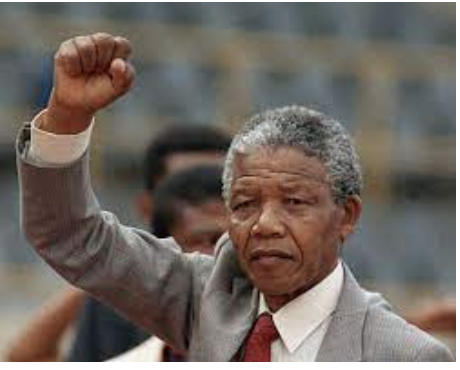
A Silent Tribute to Tata Madiba
Thanks for asking us to write something on Nelson Mandela, which we appreciate. Alas, though, we both feel somewhat exhausted on the subject, having done any number of things for the media. The Harvard Gazette has already published a long interview with us, in which we try to contextualize Mandela’s legacy and move subtly away from the big-man history that underpins all the empty hagiography now so pervasive in the US and British press.1 That legacy is not the story of an individual hero, as iconic—or, rather, metonymic—as he may have become. It is the story of a sovereign struggle, one that involved the deaths of many unnamed heroes, innumerable heroic acts without signature, processes both with and without subjects. The reason that we all feel morally orphaned by the death of Madiba, of Rolihlahla (the troublesome one), of Tata, our last living grandparent, is that he was our final link to a modernist sense of political possibility, a utopianism without innocence, with critique rather than self-obsessed cynicism. But sadly, he became a living anachronism in the land of his birth, as the latter was overtaken by neoliberal adjustment, despite all that he had done and been. Somehow, while he lived, that older sense of freedom still seemed recoverable. The death of the man is also the death of an epoch, of our epoch, one in which people like you and we actually dared to put faith in the ideals of democratic equity, of justice, of a humane humanity, of the sovereignty of citizens. All that seems fanciful, indeed irrecuperable, after Mandela. In short, the reason that we feel unable to write any more about this moment is that we have said, in deliberately few words, everything we think about it. At this point, the greatest eloquence is the eloquence of a deeply reflective silence. Much of the rest is noise, ritual noise most of it, noise often being made by people who have lacked the courage to stand openly for the things to which Madiba—and the movement at large of which he was part, since he was not “apartheid’s conqueror,” in the phrase of the US media,2 just its most famous struggle hero—gave their lives, their freedom, their spirit. Perhaps the lesson of those lives for us in the US is what we, as a country, did NOT do to fight apartheid while Rolihlahla Mandela languished in prison, what we have done repeatedly to fight AGAINST democracy under the sign of security and self-interest, why we continue to condone the blatant racism and brute inequity in our desperately unequal, cruel society. Rather than mourn Mandela, which South Africans will do, have done, in their millions, perhaps Americans should mourn the death, in our own country, of the ideals and principles for which he stood.
-
Goodly Beasts and Beastly Goods
Abstract
Among the 19th-century Tswana, we argue, cattle were like commodities; they linked processes of production and exchange, embodied an order of meanings and relations, and had the capacity to reproduce a total social world. They were, in sum, prime media for the creation and representation of value in a material economy of persons and a social economy of things. But they also had particular historical salience. As the Tswana were colonized, the encounter between periphery and center, local and global economies, was played out—materially and ideologically—in the contest between beasts and money, a contest which has given rise, also, to such token currencies as “cattle without legs.” The double character of cattle—as icons of a “traditional” order and as weapons in the struggle to assert control over modern life—has significant implications for our understanding of commodities in noncapitalist, non-European contexts, [cattle, commodities, money, colonialism, South Africa]
-
Cattle, Currencies, and the Politics of Commensuration on a Colonial Frontier
PREFATORY NOTE
Encounters between different regimes of value – regimes divided by cultural space and time — presume mediation, translation, and communication. And, therefore, currencies, at once verbal and material, that objectify them. This, in turn, depends on one thing above all else: on mechanisms of commensuration, mechanisms that render negotiable otherwise inimical, apparently intransitive, orders of signs and practices. Without such mechanisms, which have often been the object of conflict and contestation, large scale projects of world-making, like colonialism, would have made no sense, neither as a world-historical undertaking on the part of colonizers nor as a lived reality to those upon whose worlds it was wrought. Jane Guyer (2004: 13), in an acute reading of the West African archive, warns against the assumption that commensuration, especially that attributed to the alchemy of money, necessarily dissolves all distinctions between disparate scales and measures of worth. In Africa, she insists, nonequivalent exchange has been pervasive. If anything, it has been facilitated by the spread of quantifiable currencies: as people became adept at deploying monetary scales, they frequently used them for negotiating intervals, “exchanging goods and services that were explicitly not the match of each other” (Guyer 2004: 47). In similar spirit, the following essay interrogates the role of the commensuration in the colonial encounter: How might the management of value conversion – efforts, that is, both to facilitate and to impede it — play into larger processes of political contestation and incorporation at the edges of empire?
INTRODUCTION
Money is sacred, as everyone knows… Barry Unsworth (1992: 325)
This essay explores a very specific obsession with very general historical implications: the effort of Nonconformist evangelists to introduce coinage, to replace beads and cattle with banknotes, among Tswana peoples in South Africa. At its broadest, it posits a postmarxist argument, rooted in the concerns of both marxist and liberal theory, about the salience of commensuration in the modernist construction of society and history. And above all, in the forging of empires. For, we shall claim, at the heart of all “modern” colonialisms, a condition of their possibility perhaps, were mundane mechanisms that made ini- mical kinds of value, with different cultural roots, at once objectifiable, comparable, and negotiable–me- chanisms, that is, which permitted the up- and downloading of unlike forms of wealth, both human and inanimate. Commensuration and objectification, standardization and abstraction, equilibration and con- vertibility, of course, all feature prominently in classic theories of commodification; also in theories of the workings of money. But their significance in the construction of modernity as an ideology of global scale, and in the encounter between Europe and its others, has not been adequately plumbed. Nor, we believe, have their various media, their poetics and magicality, been adequately theorized..
In order to make our general point, and to explore its further theoretical consequences, we interro- gate processes of commensuration in one African colonial theater, focusing on the material transactions they enabled across semantic frontiers; on their diverse, and differently endowed media, alike in- digenous and imported; on their implications of the long-run for cultural constructions of wealth; on their existential effects upon all involved. We ask why it was that the campaign to convert Tswana to Christianity, and to the ways of the West, concentrated so centrally on recasting their currencies: on tea- ching them to use cash, to make good by buying and selling goods, to commodify their labors by transfor- ming the wages of sin into virtuous incomes. We trace how these ventures were challenged by African conceptions of value; how they called into being hybrid tokens of exchange; how they set in train strug- gles to domesticate new alchemies of enrichment while striving to protect local means of storing wealth. We shall show that, for nineteenth-century colonial evangelists in South Africa, saving savages meant teaching savages to save. If Jesus was to redeem them, his sable followers had to learn to invest. Also to produce providentially, using God’s gifts to bring forth the greatest possible abundance. Or at least marketable surpluses. Only then would Africa become part of the Christian commonwealth and its sacred economy. Drawing “native” communities into that body of corporate nations meant, first and foremost, persuading them to accept money, the ultimate currency of conversion, commerce, civility, salvation. In their efforts to do this, the Protestant missions took the waxing spirits of capitalism, its specie and its signifying conventions, on a world-historical journey.
In recuperating that journey, we seek to make visible the hidden hand, sometimes the sleight of hand, behind the political economy of nineteenth-century European colonialism. Which returns us to the broad outlines of our argument: (i) inasmuch as the building of empires depended on processes of commensuration, on rendering epistemically equivalent and transitive once incomparable objects and ideas, signs and meanings, it demanded media–beads, coin, contracts, and the like–with the capacity, simultaneously, to construct, negate, and transfigure difference; and (ii) inasmuch as those media, those currencies of conversion, opened up new lines of distinction, new languages of value, new forms of inequity, new objects of desire, new possibilities of appropriation and exploitation, they took on magical properties; this because (iii) they appeared, in and of themselves, to objectify history-in-the- making, even to make history of their own accord. Which, we shall demonstrate, is why banknotes, beads, and bovines became the objects of a protracted struggle in the South African interior; why, more generally, they became metonymic of the antinomies of value on which the colonial encounter, tout court was played out.
As this suggests, we seek here to make two species of theoretical claim. Both are instantiated by our South African story, both extend far beyond it. One is about “modern” European colonialism, whose historical logic, we propose, is incomprehensible without an understanding the processes of commensura- tion and conversion that allowed various worlds to be brought into the same orbit of being, both imagina- tively and concretely–and made phenomenological sense of the politics, economics, semantics of the en- counters to which it gave rise. The other is about commensuration itself and about the media upon which it depends: media are fetishized not merely because they congeal labor power and/or obscure relations embodied in processes of production, nor because they displace unspeakable passions from people to obj- ects or vice versa, but because , being uniquely endowed things, they take on a social life of their own. Their genius, we shall show, does not lie in their being empty, or emptied, signifiers, just as their meaning does not derive from their relations to other, equally empty signs. It is owed in part to their intrinsic properties, in part to the moral, material, and magical work they are made to do in the exigent course of history.
SPECIES OF VALUES, VALUE AND SPECIE
Christian Political Economy: secular theology, sacred commerce
If early modern European political economy was a secular theology (Hart 1986: 647), contempo- rary Nonconformist theology sanctified commerce. During the “second reformation” of the late 1700s, British Protestantism had refashioned itself with cultural fabric milled by the industrial revolution.
Indeed, the interplay of church and business, realms never fully separate, produced a rich discourse, at once religious and temporal, about value and its production (Hempton 1984: 11; Waterman 1991: 3f). Eighteenth-century evangelicals, Rack (1989: 385f) claims, had been more influenced by the language of practical reason than their espousal of scripture and spirituality might suggest; similarly Warner (1930: 138), who long ago linked the “empirical temper” of Methodist lore to the central place it accorded econo- mics.But the discourse of political economy, which fused a belief in the beneficence of existing econo- mic institutions with a whiggish desire for reform, was especially audible among abolitionists and “impro- vers” in the first years of the nineteenth century (Waterman 1991: 6). As a call to practice, moreover, it was particularly congenial to the spirit of the great evangelical societies. While liberal theory per se was seldom a subject of open discussion among missionaries to South Africa, most of them were guided, more or less, by its material and moral principles. Some actually did cite it as a charter for their labors: the LMS Superintendent, John Philip (1828,1: 369), for example, quoted Adam Smith on the need to stimulate the indigent to industry; and David Livingstone (1961: 194) made mention of Malthus on the subject of re- production. As this implies, Nonconformist theologians and their followers were advocates of moral deregulation. According to the “New System” Calvinism of the Congregationalist clergy, everyone, not just the elect, were candidates for salvation. They also sought to remove the spiritual “ceiling” that the Anglican hierarchy put in the way of aspiring dissenters (Helmstadter 1992: 15,23). These men set all available means, including economic ones, to work for their cause. Likewise the Methodists; in line with early champions of free trade, Wesley saw nothing intrinsically unworthy or antisocial in riches (Semmel 1974: 71f). Quite the reverse. The “lusty zest” with which he advocated the quest for gain went further than most previous Puritans, who tended not to celebrate wealth but to condone it as a necessary compromise with evil (Warner 1930: 138f). For him, “business” did not “interrupt communion with God.” It was merely one of its channels.
“Business,” in fact, seems to have served as a synecdoche for human action in the world,1 just as “usefulness” conveyed a sense of virtuous efficacy (Helmstadter 1992: 9). Not that commerce did not pose its own dangers. Wesley’s economic teachings were, in many ways, a lifelong effort to counter those implications of The Wealth of Nations that he saw to be corrupting (Outler 1985: 264). But therein lay the challenge: “Make yourselves friends of the mammon of unrighteousness,” he preached (1985: 266), citing Luke’s injunction (16: 1-2) to redeem the potential of wealth. In his sermon on “The Use of Money,” he (1985: 267-8) chides fellow Christians for acquiescing in an “empty rant” against the “grand corrupter of the world.” The duty of the faithful was to deploy, to the greatest possible advantage, all that providence had provided. Money was a precious “talent”; the word evoked both biblical coinage and a sense of spe- cial, God-given capacity:
[It] is of unspeakable service to all civilized nations in all the common affairs of life. It is a most compendious instrument of transacting all manner of business, and (if we use it according to Christian wisdom) of doing all manner of good.
Money, he went on (p.268), was “food for the hungry” and “raiment for the naked.” Even “father to the fatherless”–surely one of the most genial images of cash in contemporary European moral discourse. As a compendious instrument, it was an ur-commodity, condensing in itself the essential quality of all good/s. Reciprocally, it could stand for all things, even the closest of human connections.
Wesley seems to have seen coin as the servant of existing laws of value and a neutral vehicle of trade; he subscribed to the “commodity theory” of currency shared alike by classic liberal theorists and by Marx (Hart 1986: 643). Marx, of course, also stressed that money, as capital, was uniquely equipped to extract value from human producers. Wesley would himself inveigh against dishonest industry and fetter- ed exchange, but not against the powers of cash itself. In his simpler moral economy, its poison was drawn if it was used in ways pleasing to God. And it made all virtuous effort measurable and com- mensurable, permitting the conversion of worldly enterprise into spiritual credit. In this sense, the most “precious talent” of money was its capacity to enable mortals to “trade up.” Salvation itself became obtainable on free market terms. These fiscal orientations also suffused Wesleyan practice. “As a voluntary organization,” says Obelkevich (1976: 206), “Methodism…fostered in its members a new outlook, individual and collective, towards money.” Finances were a constant matter of concern and collections were taken up for many causes, not least foreign missions. In Britain, as among African converts, a ceaseless stream of demands and appeals highlighted the meliorative qualities of cash.
The great evangelical societies, in fact, were run like businesses, with men of commerce actively investing their resources and managing their affairs (Helmstadter 1992: 10). In the field, the Nonconform- ists put their trust in the power of money to bring progress, and to place all things, even God’s grace, with- in human reach. This faith in the creative powers of cash recalls Simmel’s Philosophy of Money, perhaps the most refined statement of the nineteenth-century European belief in the transformative power of coin. For Simmel (1978: 291), man was by nature an “exchanging animal” and, by this token, an “objective animal” too: exchange, in its “wonderful simplicity,” made both the receiver and the giver, replacing selfish desire with mutual acknowledgement and objective appraisal. Transaction, he went on, begets rationaliza- tion. And the more that values are rationalized, “the more room there is in them, as in the house of God, for every soul.” Because of its unlimited convertibility (p. 292), money was uniquely capable of setting free the intrinsic worth of the world to be traded in neutral, standardized terms. And so it enabled the con- struction of an integrated society of morally dependent, but psychically self-sufficient persons (Simmel 1978: 297f).
While they might never have put it in just these terms, the Nonconformists missionaries in South Africa devoted much of their effort to making Africans into “exchanging animals,” an enterprise in which cash played a pivotal role. They, too, nurtured the dream of an expansive civil society built not upon sav- age barter but upon transactions among self-possessed, moneyed persons. According to this dream, the liberation of “natives” from a primitive dependence on their kin and their chiefs lay in the creation of a higher order, a world of moral and material interdependence mediated by stable, impersonal media: let- ters, numbers, notes, and coin.
There was, as everyone knows, another side to money: its long-standing Christian taint as an in- strument of corruption and betrayal. In part, this flowed from the power of cash, indeed all instruments of commensuration, to equate disparate forms of value. It could dissolve what was unique, precious, and per- sonal, reducing everything to the indiscriminate object of private avarice: the Savior, note, had been sold for thirty pieces of silver, monastic relics melted into gold. What was more, the ability of coin to trans- pose different forms of worth enabled profitable conversions to be made among them; in particular, it allowed the rich to prosper by using their assets to control the productivity of others. Parry and Bloch (1989: 2f; cf. Le Goff 1980) remind us that this sort of profit was anathema to the medieval European church, which saw productive work as the only legitimate source of wealth and condemned, as unnatural, the effortless earnings of merchants and money-lenders. Capitalism was to exploit the metabolic qualities of money in unprecedented ways, of course–especially its capacity to make things commensurable by turning distinct aspects of human existence, like land and labor, into alienable commodities. And Protestantism would endorse this process by sanctifying desire as virtuous ambition; also by treating the market as a realm of provident opportunity. Yet its medieval qualms remained. As Weber (1958: 53) stressed, those Christians who most aptly embodied the spirit of capitalism were ascetics. They took little pleasure in wealth per se. For them, making money was an end in itself, a transcendental value. It gave evidence of ceaseless “busy-ness” and divine approval.
In so far as money remained demonically corrosive, there was only one way to avoid its corrup- ting qualities: to let it go. If it was to generate virtue, it had visibly to circulate. Hoarded wealth was “the snare of the devil” (Wesley 1986: 233). It made men forsake the inner life for superficial pride, luxury, and leisure. The Divine Proprietor required that his stewards put his talent to work either by cycling it back into honest business or by giving it away in charity; the proper movement of wealth was both creative and positive. By those lights, exchange was production (Parry and Bloch 1989: 86). Non- conformists still held to a labor theory of value, but now the notion of industry was cast in terms of manu- facture and the market, of wage labor, the circulation of wealth, and the productive character of capital.
For Nonconformists like Wesley, in short, assiduous effort and ethical dealing–the market, lite- rally, as a “moral” economy–were enough to curb the malignancy of money. Charity, itself a high yield investment in virtue, was the main means of redistributing wealth, a way to “lay up…treasures in the bank of heaven” (Wesley 1984: 629). Humble toil also paid spiritual dividends, but at a lower rate. In the here-and-now, Methodism tended to endorse existing labor relations; during the late 1700s, even child workers were said to profit from industrious discipline (Warner 1930: 151). And the just wage was just, for exertion in one’s allotted calling was its own reward. Hence it behooved the faithful to strive cease- lessly to produce all they could, an injunction that gelled well with the expansive ethos of humane imperialism.
Read in this light, it is clear that the economic emphasis of missionary practice in South Africa expressed more than a mere effort to survive or even to profit. It expressed the spirit of liberal modernity, being part of the attempt to foster a self-regulating commonwealth, for which the market was both the model and the means; also, to induce what Unsworth (1992) has aptly termed a “sacred hunger,” an insatiable desire for material enrichment and moral progress. As we shall see, the task proved onerous, for the “mammon of unrighteousness” was never easily befriended. By the mid 1820s, some of the more radical evangelicals in England were denouncing the reduction of human qualities to price. And, in the mission field, the Nonconformists were caught, time and again, in the double-sided implications of money. Meanwhile, the kind of value carried by coin would come face to face with African notions of worth, setting off new contrasts, contests, and combinations.
The Southern Tswana world of the early nineteenth century bore some similarity to the one from which the missionaries set out. Stress was laid here, too, on human production as the source of value. Here, too, communities were understood as social creations, built up through the ceaseless actions and transactions of people eager to enhance their fund of worth. Here, too, exchange was facilitated by versatile media that measured and stored wealth, and permitted its negotiation from afar.
These parallels, we have argued (1992: 127f), are sufficient to cast doubt on the exclusive asso- ciation of commodities and competitive individualism with industrial capitalism. Or modernity. But, by the same token, similar practices do not necessarily have the same genesis, constitution or meaning. Al- though Southern Tswana subscribed to a fundamentally humanist sense of the production of wealth, their understanding of value–and the way it vested in persons, relationships, and objects–was different from that of their interlocutors from abroad. Thus, while early missionaries thought they detected in the Af- ricans a stress on self-contrivance, a dark replica of Western economic man, they found, on longer acquaintance, that this person was a far cry from the discrete, enclosed subject they hoped to usher into the church. Indigenous “utilitarianism,” Tswana literati like Molema (1920: 116) insisted, was unlike European “egoism”; the evangelists referred to the “native” variant as “selfishness.” Indeed, closer en- gagement of previously distinct economies on the frontier would reveal deep distinctions behind superficial resemblances. And it would give birth to a dynamic field of hybrid subjects and signs.
The Setswana verb go dira meant “to make,” “to work,” or “to do.” Tiro, its noun form, covered a wide range of activities–from cultivation to political negotiation, cooking to ritual performance–which yielded value in persons, relations, and things. It also produced “wealth” (khumô), an extractable surplus (of beer, artifacts, tobacco, stock, and so on) which could be further deployed to multiply worth. Sorcery (boloi) was its inverse, implying the negation of value through attempts to harm others and/or unravel their endeavors. Tiro itself could never be alienated from its human context and transacted as mere labor power; that experience still awaited most Southern Tswana. Rather, it was an intrinsic dimension of the everyday act of making selves and social ties.
This vision of the production of value, based on close human interdependence, bore little resem-blance to that of liberal economics, which saw the commonweal as the fruit of impersonal transactions among autonomous beings. For Tswana, wealth inhered in relations. Which is why its pursuit involved (i) the construction of enduring connections among kin and affines, patrons and clients, sovereigns and sup- porters, men and their ancestors; and (ii) the extension of influence by means of exchanges, usually via the medium of cattle, which secured rights in, and claims over, others. But, while these rights and claims were constantly contested, the productive and reproductive properties of a relationship, be it wedlock or serfdom, could not be separated from the bonds that bore them (Molema 1920: 125; Schapera (1940: 77). The object of social exchange was precisely not to accumulate riches with no strings attached: the traffic in beasts served to knit human beings together in an intricate weave, in which the density of linkages and the magnitude of value were one and the same thing.
Because they were the means, par excellence, of building social biographies and accumulating capital, cattle were the supreme form of property here; they could congeal, store, and increase value, hol- ding it stable in a world of flux (Comaroff and Comaroff 1992: 139). Not surprisingly, their widespread use as currency in human societies was noted by early theorists of political economy (Smith 1976: 38; Marx 1967,1: 183). While Adam Smith (1976) judged them “rude” and “inconvenient” instruments of commerce, he appreciated that they embodied many of the elementary features of coin, being useful, alienable, relatively durable objects. Although standardized as species, moreover, stock come in different sizes and colors, genders and ages, and so might be utilized as tokens of varying quality and denomination. (Many African peoples, of course, have long elaborated on the exquisite distinctions among kine). True, cattle are not as divisible as inanimate substances like metal and tend, therefore, to be more gross, slow-moving units of trade. But, as we shall see, Southern Tswana took this to be one of their advantages over cash, whose velocity they regarded as dangerous. Herds were movable, of course, es- pecially for purposes of exchange, a fact stressed by Marx (1967,1: 115); for him, the apparent self-propulsion of currency was crucial to its role in animating commodity transactions. Affluent Tswana men exploited this ambulatory quality, dispersing bridewealth to affines and loaning stock to clients as they strove to turn their resources into control over people. They also rotated animals among dependents, and between cattle-posts, both as a hedge against disaster and as a way of hiding assets from the jealous gaze of rivals (Schapera 1938: 24).
It is as exchange value on the hoof, then, that cattle occupied a pivotal place in Southern Tswana political economy. Their capacity to objectify, transfer, and enhance wealth endowed them with almost magical talents. Much like money in the west. The beast, goes the vernacular song, is “god with a wet nose” (modimo o nkô e metsi; Comaroff and Comaroff 1992: 127). This is a patent instance of fetishism in bovine shape–of the attribution to objects, that is, of value produced by humans–which suggests that the commodity is not specific to capitalism. At the same time, the case of Tswana stock also shows that commodification need not be an all-or-none process; and that it is always culturally situated in a meaningful world of work and worth. Here, for example, while animals enabled rich men to lay claim to the labors of others, they did not depersonalize relations among people. Quite the contrary. They drew atten- tion to the social embeddedness of those very relations–while making them seem part of the natural order of things.
The complex qualities of cattle currency would intervene in mission efforts to transform the Sou- thern Tswana sense of value. For beasts were enough like money to be identified with it, yet enough unlike it to make and mark salient differences. On one hand, they could abstract value. On the other, they did the opposite: they signified and enriched personal identities and social ties. The capacity of animals in Africa to serve both as instruments and as signs of human relationship has long been noted; the so-called “bovine idiom” is an instance of the more general tendency of humans to use alienable objects to extend their own existence by uniting themselves with others (Mauss 1954; Munn 1977). Both in their individual beauty and their collective association with wealth, kine were ideal–and idealized–personifications of men. A highly nuanced vocabulary existed in Setswana to describe variations in color, marking, disposition, horns, and reproductive status (Lichtenstein 1973: 81; Sandilands 1953: 342). Named and praised, they were creatures of distinction. Not only did they bear their owners’ stamp as they traversed social space (Somerville 1979: 230). They also served as living records of the passage of value along the pathways of inheritance, affinity, alliance, and authority.
The intricate patterns of stock deployment among Tswana made it difficult for early European vi- sitors to assess their holdings. Longer-term records suggest a history of fluctuations in animal popula- tions, with cycles of depletion being followed by periods of recovery, at least until the end of the nine- teenth century (Grove 1989: 164). But there is clear evidence of the existence, at the beginning of that century, of large and unequally distributed herds. Observers were struck by blatant discrepancies in cattle ownership, and by the unambiguous association–Burchell (1824,2: 272) used the word “metonymy”–of wealth in kine with power (cf. Lichtenstein 1973: 76f; Molema 1920: 115). Thus the chief was the sup- reme herdsman (modisa) of his people, a metaphor that captured well vernacular visions of value and political economy. Situated atop the morafe (“nation”), he presided over a domain marked not by fixed boundaries, but by an outer ring of water holes and pasture–in other words, a range (Comaroff and Co- maroff 1992: 141). Royal stock also built relations beyond the polity, being used to placate and to trade with other sovereigns.
It was not only chiefs who mobilized cattle as a currency of power: other men of position also ac- cumulated stock and set up networks of alliance and patronage. Ordinary male citizens, however, relied on inheritance, bridewealth, and natural increase to build their modest herds. Some–serfs, and others laid low–had no animals at all. They made up what Burchell (1824,2: 348) termed an “ill-fated class,” eternal- ly dependent on their betters. In the bovine economy of the Southern Tswana, in sum, an indigenous “stock exchange” underwrote inequalities of class, gender, generation, and rank. As the pliable media used to forge all productive relations, human and superhuman alike, cattle were the quintessential form of social and symbolic capital. They moved men to intrigue, sorcery, and warfare, to deep contemplation about the nature of life and worth, and, as Somerville (1979: 134) witnessed in 1801, to passionate public poetry.
Cattle were also a prime medium in the exchanges that, by the late eighteenth century, linked Southern Tswana to other peoples on the subcontinent, yielding beads from the Kora and Griqua to the south, and iron implements, copper jewelry, and tobacco from communities to the north and northeast (Lichtenstein 1930,2: 409; Stow 1905: 449,489). Bovine capital also gave access to the ivory and pelts desired by white travelers, who arrived in growing numbers from ca.1800 (Shillington 1985: 11). And pack-oxen enabled the long-distance haulage of sebilô, a sought-after hair cosmetic, from its source in Tlhaping territory (Campbell 1813: 170). But the earliest European explorers already noted that Tswana were reluctant to trade away their beasts. Somerville’s (1979: 140) expedition to the interior failed in its mercantile objectives because of the “[natives’] unwillingness to part with their cattle.” The Englishman found this “difficult to account for, since they convert them to no useful purpose whatever.”
Nonetheless, regional exchange networks were active enough to persuade the Europeans that they had stumbled upon the “essential principles of international traffic,” or “mercantile agency in its infancy” in the African veld (Burchell 1824,2: 555; original emphasis). Andrew Smith (1939,1: 251), in fact, ob- served that chiefs managed production explicitly to foster alliances; they tried, as well, to monopolize dealings with foreigners and to control commerce across their realms (Campbell 1822,2: 194). Indeed, whites found these men aware of discrepancies in going rates for such items as ivory, and keen to profit from them. Notwithstanding the reluctance to sell beasts, occasions to traffic with Europeans–in the early years for beads, later for guns and money–were eagerly seized. When Lichtenstein (1930,2: 388) visited the Tlhaping in 1805, before a permanent mission was established, he noted that a “general spirit of trade” was easily roused. The Africans kept up an energetic exchange until his party had naught left to sell. A few years on, Burchell (1824,2: 555) was struck by the existence of enduring trade partnerships (maats; Dutch) between individual Tlhaping and Klaarwater Khoi.
We shall come back, shortly, to the entry of the civilizing mission into Southern Tswana commer- ce. Already, however, two things are clear. The first is that the Africans had long channelled their surpluses into trade, bringing them a range of goods from knives and tobacco to widely circulating forms of cur- rency. Of the latter, second, beads had become the most notable. By the turn of the nineteenth century,2 they were serving as media of transaction that articulated local and global economies, linking the worlds of cattle and money (cf. Graeber 1996). Along with buttons, which were put to a similar purpose, they were portable tokens that, for a time, epitomized foreign exchange value beyond the colonial frontier. Beads were “the only circulating medium or money in the interior,” Campbell noted (1822,1: 246), adding that every “nation” through which they passed made a profit on them. Different kinds composed distinct regional currencies; Philip (1828,2: 131) tells us that no importance was attached to particular examples, however beautiful, if they were “not received among the tribes around them.” At the same time, African communities showed strong preferences, in the early 1800s, for specific colors, sizes, and degrees of transparency (Beck 1989: 220f).3
Even as they became a semi-standardized currency for purposes of external trade, beads served internally as personal adornments; in this they were like many similar sorts of wealth objects. Their at- traction seems to have stemmed from the fact that particular valuables could be withdrawn from circula- tion for display, itself a form of conspicuous consumption.4 But men of means also accumulated hidden stocks: “their chief wealth, like that of more civilized nations, [was] hoarded up in their coffers” (Camp- bell (1822,1: 246; cf. Graeber 1996). Here it stayed, in precisely the manner abhorred by the Protestants, until favorable opportunities for trade presented themselves. Market exchange was, at this point, a spora- dic activity directed at specific exotic objects. It was set apart from everyday processes of production and consumption.
Some observers stressed the monetary properties of beads: “They answer the same purpose as cowrie shells in India and North Africa,” Campbell (1822,1: 246) wrote, “or as guineas and shillings in Britain.” But others were struck by the differences. For a start, aesthetic qualities seemed integral to their worth. “Among these people,” offered Philip (1828,2: 131), “utility is, perhaps, more connected with beauty that it is with us.” Simmel (1978: 73) would have said that the separation of the beautiful from the useful comes only with the objectification of value: the aesthetic artifact takes on a unique existence, sui generis; it cannot be replaced by another that might perform the same function. Such an artifact, therefore, is the absolute inverse of the coin, whose defining feature is its substitutability.
Among Southern Tswana, the increasing velocity of trade did render some media of exchange–first beads, then money–ever more interchangeable. But the process was never complete. And it did not eliminate other forms of wealth in which beauty and use explicitly enhanced each other. Indeed, the longevity of cattle currencies in African societies bears testimony to the fact that processes of rationa- lization, standardization, and universalization are always refracted by social and cultural circumstance. In the cow, aesthetics and utility, uniqueness and substitutability complemented each other, coloring Tswana notions of value in general–and of money in particular. Black wage laborers in early twentieth century South Africa, Breckenridge (1995: 274) notes, set special store by the physical qualities of metallic coins; in explaining their attitude, public intellectuals John Dube and Sol Plaatje contrasted “flimsy” paper money with “the good red gold we know and love.” Comeliness and usefulness play off each other in the west as well, of course; modernists, after all, insist that form should follow function. The Tswana appreciation of prized beads and beasts, similarly, expressed a sense of “attractiveness” that fused the per- fect with the practical. Persons or objects possessed of it were thought to draw towards themselves desirable qualities dispersed in the world at large. Ornamental baubles or celebrated stock were the very epitome of attractiveness: held apart from the everyday cycle of exchange, they congealed precious po- tential.
Objects that come to be invested with value as media of exchange vary greatly over time and space, a point well demonstrated by the emergence of new currencies as formerly distinct economic ord- ers begin to intersect. Marx (1967,1: 83) once said that, when the latter happens, the “universal equivalent form” often lodges arbitrarily and transiently in a particular commodity. So it was with beads, which had been mass-produced for different ends in the West, but turned out to serve well, for a while, as a vehicle of commerce beyond the colonial border. Marx also added that, as traffic persists, such tokens of equivalence tend to “crystallize…out into the money form.” So, once again, it was with beads. While Tswana would accept various articles as gifts, these were of little use in trade. “They want money in such a case,” Campbell (1822,1: 246) found, “that is, beads.” As transactions increased in volume, standards of value in the worlds linked by this new currency began to affect each other: merchants noted that rates charged by Africans in the interior rose and became more uniform.5 By the 1820s, the demand for beads at the Cape had driven up prices dramatically, to the extent that missionaries tried to secure supplies from England at one-third of the cost (Beck 1989: 218f).
The bottom soon fell out of the frontier bead market, however (although not so further north; see Chapman 1971,1: 127). That market seems to have been sustained by the dearth of fractions of the rix- dollar, the currency at the Cape in the early 1800s (Arndt 1928: 44-6). After 1825, Britain introduced its own silver and copper coinage to its imperial possessions, and paper dollars were replaced by sterling. Once the new supply had stabilized, and had filtered into the interior, its effect on bead money was devas- tating. In 1835, Andrew Smith (1939,1: 250) wrote that a white merchant
inform[ed] me that when first he began to trade in this country about 1828, nothing was desired by the natives but beads, etc., but now they are scarcely asked for; indeed nothing is to be purchased by them [beads] but milk or firewood…They understand reckoning money quite well, and if told the price of an article… they reckon out the money with the greatest precision.
Ironically, while Tswana came to reckon in money, many traders preferred to deal in kind. But, even more important than changes in the cash supply, a shift was occurring in the structure of wants and in lo- cal notions of value. It was encouraged, above all, by the presence of the evangelists and by the entry onto the scene, at their urging, of a cadre of itinerant merchants and shopkeepers.
Here, then, were two distinct regimes of value, one European and the other African, whose engagement would have a profound impact on the colonial encounter. To the Nonconformists, economic re- form was no mere adjunct to spirituality: virtue and salvation had to be made by man, using the scarce material resources bequeathed by providence for improving the world. Commercial enterprise allowed the industrious to turn labor into wealth and wealth into grace. Money was the crucial medium of convertibi- lity in this. It typified the potential for good and evil given as a birth-right to every self-willed individual. Southern Tswana, upon whom the evangelists hoped to impress these divine possibilities, also inhabited a universe of active human agency, in which riches were made through worldly transactions. Exchange, in their case, was effected primarily through cattle. In contrast to cash, stock socialized assets, measuring their ultimate worth not in treasures in heaven, but in people on earth. We move, now, to examine how these regimes of value, already in contact in the early 1800s, were brought into ever closer articulation.
EXTENDING THE INVISIBLE HAND
Civilizing Commerce, Sanctified Shopping: The Early Years
“You white men are a strange folk. You have the word of God…but [your traders] are giving beads to the girls [and] corrupting the women of my people. [T]hey are teaching my people abominations of which even they were once ignorant, heathen as they are. Here are traders enough.”
Chief Sechele, 1865 6
British observers in the early 1800s might have acknowledged that Southern Tswana showed a lively interest in exchange. But they also stressed the difference between “native commerce” and orderly European business. Thus Burchell (1824,2: 536-9) noted that “mercantile jealousy” had produced compet- ing efforts to monopolize traffic with the colony to the south. He proposed a “regulated trade for ivory… with the Bichuana nations,” to be vested in an authorized body of white merchants who would institute “fair dealing” to the advantage of all. Like liberal economies before and since, his “free” market required careful management.
The founding evangelists shared this trust in the beneficent effect of trade. Some said that the ve- ry “sight of a shop” on mission ground roused savages to industry (Philip (1828,1: 204-5). The equation of civilization with commerce might have become one of the great clichés of the epoch. But, for the Nonconformists, it was far from a platitude. The point was not to create an exploitable dependency; al- though that did happen. Nor was it simply to play on base desire to make people give ear to the Gospel; although that happened too. It ran much deeper. Trade had a capacity to breach “the sullen isolations of heathenism,” to stay the “fountain of African misery” (Livingstone 1940: 255). All of which made materi- al reform an urgent moral duty. The optimism of the missionaries in this respect was to falter in the face of the stark realities of the colonial frontier. The Christians had eventually to rethink their dream of a commonwealth of free-trading black communities, actively enhancing their virtue and wealth. But they continued to hold that the market would rout superstition, slavery, sloth; this even when, later in the century, market forces undercut their own idyll of independent African economies, compelling “their” peoples to become wage vassals in their own land.
There was, in other words, more to championing commerce among heathens than merely making virtue of necessity, as some have suggested; although it is true that many pioneer evangelists had to ex- change to survive (Beck 1989: 211). In fact, the most ardent advocates of free enterprise were often those most opposed to clergy themselves doing business. Livingstone (1857: 39) held that, while missionary and trader were mutually dependent, “experience shows that the two employments can not very well be combined in the same person.” Ironically, he was to be accused of gun-running by the Boers. But then, on the frontier, the lines between prestation, purchase, and profit were very fine indeed. And frequently in dispute. While traffic with peoples living beyond colonial borders was forbidden by law, missionaries were de facto exempt, except for the ban on selling liquor, weapons, and ammunition. Dealings with Afri- cans often went well beyond the procuring of necessities, involving considerable capital outlay. In the upshot, competition and accusations of dishonorable practice among the brethren soon became common (Beck 1989: 214). As early as 1817, the LMS at the Cape had had to confront the issue as a matter of poli- cy. Its members agreed that, while trade was forced on them by the inadequacy of the Society’s support, they should make their stations self-sustaining through agriculture and handicrafts. The quest for profit, however, was specifically discouraged.
From the first, Tswana associated evangelists, like all whites, with barter. Moffat (Moffat and Moffat 1951: 18) reports that when he and the Rev. Kay of the WMMS traveled among Tlhaping in 1821, “the Bootchuanas flocked around us with articles for exchange.”7 The clergymen tended to be less than open in their formal correspondence about their dealings; this notwithstanding the fact that, in the 1820s, the mission societies considered entering the lucrative ivory business to raise funds for projects in the Co- lony (Beck 1989: 217; Moffat and Moffat 1951: 62). Cooperation between the Nonconformists and mer- chants was close: traders journeying beyond the Orange River tended to lodge at mission stations and of- ten accompanied evangelists on their travels (Livingstone 1960: 141).
The Nonconformists also gave out goods for purposes other than trade. Early on they dispensed tobacco, beads, and buttons to encourage goodwill, only to find that prestations came to be expected in re- turn for attending church and school.8 Few Tswana seem initially to have shared the precise European dis- tinction between gifts and commodities, donations and payments. Yet one thing was widely recognized: that whites controlled desirable objects. As a result, they soon became the uncomfortable victims of deter- mined efforts to acquire those objects. Their correspondence declared that all Africans, even dignified chiefs, were inveterate “beggars”; that they persistently demanded items like snuff, which the missions were assumed to have in large supply; and that their behavior violated Protestant notions of honest gain (Moffat and Moffat 1951: 63). It took a while for the Christians to realize that “begging” was also a form of homage to the powerful (Price 1956: 166; Mackenzie 1871: 44f). Burchell (1824,2: 407), a naturalist and not a cleric, discerned that these requests were limited largely to a specific category of goods:
...they never asked for sikháka (beads); these being considered more especially as money, to be employed only as the medium of trade with distant tribes, and for the purchase of the more expensive articles; while muchúko and lishuéna (tobacco and snuff) being consumable merchandise, are…regarded as a less important species of property. (Original emphasis).
A similar contrast between treasures and trifles seems to have obtained in the brazen “theft,” in the first years, of the evangelists’ belongings, especially their produce and tools (Moffat and Moffat 1951: 57). Previous visitors, interestingly, had remarked on the virtual absence of pilfering.9 Lichtenstein (1973: 75) was struck by the fact that only items not considered as property were ever taken. But Broadbent’s account of the severe response of a Rolong chief to one such incident10 makes it clear that the sudden pre- sence of quantities of desirable goods had raised unprecedented problems of defining and maintaining ownership. The missionaries tended to see this as a lack of respect for private effects: Hodgson (1977: 336) mused, in 1826, on the “precarious tenure upon which the natives [held] their possessions.” Obviously, conventions of acquisition, proprietorship, and remuneration were being tested on both sides of the encounter.
As Beck (1989: 224) confirms, the evangelists introduced more European goods than did any other whites at the time. Their dealings eroded the local desire for beads and buttons in favor of a comp- lex array of wants, primarily for domestic commodities like clothes, blankets, and utensils. But this transformation, as we have suggested, entailed far more than the mere provision of objects. Changing patterns of consumption grew out of a shift in ideas about the nature, worth, and significance of particular things in themselves. Which, in turn, was set in play by the encounter of very different regimes of value. Thus, even where their uses seemed obvious, such goods as clothes and furniture were given meanings irreducible to utility alone, meanings which often made the Europeans uneasy (Comaroff and Comaroff 1997: Chap.5).
Yet more basic than this was the fact that, as the century wore on, it was less missionaries than the merchants they brought in their wake who were responsible for the supply of goods. Discomforted by the image of men of God haggling over the price of trinkets (Beck 1989: 213), most evangelists encouraged independent traders to settle on their stations. By 1830, John Philip (1828,1: 204f) had al- ready publicized the success of his “experiment” to have one open a store at Bethelsdorp:
The sight of the goods in their windows…produced the effect anticipated: the desire of possessing the articles for use and comfort by which they were constantly tempted, acquired additional strength on every fresh renewal of stimulus.
Money, he added, had gone up in the people’s estimation. They had begun, enthusiastically, to bring pro- duce to the trader to exchange for goods. Bechuanaland soon followed Bethelsdorp. The introduction of stores in this manner–all the better to instruct non-Western peoples in “the economic facts of life”–was a high priority among British Protestants in many parts of the world; Miller (1973: 101) describes similar ventures in the Argentine in the 1930s.
Time would mute the idyll of cooperation between missions and merchants. Already in 1841, Mary Moffat (1967: 18), while reiterating the need to foster a desire for commodities, bemoaned the high prices charged by local dealers for “worthless materials.” A decade later, Livingstone (1959,2: 152) wrote in acerbic terms about traders of all stripes. While they reaped huge profits, he complained, these men re- sented the evangelists, accusing them of driving up the price of African goods. While the whites squabbled over their dealings with Africans, Tswana sovereigns–witness the words of Chief Sechele–had their own reasons for being wary of merchants. The latter paid scant respect to long-standing mores or monopolies, being ready to buy from anyone who had anything desirable to sell; the purchase of ivory and feathers from Rolong “vassals” in the Kalahari, for instance, cost the life of one businessman and his son (Mackenzie 1871: 130). Such friction was frequent beyond the mission stations (Livingstone 1959,2: 86). But even when storekeepers operated under the eyes of the evangelists, their behavior often gave offense. Brawling, theft and sexual assault were common; Sechele banished two of them for an “indecent” attack on a Kwena woman in broad daylight near Livingstone’s home (Livingstone 1974: 120). No wonder that local rulers developed a “well-known” reluctance to allow itinerant traders to traverse their territories (Mackenzie 1871: 130). Or that, later in the century, strong chiefs would try to subject European commerce to strict control (Parsons 1977: 122).
The evangelists would have to wrestle constantly with the contradictions of commerce. In embra- cing its virtues, they had to deal with the fact that the two-faced coin threatened to profane their sacred mission. Yet the merchants were essential in the effort to reform local economies by hitching them to the colonial market–and the body of corporate nations beyond.
Object Lessons
And so the merchants remained on the mission stations. Where they prospered. Storekeepers stocked all the quotidian objects deemed essential to a civil “household economy” (Moffat 1842: 507, 502f): clothes, fabrics, furniture, blankets, sewing implements, soap, and candle molds; the stuff, that is, of feminized domestic life, with its scrubbed, illuminated interiors. Shops also carried the implements of intensive agriculture, and the guns and ammunition required to garner the “products of the chase,” inc- reasingly the most valuable of trade goods. Colonial whites abhorred the idea of weapons in African hands. But, by the 1830s, “old soldier’s muskets” were being sold for “6,7 and 8 oxen,” and three or four pounds of gunpowder for a single animal (Smith 1939,1: 232)11–although, after the midcentury, the expanding arms business was mostly in the hands of well-capitalized Cape entrepreneurs, a fact that would have far-reaching consequences for game stocks and for the economic independence of Southern Bechuanaland (Shillington 1985: 13f,21f).
Mission accounts from the late 1800s show that European commodities had begun to tell their own story in the Tswana world. As Wookey (1884: 303) wrote:
Through the settlement of missionaries, and the visits of traders and travellers, the country became known and opened up. Cattle first, and then ivory, feathers, and karosses, were the principal things brought by the natives for barter. They were exchanged for guns and ammunition, cows, wagons, horses, clothes, and…other things. To-day a trader’s stock is not complete unless he has school material, stationery, and even books…
Ornaments, cooking utensils, and consumables were widely purchased, as were coffee, tea, and sugar. The foreign goods that seemed everywhere in use spoke of far-reaching domestic reconstruction.
At least in some quarters: the acquisition of these commodities required surplus production and disposable income, which was restricted to the emerging upper and middle peasantry. At the same time, despite their taste for European things, many wealthy men remained reluctant, save in extremis, to sell stock (Schapera 1933: 648). On the other hand, the market was particularly attractive to those excluded from indigenous processes of accumulation. Client peoples, for example, were easily tempted to turn tribute into trade–which is why some chiefs lost their monopolies over exchange (but cf. Parsons 1977: 120). Especially along the frontier, ever more Tswana, citizens and “vassals” alike, entered into commer- cial transactions; as a result, they acquired manufactured goods well before the South African mineral re- volution of the 1870s and the onset of large-scale labor migration. Small objects may speak of big chan- ges, of course. Rising sales of coffee, tea, and sugar marked important shifts in patterns of nutrition and sociality. They also tied local populations to the production and consumption of commodities in other parts of the empire (cf. Mintz 1985). As George Orwell (1982: 82) once said, in this respect, “changes in diet are more important than changes of dynasty or even of religion.”
But Wookey’s account also suggests that things had veered out of mission control (1884: 304): Changes, however, have taken place in the trade of the country. A few years ago many thousands of pounds’ worth of produce annually changed hands and passed through to the colony. Now ivo- ry has become scarce…[and] the [ostrich feather] trade has dwindled down…But another door was opening for the people…I mean the Diamond Fields.
Proletarianization was an almost inevitable consequence of the economic revolution encouraged by the Nonconformist mission. Wookey (1884: 304) admitted that the material developments promoted by the evangelists had not been an “unmixed good”; in this, he anticipated the concerns of African critics, voiced later, about the impact of sugar, alcohol, and imported provisions on the health of black populations. Not only had new diseases appeared, but drink had become “one of the greatest curses of the country.” The most profitable and addictive of commodities, its effects were a sordid caricature of the desire to make “natives” dependent on the market. Despite Christian efforts to limit its distribution (Mackenzie 1871: 92), brandy was being supplied in ever growing quantities to Bechuanaland by the second half of the nineteenth century.
The issue was not trivial. Several Tswana rulers had already tried to banish brandy from their realms, and Khama III expelled traders who failed to comply (Holub 1881,1: 278). Plaatje (1996), using the black press, was to champion the Liquor Proclamation of 1904, a law prohibiting the purchase of “white man’s fire water” by “natives” in South Africa. But the flow of alcohol had been eroding the cul- tural and physical defenses of many frontier communities for decades. Holub’s (1881,1: 236) graphic account of his tour of Tlhaping territory belies Wookey’s paean to the positive, “opening” effect of Eu- ropean commodities. It sketches a dark picture of the corrupting force of the colonial market:
…men, in tattered European clothes, except now and then one in a mangy skin, followed by as manywomen. ..and by a swarm of childre n as naked as when they were born, came shout- ing ea- gerly towards us. They were nearly all provi- ded with bottles, or pots, or cans, and cried out for bran- dy…Th ey had brought all manner of things for barter for spirits. One man held up a jac- kal’s hide, another a goat-ski n;…It was a disgus- ting scene… One of the men made what he evi- dently imagi- ned would be an irresistible appeal, by offering me a couple of greasy shillings.
In the nineteenth-century colonial imagination, as we have shown (Comaroff and Comaroff 1997: Chap.5), “grease” evoked the clinging filth of savagery, the grime of uncontained bodies and unsavory as- sociations. Money was meant to promote the kind of industry and lifestyle that would dissolve its dirt. But in this instance it had failed, merely adding to the muck of heathenism, its own non-stick surfaces becom- ing coated with residues of depravity.
Accounts of this sort soon became more frequent. As new industrial centers sprang to life around the diamond fields, the satanic underside of commerce came all but to the Nonconformists’ door. And, as it did, it exposed their naivety in hoping to befriend the “mammon of unrighteousness” by introducing Tswana to the market in a controlled, benevolent manner. By then, in any case, the traders they had brou- ght into their midst had already helped to set a minor revolution in motion through the “magic” of their commodities. That magic had ambiguous effects. It led, at one extreme, to the contrivance of a polite bourgeois life-world; also, among ordinary people, to forms of consumption in which objects were de- ployed in new designs for living, newly contrived identities, all of them stylistic fusions of the familiar and the fresh. At the other extreme, it conjured up the “disgusting scenes” of poverty described by Holub and others. To be sure, the merchants had also given Southern Tswana practical lessons in the exploitative side of enlightened capitalism. From the very first, these entrepreneurs engaged in the infamous practice of buying local produce for a pittance and then, when food was short, selling it back at exorbitant profit.
The missionaries themselves had also played a crucial role in determining the ways in which wes- tern objects and market practices had entered into Tswana life, however; as we have stressed, there is more to commodification than the mere provision of goods. The Christians set out to instil a “sacred hunger,” a sense of desire that linked refined consumption to a particular mode of producing goods and selves–and that encouraged continuing investment in civilizing enterprise. Above all else, this required a respect for the many talents of money.
THE OBJECTIFICATION OF VALUE AND THE MEANING OF MONEY
…money’s educational. It’s far more educational than the things it buys. ([1910] 1992: 133) E.M. Forster
In so far as colonialism entailed a confrontation of different regimes of value, the encounter bet- ween Tswana and the missionaries was most clearly played out–and experienced–through the media most crucial to the measure of wealth on either side: cattle, money, and the trade beads that, for a while, strung them together. Encounters of this sort, especially when they involved European capitalism in its expansive form, often ended in the erasure of one currency by another. But they sometimes gave rise to processes a good deal more complex than allowed by most theories of commodification. For value is born by human beings who seek actively to shape it to their own ends. Along the frontier, cash and cows became fiercely contested signs, alibis of distinct, mutually threatening modes of existence. The Noncon- formists found themselves deeply mired in this struggle, not least in the early years.
To Tswana, it will be recalled, beasts were the prime means of storing and conveying wealth in people and things; also of embodying value in social relations. In fact, control over these relations was one of the objects of owning animals. Thus, while cattle were sometimes dealt on the foreign market, the bulk of both internal and long-distance trade seems to have been directed toward acquiring more stock.12 In ordinary circumstances, barter never drew on capital; this is why Somerville’s (1979: 140) party failed, in 1801, to persuade Tlhaping to part with bovines or to procure a single milk cow. Beads, here, stood for worth in alien and alienated form, circulating against goods on the external market, or those which had been freed from local entanglements. By being transacted with neighboring people for animals, they could also be used to convert value from more to less reified forms.
But this currency had its own logic. With the increasing standardization of the bead market across the interior in the early nineteenth century, the value of certain resources in Tswana life was rendered measurable. And more easily negotiable. Articles formerly withheld from sale, or given only for cattle (such as karosses, made as personal property; Lichtenstein 1930,2: 389), became purchasable (Moffat and Moffat 1951: 262,267). The Nonconformists encouraged this process of commodification, although their real objective was the introduction of money. Hence they used the token currency themselves to put a price on inalienable things, such as land and labor. Not only did they pay wages in it, but, in 1823, used it to acquire (what they thought was) the freehold on which their mission station was built (Moffat and Moffat 1951: 189,113). Beads were also bartered for agricultural surpluses by both missionaries and mer- chants. There is even evidence–vide Sechele’s outrage–that some traders offered Tswana women these baubles for sexual favors.
The effort of the missionaries to commodify African land, labor, and produce, and to foster a de- sire for domestic goods, eventually helped to reorient the bulk of trade from the hinterland toward the Cape. This had the effect of limiting the viability of bead currency itself. The latter had served well as long as token transactions remained relatively confined in space and time; as long as they involved a narrow range of luxuries from a few external sources of supply; as long as exchange was sporadic and did not extend to the procurement of ordinary utilities. But once the ways and means of everyday life began to be commodified, and increasingly to emanate from the colonial economy, a more standardized, readily available, and widely circulating currency was needed to buy and sell them. And so, as Tswana engaged with a broadening range of manufactures and middlemen in the 1830s, money quickly became the measure of worth. This, in turn, posed a threat to vernacular regimes of value, which before had been kept distinct from foreign traffic. Even where coin did not actually change hands, it came to stand for the moral economy, the material values and the modes of contractual relationship propagated by the civilizing mission–and its world.
In spite of this, or perhaps because of it, the first attempts of the missions to teach the value of cash were not a success. Tswana evinced distrust in European tender, most notably in paper money. Not only was it suspected of being an easy medium of fraud, but its lack of durability was also a worry. For good reason. Between 1806 and 1824, rixdollar notes were infamously fragile, and were thought unrelia- ble by many whites as well (Arndt 1928: 44,62). Later in the century, traders would pass illiterate Africans false bills–issued, in one case, by the “Bank of Leather,” entitling the bearer to “the best Value” in “London or Paris Boots & Shoes” in exchange for diamonds (Matthews 1887: 196).
Given the uncertainties of colonial currency, the evangelists did not always entrust the actual in- troduction of money, or the dissemination of its qualities, to the workings of the market. Occasionally they took matters into their own hands. Thus the Rev. Campbell had, on a tour beyond the colonial frontier in 1812-3, decided that the Griqua community merited consolidation both as a “nation” and as a base for expanding LMS mission operations into the interior (Parsons 1927: 198). Crucial to the venture was a proper coinage (Campbell 1813: 256):
It was likewise resolved, that as they had no circulating medium amongst them, by which they could purchase any small articles…supposing a shop to be established amongst them… they should apply to the Mission Society to get silver pieces of different value coined for them in England, which the missionaries would take for their allowance from the Society, having Griqua town mar- ked on them. It is probable that, if this were adopted, in a short time they would circulate among all the nations round about, and be a great convenience.
God’s bankers indeed! This mission money would be dubbed “one of the most interesting emissions in the numismatic history of the British Empire” (Parsons 1927: 202; Arndt 1928: 128). Campbell set about or- dering supplies of special coinage from a well-known English diesinker. We have record of four denomnations, two each in silver and copper. “Griquatown” and the amount were inscribed on one face, the symbol of the LMS on the other. The latter, a dove with an olive twig in its beak, aptly embodied the ideal of pacifying diffusion. Aesthetic considerations were significant on both sides: the Griqua expressly asked Campbell to obtain only silver pieces for them. Consistent with their views of beauty, Africans at the time preferred bright, shiny currency over duller coppers, a fact that seems to have had a tangible effect on the dissemination of this money (Parsons 1927: 199). Shipped to South Africa in two con- signments in 1815 and 1816, it established itself in limited circulation (pace Arndt 1928: 127), a few examples turning up in places like Kimberley in later years.
The evangelists also deployed other means to foster respect for money. At issue, as we have said, was a moral economy in which its talents measured enterprise and enabled the conversion of wealth into virtue. If there was no cash in the African interior it had to be invented–or its existence feigned. The evi- dence shows that, even when little coinage was in circulation, missionaries used it as an invisible standard, a virtual currency, against which to tally the worth of goods, donations, and services. In 1828, a few months after establishing an offshoot from the main Wesleyan station at Platberg, Hodgson wrote of his new school (WMMS 1829-31: 120):
We pay for it four shillings and sixpence per month rent; which sum, however, is raised by the children themselves, most of whom subscribe one halfpenny per week each, which they obtain by bringing us milk, eggs, firewood, &c., for sale… The first week produced three shillings and nine- pence; (the children having been requested to bring one penny each;) the second, two shillings and twopence…
Amidst a barter economy, the missions reckoned accounts with numerical exactitude. In the 1820s, the Methodists on the eastern Cape frontier encouraged offerings of beads and buttons that would be rendered in shillings and pence according to current “nominal” values (Beck 1989: 223). Also at issue in this small grinding of God’s mills was the effort to encourage calculation. Counting–adding up, that is, the margins of profit and loss–enabled accounting, the form of stock-taking that epitomized puritan endeavor. The evangelists associated numeracy with self-control, exactitude, reason; school arithmetic, for example, was taught mostly in fiscal idiom, computation being inseparable from the process of commodification itself. Numbers provided a tool with which to equate hitherto incomparable sorts of value, to price
them, and to allow unconditional convertibility from one to another. Quantification was iconic of the pro- cesses of standardization and incorporation, the erasure of differences in kind, at the core of cultural colonization. Hence the frequent association, in “modernizing” contexts, of religious conversion with various forms of enumeration; an association well captured by Spyer’s (1996) term “conversion to se- riality.” But it was also salient to the exacting logic of evangelical Nonconformism, with its need to mea- sure conquests and count treasures. This emphasis on numbers cannot be taken to imply a trading of quality for quantity, however, as Simmel (1978: 444) might have implied in arguing that the reduction of the former to the latter was an intrinsic feature of monetization. The Protestants were also preoccupied with the morality of money, with the exchange of riches for virtue above price. They sought ceaselessly to reconcile these two dimensions of value. For, just as time always entails space, quantity always entails quality.
Still, by promoting the commodification of the Tswana world–where, in fact, cattle had long been counted13–colonial evangelism spawned a shift from the qualitative to the quantitative as the domi- nant idiom of evaluation. This shift had important consequences for control over the flow of wealth, as men of substance were quick to grasp. In effecting it, the Nonconformists were helped, and soon outstripped, by the European traders. Ironically, while these men preferred to do business by barter (above, p.15), they used monetary values to compute all transactions (Philip 1828,1: 205f)–including the wholesale purchase of local produce, for which they gave goods set at well-hiked retail rates, and the extension of loans, from which they extracted high interest (Shillington 1985: 221; Livingstone 1940: 92). In attempts, later on, to exert influence over prices and profits, some Tlhaping farmers would persuade merchants to pay them in cash for their crops (Shillington 1985: 222). But coin remained scarce for a long time and struggles to elicit it from white entrepreneurs would go on well into this century in some rural areas (Schapera 1933: 649). Not only did storekeepers benefit from conducting business by barter, mediated through virtual money; by using goods as token pounds-and-pence, they also limited the impact of rising prices in the Colony on those they paid in the interior. This form of cash-in-kind was a species of signal currency that had its (inverted) equivalent in Tswana “cattle without legs,” or cash-as-kine. Such were the hybrid media of exchange born of the articulation of previously distinct, incommensurable regimes of value. They expressed the efforts of the different dramatis personae to regulate the conversion of wealth in both directions. We return to them below.
While familiarity with the value of money did not always translate into the circulation of cash, it did bear testimony to the growing volume of Tswana production for the market. Most lucrative were the fruits of the hunt. As they gained access to guns, African suppliers became ever more crucial to the capital intensive colonial trade in feathers and ivory–until natural resources gave out (Shillington 1985: 24). But agriculture was also important, especially among the middle and upper peasantry. Surpluses were sold in increasing quantities, permitting the purchase of cattle, farming implements, wagons, and other commodi- ties. With the discovery of diamonds, but before the territory was annexed by Britain in 1871, Tlhaping, Kora, and Griqua took part in the new commerce, finding stones and selling them to speculators for cash, wagons, and beasts (Shillington 1985: 38; Holub 1881,1: 242). Matthews (1887: 94f) writes that, once this trade had been outlawed, traffic was conducted in an argot in which gems were referred to as “calv- es.”
Although Southern Tswana soon lost all claim to the diamondiferous lands, many remained im- plicated in the local economy around Kimberley–wherever possible, converting their profits into live- stock. Indeed, a report in the Diamond News in 1873 voiced the worry that, by turning their cash into animals, blacks were avoiding wage work (Shillington 1985: 68). Sir Gordon Sprigg, Prime Minister at the Cape, echoed this concern to white audiences on a tour of the colony in 1878. “[L]arge troops of cattle and other stock…[mean] idleness,” he declared, to cries of “Hear, Hear!”14 Such anxieties were not base- less. But they focused only on Africans of means, underestimating the growing impoverishment of the in- terior. While most resources, even water, now had a price in Southern Bechuanaland (Holub 1881,1:231,246), the majority of Tswana were in no position to benefit from new market opportunities. Those with stock and irrigated lands might have been able to provision the diamond fields; however, as John Mackenzie observed, the “poorer classes …[were] often sadly disappointed.”15 Many had already begun to sell their labor either to rural employers or in the Colony.16
Of the ironic history of Southern Tswana proletarianization we have written elsewhere (Comaroff and Comaroff 1987; 1997: Chap.4). Here it will suffice to make two points. First, the workings of the co- lonial economy, of the very mechanisms supposed to “civilize” and enrich Africans, did more than just eat away at their material lives. It also perverted the effort of the Protestant mission to instill in them a com- mitment to the idea of self-possessed labor and enlightened commerce; to seed among them the persua- sive hegemony of the market as sacralized place, practice, and process; to replace their “primitive communism” with a lifestyle centered on refined domesticity, the nuclear family, and money. Second, despite their indigence, most ordinary Southern Tswana remained reluctant proletarians, with strong views about the terms on which they were willing to sell their labor. Even when hunger was rife, and jobs at the diamond fields were scarce, they were loath to toil on the Transvaal goldmines, where there was a great demand for employees, but where workers were known to be ill-treated (van Onselin 1972: 486; Cape of Good Hope 1907[G36]: 20). In fact, observers noted repeatedly that labor migration was not driven by brute necessity. Among other things, it was tied, as an Inspector of Native Locations observed in 1908 (Cape of Good Hope 1909[G19]: 32), to the state of cattle-holding; also, as we have said, to the desire of Tswana to invest, through various forms of stock exchange, in local social relations and political enterprises. It was just this, of course, that decades of colonial evangelism had been designed to trans- form.
STOCK RESPONSES
Cattle, Currency, and Contests of Value
Cattle are our “Barclay’s Bank”…17 Mhengwa Lecholo, 1970
By the close of the nineteenth century, Southern Tswana communities had become part of a hybrid world in which markets and migration were more-or-less prominent; in which money had become a ubiquitous standard of worth; in which coin undercut all other currencies, including cattle. For many, this last development was neither inevitable nor desirable. Turning cattle into cash was not a neutral act. It en- tailed the loss of a distinctive form wealth and endangered their autonomy. Especially older men, whose power and position derived from their herds, sought to reverse the melting of everything to money. Even more, as we have noted, they tried constantly to convert all gains from the sale of labor or produce into beasts. Their orientation contrasted with that of the rising Christian literati, for whom universalizing me- dia–cash, education, consumer goods–promised entry to a modernist, middle class commonwealth. Not that these families ceased to invest in beasts; correspondence among Southern Tswana elites at the time makes frequent mention of transactions in kine. But, as Chief Bathoen of the Ngwaketse wrote in 1909 to Silas Molema in Mafikeng, he would be happy to take payment for an old debt “in cattle or money.”18
The missionaries knew that livestock enabled Southern Tswana to sustain their independent exis- tence–and to resist the invasive reach of Christian political economy. As Willoughby once put it:19
the whole cattle-post system has been alien to our work… [T]he frequent absence of the people attheir posts has been a break in all their learning, as well as an influence of an alien order.”
Efforts to persuade men to harness their beasts to arable production might have been reasonably success- ful. But, for the most part, the evangelists had failed to decenter the “alien order” inscribed in animals. They had not convinced Tswana to dispense with their herds or the social relations secured by them. Quite the contrary: in 1881, in Kuruman, “[t]he people [were still] almost all engaged in pastoral pur- suits–either being themselves the owners of cattle, or as servicing those who are.”20 What is more, their stock gave the Africans a potent resource–their own cultural expertise–in their dealings with whites.
Here, to their obvious satisfaction, they were on home ground; here their own local knowledge gave them a clear edge; here, within the colonial economy, was one domain, one site of contest, from which they profited (Mackenzie 1887,1: 80). The corollary? By investing in wealth that served as a hedge against the market, they made themselves less dependent, conceptually and bodily, on the cycle of earning-and-spending on which the missions had banked to change their everyday life-ways. Through such ordinary deeds were grand colonizing designs eluded. For a time.
Other whites, in particular those eager to employ black labor, shared the uneasiness of the missio- naries over the enduring African preoccupation with cattle. They, too, were aware that stockwealth allow- ed “natives” some control over the terms on which they entered the market economy; hence Sprigg’s fighting talk of animals, idleness, and wage work. From the very start, the colonization of Southern Tswana society involved the gradual, deliberate depletion of their herds and the dispossession of their ran- ge. It was a process that gained momentum through the century. Early on, Boer frontiersmen tried to press Rolong communities into service by plundering their beasts, seizing their fountains, and invading their pastures. Later, in the annexed territories of Griqualand West and Bechuanaland, settlers impounded “stray” African stock in such numbers that government officials were moved to express concern (Shillington 1985: 99f). Exorbitant fees were charged for retrieving these beasts, cash that had to be borrowed from traders at the cost of yet further indebtedness. The Tswana sense that “money eats cattle” (Comaroff and Comaroff 1992: 151) owed much to such experiences.
Apocalypse, then: Rinderpest
Several of the evangelists working on the unsettled frontier protested the blatant expropriation of African stock.21 At the same time, they did not mask their relief when the rinderpest pandemic of 1896 seemed, along with overstocking and deteriorating pasture, to deal a fatal blow to Tswana herds. The Rev. Williams’s response was fairly typical:22
If the loss of their stock teaches the people the value of labour it will prove a veritable blessing in disguise. The wealth of the people has always been a hindrance to progress. So long as a man had a cattle post he cared little about anything else. The cattle have gone and larger numbers of the people are away at the Diamond and Gold Fields.
Similarly sanguine clergy elsewhere in Southern Africa reported that stricken populations were seeking refuge at missions (van Onselen 1972: 480f). Many of them cheered the apparent demise of pastoralism. A few, though, pondered its implications for the lingering ideal of viable Christian communities in the countryside. While the scourge would probably help their cause, mused Willoughby at Palapye, it had reduced “the capital of the country” by some 50% to 60%. And it had deprived Tswana of their protection from drought, their income from transport riding, and their main means of locomotion.23 From his vantage in the more heavily agricultural district around Taung, John Brown saw a revisitation of the days of Moses, when “all the cattle of Egypt died.” Wagons and ploughs lay idle, and “women and girls, and in some cases men, [were] busy picking [at the ground] in the old way.”24
The Tswana experience of rinderpest was unquestionably apocalyptic in the short run. Stockown- ers large and small lost millions of beasts (Molema 1966: 196). The southernmost peoples, who were al- ready land-poor and widely dependent on the wage labor, never fully recovered. Some communities in semi-arid regions turned to agriculture for the first time, only to be struck by locusts and drought. “Not since the days of Moses,” repeated the Rev. Williams, had there been such a cataclysm. “Re hedile,” in- toned a chorus of local voices, “we are finished!”25 Over the longer run, in fact, herds did recover in most places. But the impact of the devastation was inseparable from that of wider political and economic processes unfolding at the time; most immediately, from the protracted, at times violent, struggle of the Africans to withstand those who would deprive them of their autonomy.26 Beasts were often implicated in acts of rebellion along the frontier; they became highly charged objects of contestation on both sides. For example, Burness, a farmer killed in an uprising in 1898 (Comaroff and Comaroff 1991: 290), was the keeper of an official cattle pound beside the Orange River. When government agents sought to halt the implacable advance of the pandemic by shooting entire herds of Tswana stock,27 they were met with acute disaffection. Rumors spread that the authorities had introduced the rinderpest to reduce blacks to ser- vitude (van Onselen 1972: 487). In the end, some rulers complied with the administration and received compensation. Cattle-to-cash once more.
Africans in the Cape called the rinderpest masilangane, “let us all be equal” (van Onselen 1972: 483), a sardonic reference to its levelling effects and to the power of beasts to make or break people. While the pandemic had ruinous effects, it did not diminish the value of stock among Tswana. If anything, it enhanced the “bovine mystique” (Ferguson 1985). Exploiting the transport crisis caused by the shortage of oxen, the upper peasantry were first to rebuild their herds–and, with them, the distinctions that comprised their world. Their understanding of the economic forces at work was epitomized in the relation of cattle to coin. Not only could coin eat cattle, but the replacement of the second was made pos- sible by the first. And yet animals remained the preferred form in which to store money; a form which, barring catastrophe, allowed it to grow into, and accumulate, social worth. The association of beasts with banks became a commonplace, making livestock synonymous with wealth at its most generative (cf. Alverson 1978: 124). In the event, cash came to be seen as the most fitting recompense for kine (Schapera 1933: 649), kine the optimum medium for the storage of cash. As we said earlier, they were alike special commodities. Both had an “innate” capacity to equate and translate different sorts of value. And to pro- duce riches. It is this capacity to commensurate that give such media their magic. Because of it, they seem to bring about transformations, and so to make history, in their own right.
But cash and cattle were also different in one respect that no European political economist could have anticipated: their distinctive colors, their racination. Money was associated with transactions controlled by whites. It was the elusive medium of the trader, the hard-won wage paid to worker, the coercive currency of taxes levied by the state. It was also a highly ambiguous instrument. On one hand, it opened a host of new possibilities, typifying the culture of the mission and its object-world; and it made thinkable new materialities, new practices, new passions, new identities. Yet, in its refusal to respect per- sonal identities, it also undermined “traditional” monopolies, eroded patriarchal powers, displaced received forms of relationship–which is why, in part, many Southern Tswana rulers found their authority weakened, the centralization of their chiefdoms giving way, the hegemony of long-standing political and economic arrangements in question. “Money,” the vernacular saying goes, “has no owner”; madi ga a na mong. In democratizing access to value, it put a great deal of the past at risk, sometimes in the cause of transitory desire. Formerly inalienable, intransitive values might now be drawn into its melting pot. And, in the name of debt, tax collectors could attach Tswana cattle and force men to sell their labor to raise cash.
Government Stock, Live Stocks
Meanwhile, many observers–besides the evangelists–were announcing the death of African pas- toralism. Prematurely, it turns out. The Report of the South African Native Affairs Commission of 1903-4 (South Africa 1905: 54), concluded that “money [has become] the great medium of business where form- erly cattle were used.” In a post-pastoral age, it went on, Africans should be encouraged to use government savings banks. But the matter was not so straightforward. In 1909, a resigned Rev. Williams wrote to his superiors that, to Tswana, cattle were already like government bonds:28
…the Native is very slow to part with his cattle…Too often he will see himself, wife and family growing thin, whilst his cattle are increasing and getting fat, but to buy food with any portion of them is like draining his life’s blood…His cattle are like Government Stock which no holder will sell for the purpose of living on the Capital unless forced to do so.
The reference to “life’s blood” is telling. Williams understood that beasts, here, enabled a particular kind of existence. It was this, for Tswana, that made them capital in the first place. Indeed, any asset that did the same thing might be treated as if it were stock. Even coin. But all too often coin did the opposite, con- suming cows and threatening relations made through them. Ironically, it was referred to in Setswana as madi, an anglicism and a homonym for “blood.” But this was blood, or perhaps blood-money, in a less sanguine sense. It connoted the alienable essence of the laborer, that part of her or him from which others profited (J. Comaroff 1985: 174). As Williams implies, selling cattle under coercive conditions was tantamount to selling lifeblood.
The Rev. Williams went on to say that Christian teaching had made inroads into the Tswana re- luctance to sell beasts, that many were now willing to part with cattle when corn was scarce. But prices had fluctuated wildly on local markets: during the rinderpest, a “salted” (disease resistant) ox had fetched £30; by 1908, the finest animal brought £6 at most. No wonder, Williams concluded, contradicting what he had just said, that Tswana were slow to retail their stock. Returns on agricultural produce were also erratic. As a result, money was often scarce. Under these conditions, the capacity of kine to serve as the “safe custody” of wealth was underlined. They were a bulwark against the ebb and flow of other, less sta- ble stores of value. Hence their enhanced mystique. Hence, too, the fact that they were exchanged only for coin or other forms of capital; in particular, wagons, ploughs, and guns, which had become the primary means of producing wealth in a receding rural economy.
But as importantly, cattle were also shares–live stocks as it were–in a social community and a moral economy whose reproduction they enabled. While overrule further eroded courtly politics in Sou- thern Tswana chiefdoms, patronage continued to be secured through the loan of cows; young, educated royals seem, in the early 1900s, to have used their cultural capital to shore up family herds, and vice ver- sa.29 Court fines were levied in kine, and marriage involved the transfer of animals, late into the twentieth century. Significantly, where bridewealth came to be given in cash payments, the latter was often spoken of as token beasts, “cattle without legs” (Comaroff and Comaroff 1992: 148).
ENDINGS, CONTINUITIES
Livestock, in sum, were still the medium for making the social connections that, by contrast to more ephemeral contracts, formed and reformed a recognizable social world. These “signal transactions” (Sansom 1976: 145)–in nominal animal currency at a rate well below prevailing prices–distinguished pri- vileged exchanges from ordinary commercial dealings. Legless cattle were a salient anachronism, an en- clave within the generalizing terms of the market. Counted in cows but paid in coin, this notional cash-in-kine was the inverse of the cash-as-kind deployed by merchants to compel Africans to barter at non-competitive rates. Both virtual currencies served as modes of surge control that tried to harness the flow of value, if in opposite directions, by putting a brake on the rapid conversion from one form to another.
It was precisely because they experienced colonization as a loss of control over the production and flow of value that so many Tswana–-as Tshidi-Rolong elders at the court of the late Chief Setumo Montshiwa reminded us recently–pinned their hopes on cattle in the early twentieth century. In them, it seemed, lay the means for recouping a stock of wealth and, with it, a sense of self-determination. This did not imply an avoidance of money or wage work. The Africans had been made dependent, to a greater or lesser degree, on the colonial marketplace; their access to beasts and other goods–not to mention cash–lay increasingly in the sale of their produce and/or their labor. Neither did it imply opposition to Christianity. By the turn of the century, as we have seen, most chiefs had joined the church, and many of their people followed suit, even if they were not, in the main, pious converts. The significant contrast in this world did not lie between Christian and non-Christian. It was between those for whom the values and relations inscribed in cattle remained paramount and those more invested, ideologically and materially, in the capitalist economy of turn-of-the-century South Africa. Cows, and the ways in which they were used, were the markers of this contrast. Rather than the bearers of a congealed, unchanging tradition, they were the links between two orders of worth. Thus, even where they served as icons of setswana, they were hybrid signs of identity in the here-and-now; identity that was itself a matter of shifting relations and distinctions.
Remember too, in this respect, that stockwealth was not repudiated by those of more modernist bent; they tended to treat it like other forms of capital in a world of mercantilism, commerce, and commo- dities. It was they–the educated children of old elites, the upper peasantry, and the petite bourgeoisie cultivated by the mission–who were heirs to the liberal vision of the early evangelists. Others, less able to ride the contradictions of colonial political economy and Protestant modernism, remained marginal to the conventions and the cultural practices of the marketplace. They sought to garner what they could of its wealth,30 and to invest it in the social and material assets they knew and appreciated. This was to be an enduring strategy, visible even as the forces of global capital reshaped the post-apartheid Southern Afri- can periphery in the late twentieth century. In August 1995, the Gaming Gazette of the Sun International Corporation carried the story of a man, apparently of modest means, from Ramotswa in Botswana. He had hit the jackpot on a slot machine at the Gaborone Sun Hotel. Ralinki, his given name, would use his winnings to buy beasts. For Tswana, he explained, “cattle are…wealth, and it is traditional to have as many as possible to pass on to your sons.”31
Which brings us back to the matters with which we began.
World historical movements of social incorporation–nation-building, colonialism, globalization, and the like–are all founded on a logic of commensuration and conversion. On the demand that inimical sorts of value–in respect of language and culture, wealth, beauty, even the idea of god–are made equata- ble and translatable; that irreconcilable forms of difference among people and things are rendered reduc- ible, imaginatively and concretely, to common denominators. As our case shows, such processes of com- mensuration and conversion, and above all their enabling currencies, have often been the focus of con- cern, indeed of struggle, among people caught up on all sides of colonial encounters. These people tend to be minutely sensitive to the capacity of diverse media–money, beads, stock, or whatever–to make or to resist convertability and, therefore, the modes of exchange, abstraction, exploitation, and incorporation they allow; modes that sustain or threaten the autonomy, distinctiveness, and control we often associate with the “local.” That is why currencies of conversion often come to be fetishized; why they seem to have a power all of their own; why they loom so large at times of great historical changes of scale in economy, society and culture. Hence the obsession on the part of European missionaries with inducting Africans into the use of money–and the equally impassioned investment, among Tswana, in retaining their wealth in kine. Conversion, after all, was not merely a matter of religious reform. It was the key mechanism of imperialism at large.
-
Occult Economies, Revisited
In an essay written 20 years ago—of which this version is an update1—we sought to explain an unforeseen effect of the rise of neoliberalism and, with it, the spread of democracy to places it had not been before. These two processes, then widely thought to infuse each other, were attributed an almost magical potential to transform the human condition for the general good; magical in that the means-ends relations involved, and the causal circuits that linked them, were taken on faith rather than subjected to critical scrutiny. This millennial mood of expectation, of an eternal path to prosperity primed by the end of the Cold War, was driven by radical realign- ments in the received order of things—things at once political, economic, social, techno-scientific, ethical, even ontological—that shook existing inter/national institutions and eroded long-standing visions of society and world-making. New levels of global integration were experienced almost everywhere: an increasingly planetary division of labor notable for its mobility and flexibility, for instance, and an electronic commons that cir- culated capital, knowledge, images, consumer goods, and cultural practices with unprecedented speed, thus to compress space-and-time and to pro- mote “free” trade. This was felt especially in places like South Africa, Latin America, and Central Europe, so-called transitional societies, where the collapse of authoritarian regimes had been accompanied by an uneven infu- sion of liberal freedoms, freedoms long deferred.
The sense of possibility that characterized that moment also brought with it new forms of uncertainty and precarity. In a world that saw the rapid ascendance of finance capital, a world in which unfettered market forces and entrepreneurialism were held to be the alchemic key to abun- dance, liberty, and opportunity for all, huge amounts of wealth accrued in some quarters, leaving an ever larger sediment of poverty in its wake; this as “jobless growth” became a measure of national well-being, as man- ufacture moved to ever cheaper, less regulated elsewheres, as the unbot- tled genie of “new” capitalism fed rising Gini-coefficients, separating affluent from disposable populations, the insured from uninsured, the propertied from propertyless. And leaving many caught more or less in/ securely between. It was in this context, itself heavily inflected by race, gender, and generation, we argued, that there had been a turn, in many places, toward “occult economies”: to what appear to have been arcane modes of attempting to generate value, often by experimental means, thus to access the hidden mechanisms held to operate behind conven- tional forms of accumulation. Hence the upsurge, we suggested, of “fee- for-service” theologies and prosperity gospels, “get-rich-quick” scams, and pyramid schemes of various sorts that eroded the clear line between the mundane and the miraculous (West and Sanders 2003; Wojcik 1997; Stoll 2013). Hence, too, the rise of locally inflected satanic scares and witch hunts. And a palpable preoccupation with magical practices: with mimetic performance of all kinds, from conjuring with body parts to the practices of voodoo economics—among them the turn to derivative financial instruments to charm assets from abstractions. All of which spoke, at once, to efforts to make sense of the mysterious possibilities of the “new way of the world” (Dardot and Laval 2014) and, to one degree or another, to act upon them.
Our conceptualization of occult economies, elaborated below, has received its fair share of critical attention, although it has also been pro- ductively deployed across several disciplines. Leaving aside disagree- ments over details, a few serious objections have been raised. One is that the concept “indiscriminately aggregate[s] … disparate phenomena” (Murray and Sanders 2005: 295). As Ranger (2007: 279) notes, this critique arises from the view that the various practices that we take to be interrelated—witch killings, medicine murders, ponzi schemes, what- ever—ought each to be analyzed in its own (“local”) right; this because they have different motivations and determinations. The argument here, he adds (p. 276), is a foundational one between “splitters,” who insist on treating those practices as if each were discrete unto itself, and “lumpers,” who prefer to look for, and find explanations in, the connections among them, hypothesizing that they are cognate elements in an embrac- ing economy—itself conditioned by larger historical forces. In point of fact, in our original essay, pace those who accuse us of not taking indigenous beliefs seriously in and of themselves, we stressed that occult economies are always mediated by the substance of local signifying prac- tices. However, our intention was not to write yet another micro-anthropology of witchcraft. It was to seek out higher order articulations, pragmatic and expressive, between patently different, but interrelated efforts to engage with changing material and social conditions: condi- tions that, to many, either appeared unpropitious or seemed to hold the key to great wealth—if only one could unlock the secret of their work- ings. The object of interrogating an occult economy is precisely not to look at its component elements in isolation. It is to account for the way they are subsumed in a logic of concrete practices and rationales. Whatever the specific ends those practices seek to accomplish, whatever the specific means they use to do so.
This is also why another critique—that our approach to the occult is functionalist, that it revives old anthropological arguments about social breakdown (Kapferer 2001, 2002; Rutherford 1999: 102)—is frankly spurious. We should, says Kapferer (2002: 18), have “rather” seen con- temporary sorcery and witchcraft as “being generated in specific kinds of structural dynamics which … generate forces that are embodied in the forms that magical beliefs and practices take.” This is exactly what we did do in showing how occult practices concretized the structural contradictions of everyday life in fin de siécle South Africa. Far from treating “sor- cery and witchcraft as pathological indicators of social breakdown,” this being the original sin of British functionalism, we showed these practices to be directed toward explaining and acting on an historically labile world, thus to produce new forms of knowledge and creative action— and pointed out the parallels to, among other things, casino capitalism in New York City. Unless all historical change is taken to be “social break- down” and hence “pathological”—which may be Kapferer’s view, but is certainly not ours—our account of occult economies has nothing to do with functionalism. Unless, of course, any explanation, any analysis of cause or determination, is dubbed “functionalist,” a common, if often meaningless, term of abuse in anthropological discourse these days. As we put it in another essay (Comaroff and Comaroff 2012: 169), “witches and zombies are to be read as aetiological principles that translate struc- tural contradictions, experiential anomalies, and aporias … into the argot of human agency, of kinship, of morality and passion.” Their “symbolic excess and expressive exuberance … gesture towards an imaginative play infinitely more elaborate than is allowed by purely pragmatic, functional- ist explication.” It is a play, we took care to show, that involves subtle dis/ continuities between past and present (see Moore and Sanders 2001: 14).
A further objection to the concept of occult economy is tied to the question of rationality: Bastin (2002: 169), for example, has it that we “cast sorcery and witchcraft as … an irrational response to the world by the impotent.” Really? Even when we relate them to the workings of finance and venture capital? To be sure, we take care to extend the con- cept of occult economy to those among the wealthy and powerful everywhere who seek new, unconventional ways to become yet wealthier and more powerful. Mark also our stress on the fact that, at core, occult practices seek to produce knowledge by experimentation with means and ends. This is true of, and no more ir/rational than, most other techniques of knowledge production, which have their own enchantments—as do such “hard” scholarly disciplines as economics, itself sometimes viewed “as a religion” (Rapley 2017). This line of cri- tique appears also to project onto our account other preoccupations. One, addressed elsewhere (Comaroff and Comaroff 2003), is that we have imposed a Eurocentric master-narrative of modernity on African beliefs and practices (Englund and Leach 2000)—as if Africans are not actively concerned to construct their own cutting-edge modernities, are unconscious of the colonizing effects of Euro-modernity on their life- worlds, and do not engage in critical debate about the relationship between the two.
Which, in turn, responds to one last critical point: Ruth Marshall (2009: 25, 28) asks “[w]hat allows [us] to assume that these [occult] prac- tices are principally modes of interpretation and understanding? Why might they not be, rather, principally forms of political practice, modes of action on the world?” Again, it is hard to take this seriously. As will be plainly evident below, we emphasize how occult practices are precisely that: modes of action on the world whose culturally grounded means and material ends have both political intention and consequences—unless one intends “political” in the most narrow, formalist, and literal of senses of the term. But why, ab initio, do we say that occult practices “are … modes of interpretation and understanding”? Because, unless one refuses interpretation entirely—which Marshall (p. 29) appears to do on a priori grounds—actions on the world, not least political ones, usually have some foundation in cognition; unless, that is, one treats those engaged in them as unthinking automatons, as zombies. Which we refuse to do. Our preference, by contrast, is to listen “principally” to indigenous voices. Says one South African scholar, Sibusiso Masondo (2011: 37), who has heard the same voices, those practices are just this: “a mode of producing new forms of consciousness, of expressing discontent with modernity and dealing with its [structural] deformities.”
But a number of more pressing matters here: Was the turn to occult economies in the late twentieth century merely a passing, ephemeral phe- nomenon? Or did it bespeak something more enduring sewn into the fabric of polity, economy, society, and personhood with the triumphal rise of neoliberalism? How transitional was the moment at which we first wrote this chapter? What has happened as the millennial mood has given way to a new normal, a time of “entrepreneurial governance” (Dardot and Laval 2014)? As global integration and deregulation have yielded yet greater accumulations of wealth in certain quarters, deepening inequality and some of the dystopic effects of contemporary capitalism in others? As nation-states, often unable or unwilling to ensure the viability of many of their subjects, condemn them either to a life of immobile disposability or to a desperate, migratory search for more secure footholds elsewhere? As means of communication, knowledge production, and conflict extend in both range and accessibility, linking local intimacies to political and economic processes of ever larger scale? As “truth” itself becomes harder and harder to plumb? How, in sum, does our argument about enchantment and the violence of abstraction hold up two decades on? With these ques- tions in mind, let us return to our reflections on millennial capitalism and occult economies in the late 1990s. We begin, as we did our earlier version, with a clutch of ethnographic fragments; different from our three original ones, they are drawn from a more recent South African archive.
II
The First: from a report in Times Live, South Africa, 26 February 2014 (Sapa 2014a):
There has been an increase in occult-related crimes reported in Gauteng [South Africa], police said on Wednesday. In the last three months, 78 … were reported, Lt-Col Hendriek de Jager, head detective of harmful and religious practices in Gauteng, said in Johannesburg ….Occult-related crimes “are on the increase, especially in the black areas where young boys and girls are promised fame and riches”…
“It’s all over Gauteng. It pops up, goes down and then appears again,” he said.
Occult-related killings were not limited to Gauteng, but were reported across the country.
The second: from The Daily Maverick, 13 October 2013 (Munusamy 2013):
In the Gospel according to Jacob (Zuma, that is, not the son of Isaac and grandson of Abraham in the Old Testament) a whole lot of us are going to Hell for sins against the government … “When you are carrying an ANC membership card, you are blessed. When you get up there, there are differ- ent cards used but when you have an ANC card, you will be let through to go to Heaven …”
In the build up to the 2014 elections, there will be lots more sermons and laying of hands, not only with Zuma as the anointed one but many other political leaders desperate for spiritual guidance, endorsement and support from the faithful. [Julius] Malema2 has already ventured beyond the borders for his spiritual enrichment when he led the EFF’s “central command team” on a visit to the Synagogue SCOAN Church of All Nation International of the great Prophet of God T B Joshua in Nigeria.
It might be indulging in the “opiate of the masses” or “drinking from the well of living water”, but making election promises is so much easier if it comes sanctioned by God.
Like the Lord, politicians work in mysterious ways.
The third: from IOL News, 24 January 2009 (Kgosana 2009):[In January 2009, a doyen of the ruling African National Congress, indus- trial tycoon Tokyo Sexwale, accused the founders of a breakaway political party, the Congress of the People (COPE), of using witchcraft to attract support, JC/JLC]
Businessman and ANC leader Tokyo Sexwale fiercely attacked Congress of the People for parading ‘old women’ on TV, using them as witchcraft to attract support. Sexwale was speaking at an ANC rally in Zwide township, outside Port Elizabeth, hardly 10km away from a COPE rally in the same city.
Speaking mainly in isiXhosa, Sexwale said: “Our mothers are taken, house to house, they are also paraded on TV, these people are performing witchcraft with our mothers ….They are liars. You can’t have respect for people who use older people in that fashion,” said Sexwale … The defectors include the 92-year old mother of President Thabo Mbeki, Epainette and a veteran ANC MP Lillian Ma-Njobe.
The fourth: from Inquisitr, 1 February 2016 (Sewell 2016):3
Customers of a sangoma (or traditional healer) in South Africa are angry after the woman has failed to raise their loved ones from the dead as she promised. She reportedly claimed to be able to put the life back into “zom- bies” and return them to the heart of their families.
Nolonwabo Mangele, 50, appeared in the Stellenbosch Magistrate’s Court after being arrested in the Eastern Cape of South Africa on January 18. She is now facing fraud charges for conning victims into believing she could raise the dead and bring back their loved ones.
Victims reportedly had paid R2800 ($231) plus a consultation fee of R60 ($4.95) to Mangele after she claimed she could “heal” dead people, or “zombies” as she called them, and bring them back to life within a year …
According to Mangele’s alleged fraud victims, she told them to buy clothing, blankets, toiletries and even airtime for cell phones and to deposit money into their dead relatives’ bank accounts. [H]er clients didn’t ques- tion why the clothing sizes kept changing as Mangele requested more to keep the “zombies” warm …
According to a story on Eye Witness News, sangomas in South Africa … now advertise their services on Facebook.
As these snippets suggest, forces at once spirited and ostensibly arcane remain vibrant actants in South Africa. While they may seem lurid exot- ica from the cool distance of Academia Americana,4 in their own context they seldom appear so, capturing a near-ubiquitous preoccupation—at times curious, at times playful, at times desperate, defensive, therapeu- tic—with those forces. And with the ways in which they may be wielded to gain advantage, private or collective, licit or illicit. This, moreover, has plenty of parallels elsewhere; although, to be sure, what counts as magic, and equally as rationality, varies across time, place, and cultures of knowledge production. Euro-America produces its own share of the late modern fantastic, the occult, and magical thinking (Kerr and Crow 1983; de Blécourt and Davies 2004; J. Comaroff 1994; Schwartz 1976). Commentaries on the turn to faith as “mysterious opiate” abound: vide, for instance, Jeff Sharlett’s (2016) account of Donald Trump as “American Preacher, [b]uilding a congregation for his prosperity gospel” that offers “belief in return for relief.” So does a vibrant discourse, espe- cially in the conservative Christian press, about resurgent Satanism in a USA “‘Submerged’ in the Occult”; also about witchcraft that, some claim, “is on the uprise” and has gone “mainstream” (Gryboski 2013).5 But not only in religious contexts. The turn to the paranormal, spirits, and magic, notes Annette Hill (2010: 1f.), is on the “uprise” across all contemporary Western societies. Even more, adds Eric Kurlander (2017: 299), the “renaissance in supernatural reasoning, shadowy conspiracy theories and extraterrestrial powers” has gone global in this age of uncer- tainty; significantly, Kurlander documents the centrality of the occult in other structurally similar times and places, among them Nazi Germany, where, among other things, the Schutzstaffel (SS) actually set up a “witch division.” In sum, occult economies are not new. Those of the present day have any number of precedents, each one taking on the form and substance of the social, cultural, political, and economic context in which it emerged.
The recent explosion of electronic communications has greatly acceler- ated the dissemination of narratives of the supernatural, digging deep into the archive of gothic, transcultural, and futuristic exotica: of zom- bies, vampires, revenants, wiccans, genies, jinns, and tokoloshes, all of them pulsing with the realistic half-life of digital animation. In tune with this, the boundaries of the post-enlightenment human are increasingly being called into question. Hence the fascination with transhumanism of one or another kind: with werewolves, changelings, or invading aliens clothed in ordinary physical form. And with paranormal processes like mind-uploading and digital immortality.6 Africa has long been replete with accounts of the ways in which powerful people deploy devilish pacts and freakish familiars, the better to attract capricious wealth, political power, personal invincibility, ever more so in libertarian times (Comaroff and Comaroff 1993). Where postcolonial, post-totalitarian societies have been baptized anew in the gospels of democracy and laissez faire, a yawn- ing gap has opened up between promise and possibility, means and ends. It is a gap that has been widened by the dizzying, apparently uncharted flow of goods, money, and influence across local horizons.
These “new situations,” to evoke the ghost of Evans-Pritchard (1937: 513), have called forth “new magic.” And new organic theories to account for the hidden forces driving the moral and material economy of wealth creation, many of them decidedly unorthodox in repurposing old knowl- edge to fresh ends, thereby to divine the mysteries of the moment. In Africa, amidst the extremes of affluence and destitution that followed the impact of structural adjustment, stories abounded about visceral forms of extraction and exchange, about the sacrificial logic—the violence, fast and slow—said to underwrite unnatural accumulation: stories of traffic in organs (Scheper-Hughes 1996; White 1997; Durham 2004); of blood drawn by “electric vampires” for illicit medical ends (Weiss 1996: 203; Bastian 1993); of trade in AIDS-impregnated clothes (Vision Reporter 2015); of commerce in indentured workers, sex slaves, brides, and the bodies of albinos, thought to hold the secret of power, prosperity, and health (Masanja 2015; Schühle 2013).
Often referred to as rumors or panics, terms that speak to their unau- thorized, provisional, even perverse quality, these persistent suspicions tend to resonate at the interface of the corporeal and the commodity, captured by images at once apocalyptic and banal. Hence headlines like “Child Abductions at Spur Restaurants” (Sapa 2014b),7 a South African restaurant chain, which tell of new frontiers of consumerism both emi- nently benign—blacks frequenting establishments once the sole preserve of whites—and deadly. Similarly, the spreading rumors, around 2001, of organ trafficking in Chechnya: Russian forces, it was said, were murdering Chechen youths in order to sell their body parts, marking out new hor- rors of war-as-commerce (Regamey 2012). As elsewhere in the world, this traffic is suspected of charting new forms of imperialism, in which the vitality and procreative capacity of impoverished “others” is siphoned off in an increasingly corporate, transnational system of extraction for the benefit of those at the centers of power and affluence. The point is brilliantly captured in Stephen Frears’ film, Dirty Pretty Things (2002), about a London hotel staffed by over-worked immigrants, alike licit and not, that hosts a clandestine operation in which desperate illegals swop kidneys for forged passports.
Given that many of these panics, especially nightmares of organ steal- ing, have deep histories, having long marked out the fault lines of colo- nial extraction, is there anything distinctive about the arcane, enchanted visions of economy and society characteristic of the present? Or about the occulting of the relations of means to ends that they invoke? Or about the preoccupation with the literal use of the bodies of some for the empower- ment of others (cf. Meyer and Geschiere 1999)? Why now the acute anxieties about reproduction, physical, and social? What, if anything, has any of this to do with processes of globalization and the particular forms of capitalism associated with it? With postcoloniality? Or with the sociology of post-revolutionary polities?
We pose this problem as both a general matter of anthropological interest and, more specifically, one of concern in contemporary South Africa. Is it not surprising, for example, that the thoroughly modernist African National Congress saw it necessary, among its earliest gestures in government, to appoint a commission of enquiry into witchcraft and ritual murder in one of the new provinces (Ralushai et al. 1996)? That it found itself presiding over a so-called epidemic of mystical evil? That this “epidemic,” far from abating with the end of apartheid, increased with the democratic dispensation, despite the rationalist predictions of theorists of modernization? That, according to a former head of the Occult-Related Crimes Unit of the South African Police Services—itself a curious, oddly enchanted creature—the devil had been “[making] a revolutionary re-appearance” here (Gevisser 1995)?8 What are we to make of the strange longevity of this Unit, which survived legal challenge on the ground that its treatment of witchcraft and Satanism violated the constitutional rec- ognition of all religions and cultures? Officially disbanded in 2006, it was soon revived again, according to an internal police memo leaked in 2012. Now called the SAPS Harmful Religious Practices Unit, it strives, like its predecessor, to combat crimes driven by “belief in the supernatural, rit- ual, and spiritual coercion”—all held to be on the rise, as our opening fragment makes plain. Its 40 officers remain active across the nation (Kemp 2015).
In short, the story we told continues to unfold. If anything, even more palpably, more urgently.
III
The popular preoccupations that, in late 1990s, sedimented in the spread of an occult economy—with the pursuit of prosperity by all possible means; with the rising incidence of witchcraft, real, or imagined (Ashforth 1998: 505); with killing those suspected of magical evil; with zombies, Satanism, the piracy of body parts, Faustian bargains, and much besides— waxed behind the more mundane surfaces of the “new” South Africa. This, to paraphrase Julian Barnes (2016: 125, 91), was the “whisper of history” beneath the more audible, more strident “noise of time.” Primed by the expanding horizons of the post-Cold War world (cf. Piot 2010), with a sudden awareness of new geographies, new media, new means of mobility and accumulation, these preoccupations, as we have repeatedly said, drew on cultural elements with deep local pasts. But, in probing circumstances at once familiar and uncanny, they also invoked the narra- tive of liberal transition that beckoned them into the “brave neo world”: the narrative of democratization and development, of rights, resources, redress. And, above all, of the free market, the salvific spirit of millennial capitalism—which, in the global south, was experienced, ambiguously and ambivalently, as an uneasy fusion of the modern and the postmodern, utility and futility, promise and its perversion (Comaroff and Comaroff 2001).
As this suggests, the roots of the rising occult economy are not to be found simply in poverty or deprivation; local populations had suffered these things, and worse, for a very long time. They were grounded, rather, in a doubling. On one hand was the perception that, behind the ordinary, visible workings of the market lie mysterious mechanisms that hold the real key to its bounty: to the rapid, often immaterial, invisible flow of value across time and space, converging in the gray spaces where the local meets the transnational. This perception was authenticated by glimpses of vast wealth passing through many postcolonies into the hands of a few of their citizens. On the other hand was a dawning sense—not only among the poor, also among those caught in the mid- dle—of having been left out of the full promise of prosperity. In South Africa, after all, the end of apartheid held out the prospect that everyone would be free to speculate, accumulate, and indulge repressed desires. But, for many, the millennial moment went by without payback, either economic or political. While those who enriched themselves openly— political “big men,” cultural producers, property tycoons, prosperity preachers, sports stars, even “great” criminals—became objects of fame and admiration, others whose sudden affluence had no discernible source were subject to suspicion and scandal. And were thought, by vir- tue of their presumed control of the dark arts, to be potentially danger- ous to those around them. This, in turn, underlies an essential tension at the core of many occult economies; or, more precisely, the fact that they tend to manifest themselves on two inimical fronts at once. The first is the search for the key, the hidden means—often taken to lie in the power of profanation and the flouting of moral conventions—to tap into the arcane knowledge that yields this new kind of wealth-without-work. The second is the effort to identify and eradicate those held to have enriched themselves by those very means.
Partly because of the nature of the struggle to end apartheid, partly because of the legacy of racial capitalism here, partly because of the eco- nomic and political history of South Africa since 1994, most of those who experience the present as privation and thwarted aspiration, and who engage most visibly in enchanted commerce, are young. It is they, progeny of the digital age, who held out the greatest expectations for “the revolution.” They see themselves, with good reason, as the repressed for whom the promise of postcolonial return has been most obviously blocked by the hardening materialities of life. As a result, the dominant line of cleavage across the land has become generation. Post-1994 South Africa, to put it bluntly, has been attempting to construct a modernist nation-state under postmodern conditions, a historical endeavor fraught with contradictions and impossibilities. Black underclass youths embody those contradictions and impossibilities most tangibly. And volubly. It is the males among them, more than anyone else, who have to face up to the contemporary situation: to the difficulties of social reproduction in an age that once held out fervent hopes of rebirth. But, as we have already intimated, it is not only them. Entry into the occult economy transects color, culture, age, and sex.
In order to illuminate this, and to explore how locally grounded occult practices retool culturally familiar technologies for new ends, how they give voice to discontent with prevailing the social, economic, and politi- cal order, how they produce new forms of consciousness, and how they express themselves as one variant of a global phenomenon rising in response to similar structural conditions, we focus on a particular ethno- graphic setting: the northerly provinces of South Africa, just before the end of apartheid. And after, into the continuing present.
IV
In March 1995, in response to a mounting sense of emergency in the countryside (above, p. 00), a Commission of Inquiry into Witchcraft Violence and Ritual Murders in the Northern Province9 was established by the new provincial administration. Not unlike official commissions in colonial times (Ashforth 1990), this one was an uneasy hybrid of gover- nance and ethnography: an effort at once to regain control over a runaway world and to grasp persistent lived realities, its terms of reference drew both from the tropes of scientific universalism and from the language of cultural difference. Chaired by Professor N.V. Ralushai, it comprised nine members, eight of them Africans. Their report is a rich, barely analyzed, amalgam of informant accounts, case records, first-hand observa- tion, and recommendations. These recommendations voice two impulses: (1) civic rationalism, expressed in a call for liberation through education and for a rigorous response to witch-related violence, including possible reinstatement of the death penalty and (2) frank, even assertive cultural relativism. Consistent with the latter, the report declares that most Africans regard magical attacks as “normal events of everyday life,” a real- ity incompatible with the legacy of European law, which criminalizes witch-finding (p. 61). The report also notes (p. 63) that most black police believe in witchcraft, making them reluctant to intervene when suspects are attacked. The conclusion? That there is “no clear-cut” solution to the legal problem—other than to advocate various strategies to stem the brutality with which accused witches are hunted down. The actuality of witchcraft itself, however, was never called into doubt.
On the contrary. The urgent tone of the commission, the sense of crisis to which it spoke, was underscored by a rising demography of violence: between 1985 and 1995 there occurred over 300 cases of witch-related killings in the Northern Province (p. 31); in the first half of 1996 there were 676, a 45-fold increase. Similarly in the Northwest Province where, although the overall incidence was lower, it also increased over the decade. Two decades later, in 2014, as we saw in our first fragment above, it was also said to be rising in Gauteng Province. Little wonder that many peo- ple, here as elsewhere in Africa, feared that witchcraft was “running wild.” Many still do. The mood of alarm was well captured in the opening remarks of the report (p. i): “[A]s the Province continued to burn,” as “witchcraft violence and ritual murder” were becoming endemic, “some- thing had to be done, and very fast.”
The countryside was burning alright. But there were lots of ironies in the fire. For one thing, this was a much heralded moment of exodus from colonial bondage. And yet rural populations were convinced that their communities harbored trenchant human evil; that familiar landscapes were alive with phantasmic forces of unprecedented power and peril; that the state, past and present, had failed to shield them from malignity, leav- ing them to protect themselves. For another thing, it was youths, not persons in authority, who felt most moved to cleanse their towns and villages by executing “instant justice.” They had greeted Nelson Mandela’s release from prison, viewed by the world as a sign that reason had pre- vailed at last, with a furious spate of witch burnings—often to the august chanting of freedom songs (pp. 62, 244). All this was accompanied by a growing fear, in the northerly provinces, that some people, mainly old people, were turning others into zombies: into an army of ghost workers whose lifeblood fueled a vibrant, immoral economy pulsing beneath the sluggish rhythms of rural life. The margin between the human and the inhuman had become permeable, ruptured by the living dead and their depraved owners. Along with a grisly national market in human body parts, these zombies bore testimony to a mounting confusion of people with things.
None of this, we repeat, is entirely new. In much of Africa, the colonial encounter gave rise to the sorts of frictions that ignite witch hunts (e.g. Richards 1935; Auslander 1993). To be sure, witchcraft has proven to be every bit as protean as modernity itself, thriving on its contradictions and its silences, usurping its media, puncturing its pretensions. Yet longevity does not imply continuity. Whatever their putative powers, witches can- not escape history. Neither is their flexibility infinite or random. Shifts in their cultural conception often speak, if often indirectly, to the impact of large-scale structural transformations on local worlds. Indeed, their very durability stems from a genius for making the parochial language of inti- mate, interpersonal affect register the impress of abstract social forces. It is this articulation, in both senses of the term, that has underlain the intensification of witch-finding in South Africa, and throughout the con- tinent, since the late twentieth century (Geschiere 1997; Meyer and Geschiere 1999). The parochialism of witches, it seems, is an increasingly global phenomenon.
Because witches distill complex, diffuse material and social processes into comprehensible human intentions and actions, they tend to figure in narratives that tie translocal forces to local events, map them onto proxi- mate landscapes, and translate them into vernacular vocabularies of cause-and-effect. In rural South Africa, the 1990s rise in witch-finding coincided with an efflorescence of other occult technologies that linked the arcane and the ordinary by thoroughly modern, even postmodern, means; means that evoked, parodied, and contorted the mechanisms of the market. Thus ritual murder was widely reported in the media to have become “big business” in northerly South Africa. In 1995, for example, stories spread about dismembered corpses found in the freezer of a casino in Mmabatho, capital of the Northwest Province, formerly the “independent” Tswana “homeland” of Bophuthatswana. The casino had been built for tourists during the apartheid years, when betting and interracial sex were illegal in South Africa—but not in the ethnic “homelands.” There, over the border, in the gray interstices of the transnational, white South Africans came to gamble and purchase sexual services. After 1994, as we have noted, black bodies were still for sale, but in different form; the gruesome trade now nested within the orbit of everyday commerce, circulating human organs to whomever could invest in them, thus to abet their undertakings by occult means.
Much the same thing was apparent, too, in all the talk about the “fact” that some local entrepreneurs were turning their fellows into working zombies, a practice that conjures with a foundational law of the market, namely, that rates of profit are inversely related to labor costs; as our fourth fragment makes plain, zombie-conjuring remains part of the social and media landscape in South Africa. But the most fabulous narratives, especially in the Northwest Province, concerned Satanism, held to be the most robust, most global of all occult enterprises. Less a matter of awe- some ritual than mundane human greed, dabbling in the diabolical was said to be particularly captivating to the young. In 1996, when the Setswana TV network broadcast two programs on the subject, the “reformed” ex-Satanists featured were juveniles. Taking calls from the public they told, in prosaic terms, of the translocal power of the black arts, among them an ability to travel great distances at miraculous speed to garner fabulous riches at will.
We shall return to ritual murder, zombies, and Satanism in due course. Here we note merely what our local interlocutors insisted on telling us: that the available array of enchanted, often visceral, modes of produc- ing value was expanding rapidly. Visceral, yet also oddly banal. In the past, divination and resort to occult means involved a clandestine encounter with a human expert. Now anxieties about witchcraft, money magic, ritual murder, and unnatural death are ventilated in a public sphere comprising “electronic” churches, radio, TV, and social media; newspapers, magazines, and online websites regularly advertise “dial-in- diviners” and “short time call” consultations with traditional healers on WhatsApp (see e.g. Gumtree n.d.). The multimediated quality of this communication is neatly captured in innovative ritual technologies. One is divining by “mirror” or “television” (Ralushai et al. 1996: 6, 148, 177): it requires clients to visit a “screen-room,” where they imbibe a fermented drink and watch a white, wall-mounted cloth, on which appear figures of miscreants, both human and animal. Their transmis- sion mimics the way in which satellite dishes, broadcast networks, and long-distance magic condense images, objects, and sounds from afar. Such technologies, moreover, keep evolving, like those facilitated by texting, whose enchanted potential has not been limited to Africa, as the haunting movie, Personal Shopper (2016, dir. Olivier Assayas), makes plain.
Once these theaters of mundane magicality render their verdicts, who are revealed as the witches? And who take responsibility for acting against them? According to Ralushai et al. (1996), the purported malevolents were, as they continue to be, the usual suspects of African witchcraft— men and women of unshared, conspicuous wealth (pp. 219, 253)— although those physically attacked were typically old, often socially isolated, and defenseless. As to taking action against them, “[i]n general the community is responsible … but the youth who are called ‘comrades’ are in the forefront” (p. 15). Not only were these young men the primary perpetrators of witch-related violence but they seem often to have forced neighbors and ritual experts to do their bidding.
Let us take a closer look at the most extended case recorded by the Witchcraft Commission, the Ha-Madura witch hunt (pp. 193f).10 The defendants, who ranged from 14 to 35, were charged with having mur- dered an elderly woman by “necklacing” and attacking two other elderly persons. Witnesses recounted that, on the afternoon of 21 March 1990, “the majority of the youths” of Madura, most of them male and unemployed, gathered under a tree near the primary school. Speakers urged them to exterminate the witches in their midst (p. 202), and they set off in search of suspects. The vacant homes of a couple of suspected miscreants were torched before the youths moved on to the yard of the deceased. When they found her, they doused her with petrol and set her alight. She tried to flee across a nearby field but the crowd caught up with her. “Why are you killing me, my grandchildren?” she wailed. Her assail- ants responded: “Die, die you witch. We can’t get work because of you!” (pp. 206, 212).
There could scarcely be a more bald statement of deadly antagonism between generations. Or the reasons for it. Or its political consequences. For these youth, mass action might have vanquished the ancien regime. But it did not bring them the wealth or empowerment that was sup- posed to follow. South Africa threw off the shackles of apartheid just as global processes were compromising the sovereignty of liberal nation- states and their control over economic growth, as the manufacturing sector was shrinking, as multinational capital found more exploitable sites of production, as the service sector and the immaterial economy grew, and as other features of the neoliberal turn took root—all of which made un- and under-employment increasingly chronic, dispro- portionately so in the countryside. The fact that the living standards of a growing urban African middle class were rising at the same time (Mabandla 2013) only underscored the predicament of those rendered disposable in the post-apartheid moment. Complex historical forces, these: forces that brought deep structural change in their wake—but, to underscore our point, distilled into the vernacular idiom of occult evil. And into a proximate, human cause, one that was actionable. Thus the cry from the youths as they killed the alleged witch: “We can’t get work because of you!”
It is no wonder, then, that the most spirited witch-finding tends to occur where conditions are especially straitened, where raw inequality is especially blatant, and where contradictions inherent in the new order of things are most acutely felt.11 Limpopo, the former Northern Province (see note 9), is the second poorest in the country;12 the remote reaches of the Northwest come close behind. The failure of plans for reconstruction, development, redistribution, and accelerated growth has been most evi- dent in these regions. Agriculture is still practiced, largely by women, but much of it is pitiably limited. Along with social grants, petty business— beer-brewing, food vending, construction, service- and piece-work— supplements household budgets. At the same time, the migrant wages that had long subsidized faltering agrarian endeavors, and had granted young men a modicum of autonomy, have diminished markedly. Concomitantly, cash assets vested in the elderly, like pensions and grants, have risen in relative value; as disposable income, they are the object of fierce jealousy and mystical activity (e.g. Ritchken 1994: 361, 357). Also, conditions in the countryside have facilitated the emergence of modest new elites there too, if on nothing like the scale of the rising urban mid- dle class. And so, in places like Madura, material distinctions, albeit of widely variable magnitude, have become apparent among neighbors. Such differences are embodied in the kinds of commodities that index prosperity: houses, cars, televisions, even cell phones. The alleged witch of Madura owned some of these luxuries. She was, in fact, the occasional employer of several of her attackers and sometimes let them watch her TV (p. 212). The petrol that consumed her was seized from local men who now could afford cars by young men who saw little chance that they would ever do so.
Witch-hunting youth in the Northern Province acted as a cohort, much like an age-regiment (mophato) in Sotho-Tswana society of old. Ridding the countryside of baloi, witches, was all of a piece with the other forms of mass action that had fought a repressive social order; dur- ing the struggle, it should be noted, urban “comrades” denounced their parental generation as passive sellouts to colonial oppression. Indeed, the war against mystical evil fused political and ritual means of both recent and older vintage. In addition to singing songs of freedom as they carried out their exorcisms, “comrades” in Venda and Giyani also intoned a well- known circumcision chant (pp. 50, 179, 244).
Age, of course, is a relational principle. The young comrades forged their assertive identity against the foil of a gendered gerontocracy; signifi- cantly, those attacked were referred to as “old ladies,” even when they were men (p. 211). The antisocial greed of these predators was epitomized in the idea of unnatural production and reproduction, in images of toxic, ungenerative sexuality, of adultery, rape, and abortion (Ritchken 1994: 325, 363). The Commission, for example, made repeated reference to the inability of witches to bear children, to their “red” vaginas, and to their lethal, “rotten” sperm (pp. 141, 150, 158, 168). Killing these “per- verts” by fire, a vehicle of simultaneous destruction and rebirth, bespoke an effort to engender, literally, a more propitious, socially constructive mode of reproduction.
Threats to local viability, as we have noted, were also ascribed to the creation of a zombie work force. Thus, the following fragment from a case record (pp. 50, 158):
On a certain day … [when] the accused arrived … [people] shouted from the street that she is a witch with a shrinked [sic] vagina. They further said that she had killed people by means of lightning and that she has a drum full of zombies. They also said that her son “Zero” has no male seed and that he could not impregnate a woman.
It is hard to imagine a more pointed portrait of perversion: of witchcraft as a negation of life-giving, social exchange. In place of fertile procre- ation, and the forms of wealth that nurture community and enrich oth- ers, the witch makes ghost workers out of the able-bodied. She thrives by cannibalizing people, especially robbing the rising generation of a legiti- mate income and the wherewithal to marry and establish their own fami- lies, indeed, of becoming fully adult.
This sense of illegitimate production and reproduction pervades youth- ful discourses of witchcraft in much of South Africa. Many young black men, their adult masculinity ever more at risk, blame their incapacity to ensure a future for themselves on an all-consuming, aged elite. Their concern is underscored by the preoccupation with zombies (sing., setlotl- wane, Northern Sotho; sethotsela, Tswana). Long a feature of Caribbean vodoun, their appearance here owes much to a diasporic flow of occult images (Appadurai 1990), although they resonate with an indigenous affliction known as sefifi, a state of “living death” first described by nineteenth-century missionaries (Comaroff and Comaroff 1991: 143). Spliced into local mystical economies, these shadowy figures take on the color of their surroundings. As one of our opening fragments suggests, they are persons who are thought to have been killed and revived by witchcraft. The living dead exist only to serve their creators—generally, in the South African context, unrelated neighbors. Bereft of tongues to give voice to their alienation, they are believed to work after dark, mainly in agriculture (Ralushai et al. 1996: 5; Ritchken 1994: 329). Ghost workers can also be magically transported to urban centers, in fact, to any place where they might toil for their owners. In this era of casualization, there are even “part-time zombies” (pp. 224–225): people who awake exhausted in the morning, having toiled unwittingly at night to feed the greed of their masters
Reduced from humanity to raw labor power, the zombie, like the murderous criminal, is a nightmare citizen of contemporary South Africa. His absent presence makes tangible the sort of violent abstrac- tion that fuels otherwise inexplicable accumulation; to be sure, he dis/ embodies that mode of abstraction. Existing solely for the benefit of its owner, the toil of the living dead is pure surplus value (Marx 1976: 325): it has “all the charms of something created out of nothing.” Zombie production is thus an apt image of the inflating occult econo- mies of postcolonial Africa, of their ever more brutal forms of extrac- tion. As spectral capital, it will be evident why these forms of extraction are typically associated, as is witchcraft in general, with older people of apparent affluence: why they are thought to have multiplied as wage work has become scarce among the young and unskilled. Not only does the rise of a phantom proletariat consume the life force of others. By yielding profit without cost, it destroys the labor market, conven- tional patterns of social reproduction, and the legitimate prospects of “the community” at large. This, in essence, was the point made by striking workers on an Eastern Transvaal coffee plantation in 1995: they demanded the dismissal of three supervisors accused of killing employees to gain control of their jobs and keeping zombies for their own enrichment (Weekly Mail & Guardian 1995: 8). Spectral times also yield spectral crimes: the power of zombies to materialize wealth in the guise of ordinary things that mark the good life—clothes, toiletries, cell phone airtime—also shapes the fraudulent imagination; vide the case of the fake sangoma we encountered above in our final fragment.
But zombie production is merely one means among several. Recall that there has also been an increase in recent years of the incidence of ritual murder, of killing for the purpose of harvesting body parts. As Ralushai et al. (1996: 255) explained:
[B]ody parts are used … to secure certain advantages from the ancestors. A skull may … be built into the foundation of a new building to ensure a good business, or a brew containing human parts … buried where it will ensure a good harvest.
While they have long been part of the ritual repertoire of southern African societies, these practices appear to have been rare in the past. But a great deal of evidence confirms that, in this domain too, market forces have spurred production. In addition to stories of mutilated remains, the press purveys matter-of-fact details of such things as going rates for various body parts (Khoza and Mapoma 1994). Evidence from court cases in dif- ferent regions of the country confirms that would-be entrepreneurs, most of them young, engage in the sale of organs.13 These youths appear to act on the assumption that the occult economy feeds the malevolent ambi- tions of their elders, said to be the most ready consumers of the purloined parts. Already in 1988 it was noted that, in the (future) Northern Province, any disappearance of persons, especially children, was “imme- diately linked to businessmen and politicians” by young activists (p. 271). Across the border at Mochudi, Botswana, public discontent over the han- dling of a girl’s ritual murder in 1994—allegedly by local entrepreneurs, abetted by her father—brought youth onto the streets of the capital, prompting the Office of the President to call in Scotland Yard to help solve the crime (Durham 2004).
We reiterate that, just as the traffic in human organs is not new, neither is it restricted to South Africa: that there is a well-established, global economy in body parts (e.g. Frow 1997; White 1997: 334; Scheper- Hughes 1996), which flow from poor to rich countries, south to north, east to west, young to old; that some governments are said to raise reve- nue by farming corneas and kidneys for export; that, from the Andes through Africa to East Asia, mysterious malevolents are believed to extract blood, fat, members, and living offspring from the unsuspecting (Scutti 2014). At issue in these panics about corporeal free enterprise is a fear of the creeping commodification of life itself. Among Sotho and Tswana, people speak apprehensively of a relentless process that erodes the humanity (botho) of persons and renders them susceptible as never before to the long reach of the market.
Notice the emphasis on distance. The translocal dimension of the occult economy is crucial to the way in which its workings are understood in rural South Africa. Throughout the northerly provinces, people ponder the role of mobility and the means of abstraction—specifically, the capacity to siphon goods and people across space in no time at all—in producing new forms of wealth. Preternatual movement adds value. But how? How are its mechanics to be mastered? As South Africa has cast off its pariah status and has sought ever greater integration with transnational markets, the grow- ing velocity of long-range transaction, of the almost instantaneous flow of signs and styles and commodities across the earth, is discernible all around. This, to wit, underlay the fascination in the Northwest with Satanism (see above), itself a feature of the millennial moment in many parts of the world (e.g. Wright 1995; La Fontaine 1998; Meyer 1999).
Remember, in this respect, the television programs mentioned earlier, the ones in which “reformed” devil worshippers spoke to callers. When asked to explain the relationship of the diabolical to boloi (witchcraft), one laconic youth said, in a fluent mix of Setswana and English: “Satanism is high-octane witchcraft. It is more international.”14 So it is that old ideas are extended and new tropes domesticated to meet altered conditions. The devil’s disciples were rumored to travel far and wide, fuelling their accumulation of riches with human blood. As the petrochemical image suggests, the basis of their potency was, again, the capacity to “ride the tiger of time-space compression” (Harvey 1990: 351): to move seamlessly between the parochial and the translocal—here and there, then and now—thus to weave the connections of cause-and-effect that hold the key to the mysteries of the history of the present.
V
It will be clear now why, in post-1994 South Africa—and elsewhere in a world of whose epochal shifts South Africa is symptomatic—there has been a palpable intensification of appeals to enchantment. The rise of occult economies has tended to occur, at the turn of the twenty-first cen- tury at least, in contexts in which an optimistic faith in the free market has encountered the realities, indeed the “crises,” of neoliberal times: unpredictable shifts in sites of production and increasingly casualized, increasingly scarce, increasingly insecure labor, exacerbated, for many, by the contraction of real wages; the rising power of corporations and, with it, explosive levels of inequality; the dis/ordering of space, time, and the flow of value that has accompanied tightening global integration and the spread of a digital commons; the devolution of many of the func- tions of state to the private sector, rising authoritarian populism, de- democratization, and the dissolution of received political alignments— without any obvious coordinates, beyond identity and interest, along which new ones are taking shape. In South Africa, still struggling to cast off the legacies of apartheid, these things have been felt especially acutely, along with the dawning realization that the dream of liberation, its prom- ise of new freedom, prosperity, plenitude, has given way to a new normal. It is a “normal” characterized by state capture and epidemic corruption, by mass concern with violent crime against persons and property, and by the highest levels of debt in the world. Almost daily protests—for the delivery of basic services among the poor, for free and decolonized education among students, for safety, protection, and ethical government among the public at large—express spreading political disaffection. And urban environments continue to juxtapose the comfortable neighborhoods of the propertied against the violent, insecure streets of their less privileged, racially marked compatriots.
Such are some of the corollaries of the new age of capital. At the same time, of course, all sorts of legitimate ventures, some of them strik- ingly inventive, prosper and propagate themselves. From the quiet back- yards of rural homesteads through the teeming taxi ranks of large townships to sedate urban corporate quarters, African entrepreneurs “do business,” dissolving many, if not all, older cleavages of color. And a goodly number of whites continue to live in paradisiacal comfort. A poli- tics of optimism is actively purveyed by the ANC, not altogether in vain; the broadcast media envisage an Afropolitan future in which black is not bleak. Cultural production, often exhilaratingly experimental, spirited, intense, thrives across the country. Still, the dystopic undersides of the moment persist, although they evince ups and downs. At times they recede in the popular imagination, at other times—in the wake of the 2008 economic recession, for example, or with spikes in official crime rates and fresh revelations of corruption in the upper reaches of government— they grow increasingly baroque, medieval almost.
Perhaps all this will turn out to be transitory, a mere passing moment in the longue dureé. For now, however, enchantment in its diverse mani- festations, far from slipping away with the resolute march of modernity, seems virtually everywhere on the ascent, from back country Limpopo to an American presidency deeply mired in millennial thinking. In South Africa, as we saw in our opening fragments, it is palpable in police reports of spiraling occult crimes, especially killings, across the country; in “the Gospel according to (ex-)President Jacob Zuma,” according to which an ANC membership card is not merely a guarantee of direct access to heaven, but a ticket to electoral success and the privilege it conveys; in the claim by leading public figures that witchcraft has the magical capacity to attract electoral support; and in the fact that zombie conjurers advertise their services in the national media, even, allegedly, on Facebook. No wonder, then, that, in July 2017—amidst a rush of bewilderingly com- plex scandals surrounding state capture and political corruption—a pub- lic intellectual wrote, in the largest national newspaper, that, “against a backdrop of precipitous economic decline and a total collapse of governance,” the country at large has become “[an environment] fertile for purveyors of miracles” (Zibi 2017). The conditions that gave rise to the occult economy with which we were concerned almost 20 years ago, it seems, have not disappeared. If anything, that economy has become endemic, constantly reinventing itself in step with the contingencies of the historical present.